

The western capercaillie, also known as the Eurasian capercaillie, wood grouse, heather cock, cock-of-the-woods, or simply capercaillie, is a heavy member of the grouse family and the largest of all extant grouse species. Found across Europe and the Palearctic, this primarily-ground-dwelling forest grouse is renowned for its courtship display. The bird shows extreme sexual dimorphism, with males nearly twice the size of females. The global population is listed as "least concern" under the IUCN, although the populations of central Europe are declining and fragmented, or possibly extirpated.
Region
Palearctic Europe and western Asia
Typical Environment
Occurs across Scandinavia, the Baltics, much of central and eastern Europe, the Alps, the Carpathians, and into western Siberia. It occupies mature coniferous and mixed forests, especially Scots pine and spruce, where a dense ground layer of bilberry, heather, and other ericaceous shrubs is present. The species favors mosaics with forest bogs, clearings, and open understories for lekking. It avoids heavily fragmented or intensively managed stands lacking ground cover.
Altitude Range
0–2200 m
Climate Zone
Continental
Ease of Keeping
Beginner friendly: 1/5
The western capercaillie is the largest living grouse, with males performing dramatic, clicking and wheezing display songs at communal leks in spring. It depends on mature coniferous and mixed forests with a rich ground layer of bilberry and heather. Chicks feed heavily on insects in their first weeks, while adults shift seasonally to buds, berries, and conifer needles. In winter they may roost in trees or even dive into soft snow to avoid predators and conserve heat.


Cock singing during courting season in the Spanish Pyrenees

Male and female

Skeleton of Tetrao urogallus
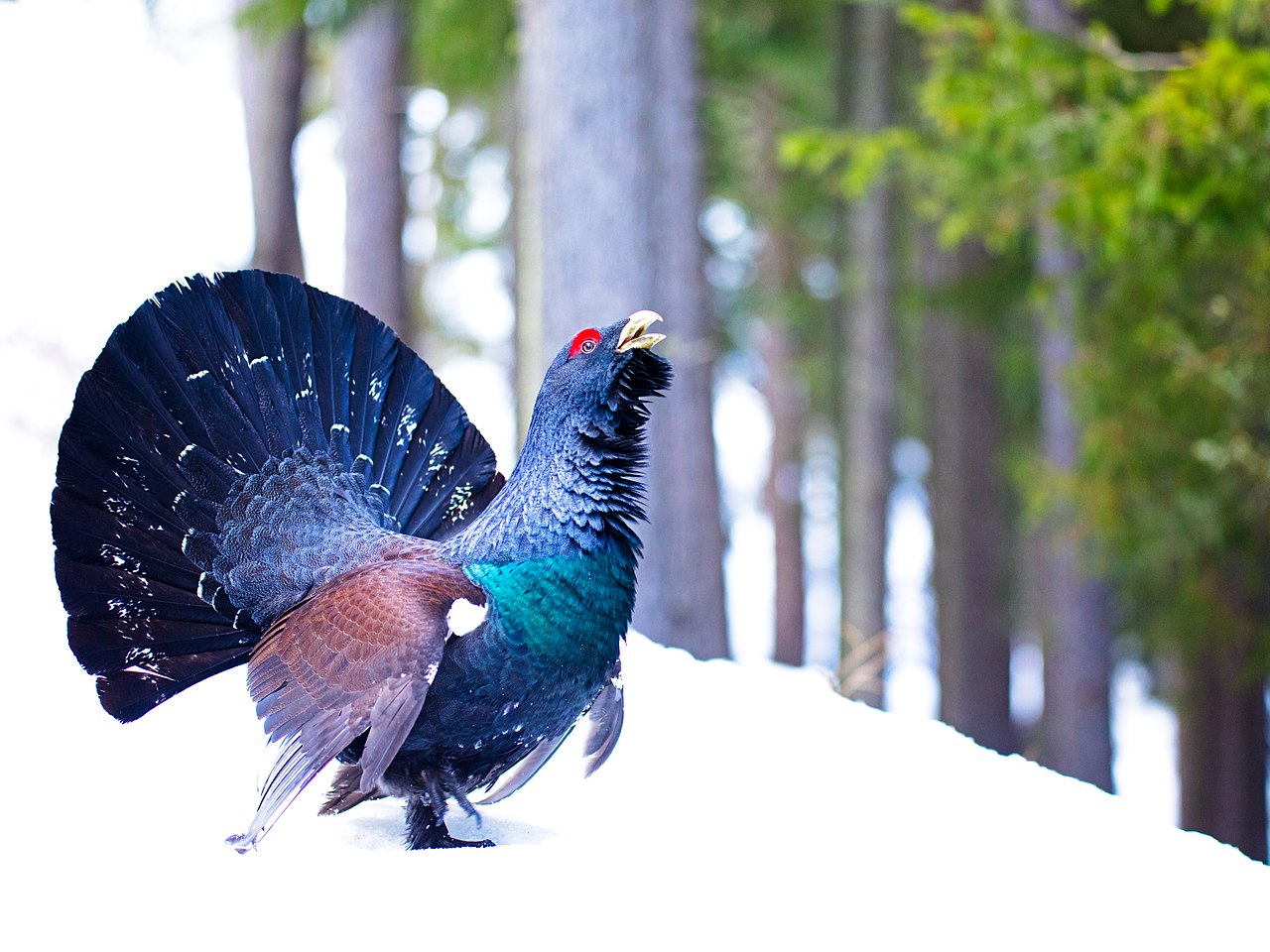
Male capercaillie the Stelvio National Park, Italy.
![A capercaillie in the coat of arms of the Central Finland region. It is also the official regional bird of the region.[16]](https://upload.wikimedia.org/wikipedia/commons/thumb/7/74/Keski-Suomi_Coat_of_Arms.svg/500px-Keski-Suomi_Coat_of_Arms.svg.png)
A capercaillie in the coat of arms of the Central Finland region. It is also the official regional bird of the region.[16]

Footprints of western capercaillie in the Czech national nature reserve Kladské rašeliny

Ferdinand von Wright, The Fighting Capercaillies (Taistelevat metsot), 1886

Female in Bavarian Forest, Germany
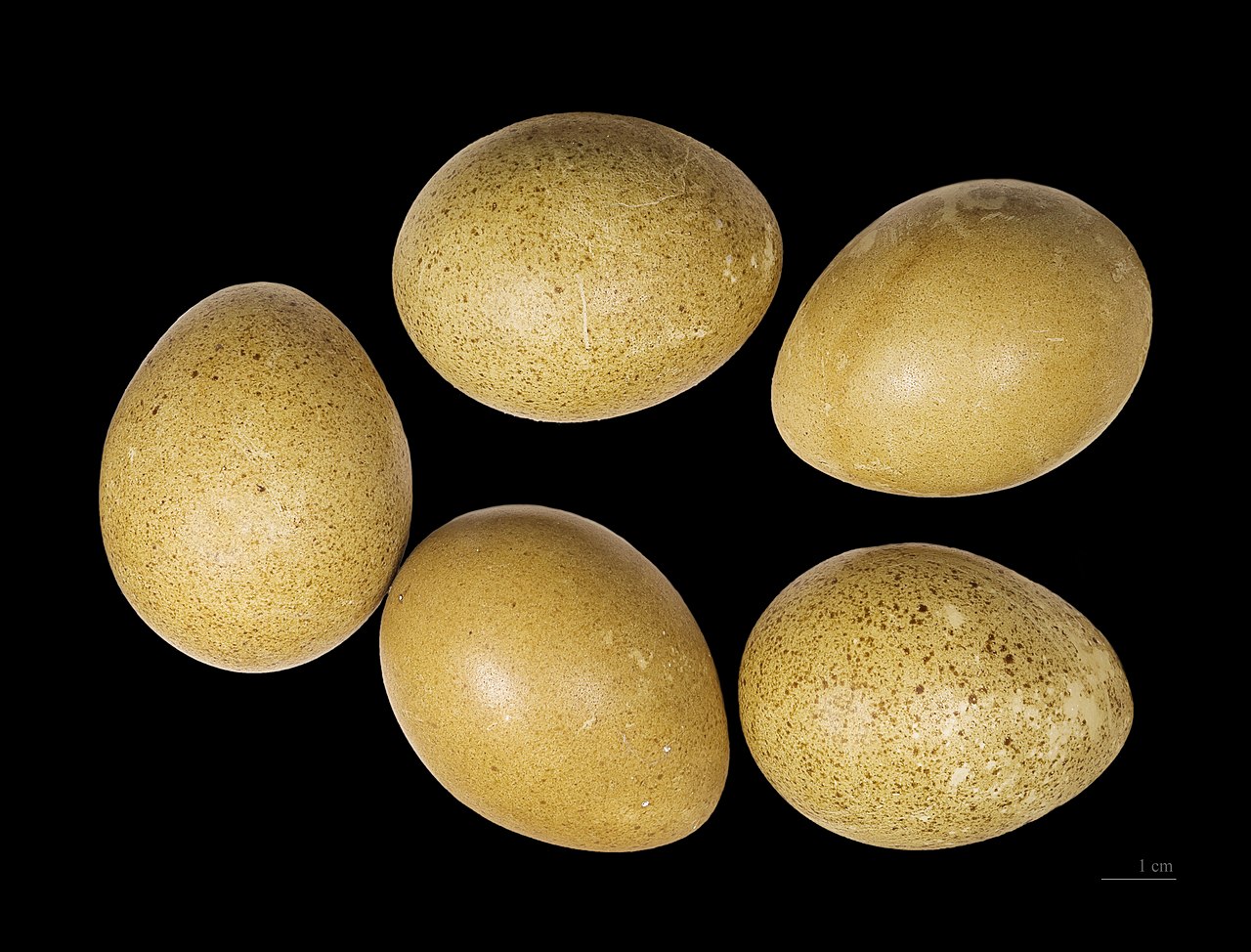
Tetrao urogallus urogallus—eggs

Male capercaillie marking his territory to a hiker in a Finnish taiga forest
Temperament
solitary and territorial
Flight Pattern
short rapid wingbeats with heavy takeoff; glides between trees
Social Behavior
Outside the breeding season individuals are generally solitary or in small loose groups. In spring, males gather at traditional leks where they display and compete for females; mating is strongly polygynous. Nests are shallow ground scrapes concealed in dense vegetation, and the hen incubates alone; chicks are precocial and accompany the mother in brood groups.
Migratory Pattern
Partial migrant
Song Description
The male’s display includes a distinctive sequence of sharp clicks, rattles, and a cork-popping note, followed by a hissing or wheezing finale. Calls carry well through the forest at dawn and are most frequent during the lekking season.
Plumage
Males are mostly dark with a glossy green breast, brown wings, and a broad fanned tail marked with white spots; females are finely barred and mottled in rufous, brown, and black for excellent camouflage.
Diet
Adults take buds, shoots, leaves, catkins, berries (especially bilberry), heather, and in winter large quantities of conifer needles. They also consume invertebrates, particularly in spring. Chicks rely heavily on insects and other protein-rich invertebrates during their first weeks to support rapid growth.
Preferred Environment
Feeds on the forest floor among bilberry and heather patches, at forest edges, clearings, and bog margins. In winter it often feeds in conifer canopies, clipping needles and buds.


