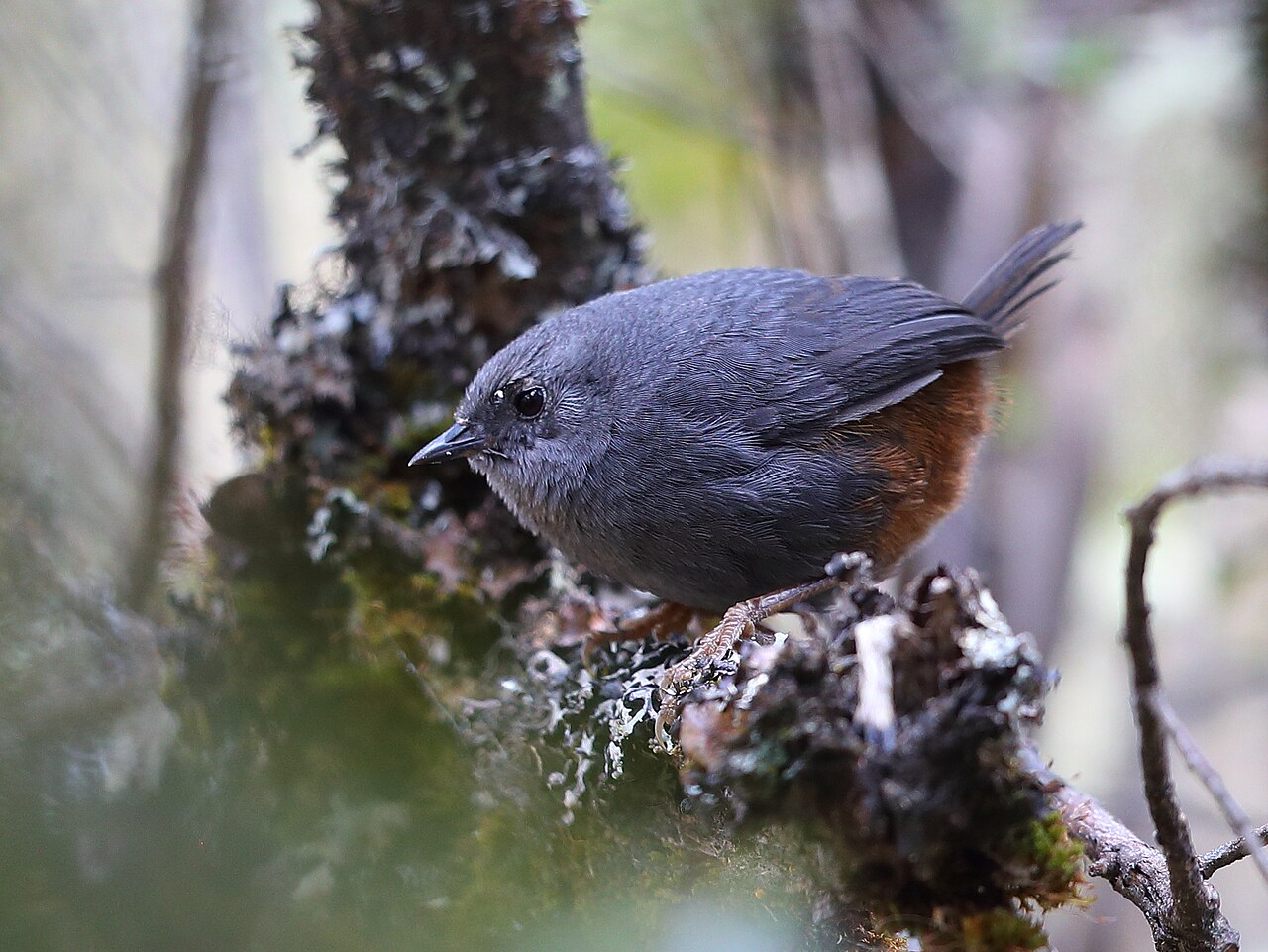
The Vilcabamba spinetail is a species of passerine bird in the Furnariinae subfamily of the ovenbird family Furnariidae. It is endemic to Peru.
Region
Andes Mountains
Typical Environment
This species is confined to humid montane forests of the Cordillera de Vilcabamba in southeastern Peru. It favors cloud forest edges, elfin forest, and dense Chusquea bamboo stands, especially along steep slopes and ridge crests. The bird readily uses second-growth and forest borders where tangles and bamboo are abundant. Within its small range it can be locally fairly common where suitable habitat persists.
Altitude Range
2400–3600 m
Climate Zone
Highland
Ease of Keeping
Beginner friendly: 1/5
The Vilcabamba spinetail is a furnariid specialized for life in humid Andean forests, where it creeps through dense foliage and bamboo to glean small arthropods. It often joins mixed-species flocks, staying active and hard to spot in the understory and midstory. Its very limited range in the Cordillera de Vilcabamba makes it sensitive to habitat loss and fragmentation. Conservation efforts focus on preserving montane cloud forest and bamboo thickets within its range.


Temperament
active and secretive
Flight Pattern
short rapid wingbeats between dense cover
Social Behavior
Usually seen singly or in pairs, it frequently associates with mixed-species flocks moving through the midstory and bamboo. Pairs maintain small territories and communicate with soft calls while foraging. Nests are typically bulky, domed structures of twigs and fibers placed in dense vegetation or bamboo, with both parents involved in care.
Migratory Pattern
Resident
Song Description
A fast series of thin, high-pitched notes that accelerates into a short trill, often delivered from concealed perches. Calls include sharp chips and a dry scold given while moving with mixed flocks.
Plumage
Warm brown upperparts with a contrasting pale buffy supercilium and grayish face; wings and long tail show rich rufous tones. Underparts are buff-gray with subtle streaking on the throat and breast. Feathers are compact and slightly shaggy on the crown, giving a tousled look. Tail is graduated and often held cocked.
Diet
Primarily gleans small arthropods such as insects and spiders from leaves, twigs, and mossy branches. It probes bamboo culms, epiphytes, and leaf clusters, often hanging briefly to reach the undersides of foliage. Occasionally it may take small fruits or seeds, but animal prey dominates.
Preferred Environment
Feeds in dense understory and midstory of humid montane forest, especially in Chusquea bamboo thickets and along forest edges. It works methodically through tangles, vines, and moss-laden branches, often following mixed flocks to exploit disturbed prey.