

The village weaver , also known as the spotted-backed weaver or black-headed weaver, is a bird species in the family Ploceidae found in much of sub-Saharan Africa. It has also been introduced to Portugal and Venezuela as well as to the islands of Hispaniola, Martinique, Puerto Rico, Mauritius and Réunion.
Region
Sub-Saharan Africa
Typical Environment
Village weavers inhabit a wide range across much of sub-Saharan Africa, favoring savannas, woodland edges, wetlands, farmland, and gardens. They commonly breed in large colonies near human settlements, especially where suitable trees or reeds occur. The species has been introduced beyond Africa, including to Portugal, Venezuela, and islands such as Hispaniola, Martinique, Puerto Rico, Mauritius, and Réunion. They thrive in open, patchy habitats with access to grasses for nest-building and seeds for food, and readily exploit agricultural areas.
Altitude Range
Sea level to 2500 m
Climate Zone
Tropical
Ease of Keeping
Beginner friendly: 3/5
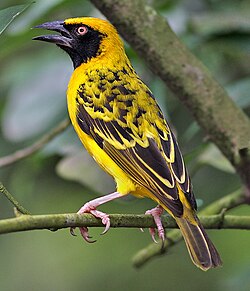
Village weavers are highly social, colonial nesters that weave intricate, hanging globular nests from fresh grass strips. Males are polygynous and build several nests to attract females, often over water or in trees within villages. Their adaptability to human-altered landscapes has aided their spread, and introduced populations can impact local agriculture. Breeding males show a striking black hood and red eyes, while females and non-breeding birds are more subdued.




Temperament
social and active
Flight Pattern
short rapid wingbeats
Social Behavior
They form noisy colonies, sometimes with dozens to hundreds of nests in a single tree. Males weave nests from fresh grass and display by fluttering and calling to entice females; polygyny is common. Nests are often suspended over water or open ground to deter predators.
Migratory Pattern
Resident
Song Description
The vocalizations are a busy mix of harsh chattering, buzzing notes, and repetitive chips, especially intense at colonies. Males deliver energetic display songs near their nests, creating a constant chorus.
Plumage
Breeding males are bright yellow with a black hood and heavily scalloped, spotted-looking back; underparts yellow with variable black on the throat. Females and non-breeding birds are olive-brown above with streaking and paler underparts, lacking the full black hood. Plumage is sleek with strong contrast during the breeding season and more subdued outside it.
Diet
They feed on a variety of grass seeds and grains, including cultivated cereals, as well as fruits and nectar on occasion. Insects and other small invertebrates are important, especially during breeding when they are fed to nestlings. They forage both on the ground and in foliage, often exploiting spilled grain and crop fields. Their flexible diet helps them succeed in disturbed and urbanizing landscapes.
Preferred Environment
They often feed in farmland, village edges, lawns, and open woodland, moving in flocks between trees and ground. Colonies near water provide nearby reedbeds and grass stands for foraging. They also visit bird feeders and glean insects from leaves and bark.


