

The vinaceous-breasted amazon, also called the vinaceous-breasted parrot and occasionally simply vinaceous amazon/parrot is an endangered species of bird in subfamily Arinae of the family Psittacidae, the African and New World parrots. It is found in Argentina, Brazil, and Paraguay.
Region
Atlantic Forest, South America
Typical Environment
Occurs in remnant Atlantic Forests of southern Brazil, eastern Paraguay, and northeastern Argentina, with a strong association to Araucaria moist forests. It uses primary and mature secondary forests, forest edges, gallery forests, and nearby cultivated areas when food is available. The species favors tall, old-growth trees for nesting cavities and communal roosts. It can persist in mosaics of forest and farmland if fruiting and seeding trees are retained, but is sensitive to extensive canopy loss.
Altitude Range
200–1500 m
Climate Zone
Subtropical
Ease of Keeping
Beginner friendly: 2/5
This striking amazon is named for its wine-colored throat and breast, a standout patch against otherwise green plumage. It relies heavily on seeds of the Paraná pine (Araucaria angustifolia), making it especially vulnerable to loss of Araucaria-dominated forests. Habitat destruction and trapping have contributed to a steep decline, and conservation now focuses on protecting remaining Atlantic Forest fragments. Pairs often keep strong lifelong bonds and nest in large tree cavities.


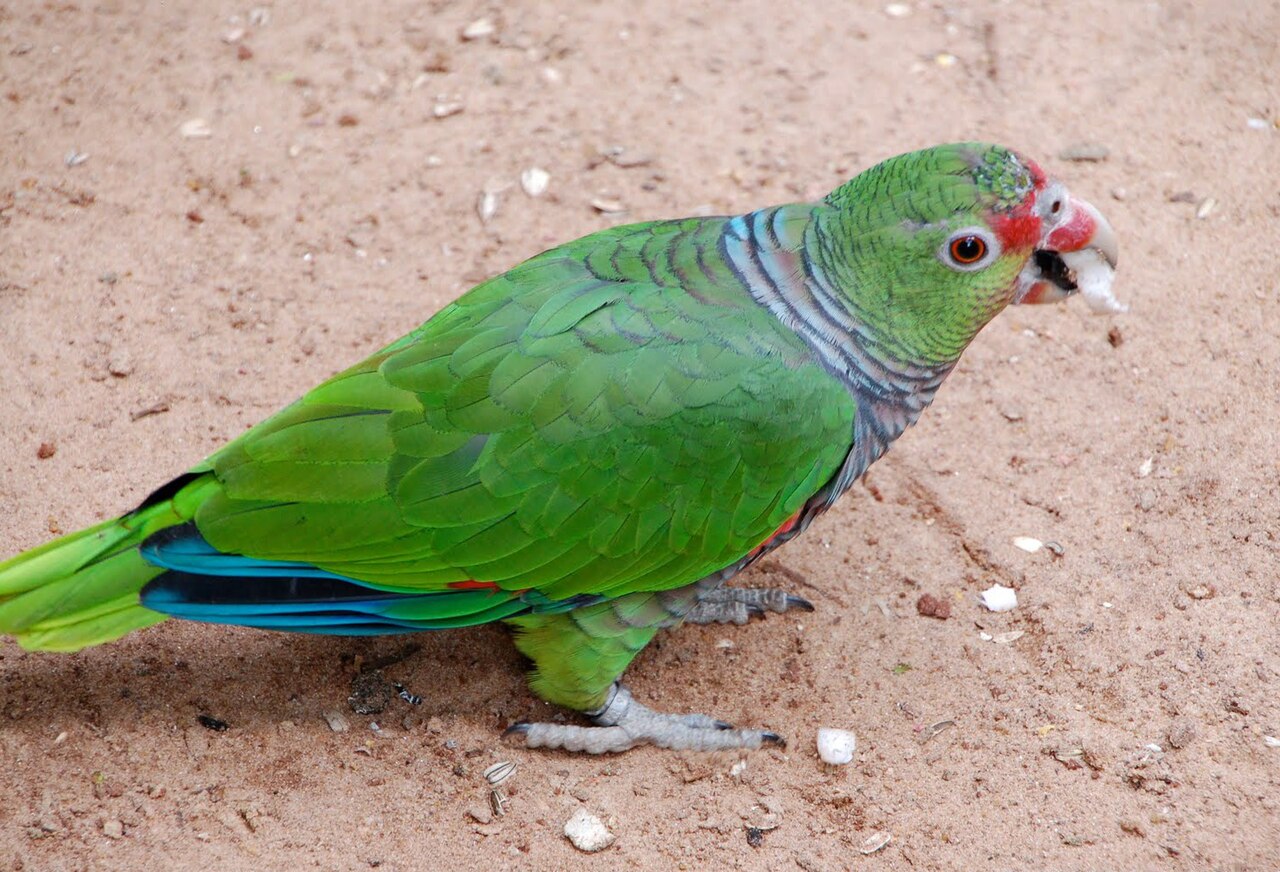
At Iguazu Bird Park, Brazil

Temperament
social and alert
Flight Pattern
strong flier with rapid, direct wingbeats
Social Behavior
Usually seen in pairs or small family groups, and larger flocks form at favored roosts and feeding trees. Pairs are monogamous and nest in large cavities of mature trees, often Araucaria or other tall species. They exhibit strong site fidelity to nesting and roosting locations.
Migratory Pattern
Resident
Song Description
Vocalizations are loud, ringing screeches and harsh squawks typical of amazons, carrying over long distances. At close range they also produce chattering contact calls within flocks.
Plumage
Mostly bright green with darker scalloped edging; throat and upper breast a distinct vinaceous-wine color. Crown often shows a bluish wash, and the bend of the wing has reddish tones with blue in primaries. Tail green with yellowish tips.
Diet
Feeds heavily on seeds of Paraná pine (Araucaria angustifolia) where available. It also takes a variety of fruits, seeds, nuts, buds, and flowers from native forest trees and occasionally from cultivated plants. Seasonal availability of fruiting and seeding trees strongly influences local movements and flock sizes.
Preferred Environment
Forages mostly in the canopy and along forest edges, moving between fruiting trees. It will visit mixed forest–farmland mosaics, orchards, and plantations when natural foods are scarce but stays close to cover.


