The thick-billed murre or Brünnich's guillemot is a bird in the auk family (Alcidae). This bird is named after the Danish zoologist Morten Thrane Brünnich. The very deeply black North Pacific subspecies Uria lomvia arra is also called Pallas' murre after its describer.
Region
Arctic and Subarctic Oceans
Typical Environment
Breeds on coastal cliffs and sea stacks around the high Arctic of the North Atlantic and North Pacific, including Greenland, Canada, Alaska, and Russia. Outside the breeding season it disperses southward to subarctic and cold temperate seas, often along the pack-ice edge. It forages primarily over continental shelf waters and productive upwelling zones. Colonies are typically on narrow ledges with immediate access to open sea. Winter distribution tracks areas with high prey availability and reduced ice cover.
Altitude Range
Sea level to 600 m
Climate Zone
Polar
Ease of Keeping
Beginner friendly: 1/5
Also called Brünnich's guillemot, the thick-billed murre is a high‑Arctic auk renowned for deep, wing‑propelled dives that can exceed 100 m. It nests in vast, noisy colonies on sheer sea cliffs, laying a single pyriform egg that resists rolling. A thin white line along the bill’s cutting edge is a key field mark in breeding plumage. Populations are sensitive to bycatch, oiling, and sea-ice changes driven by climate warming.


Head color in breeding plumage is identical in all Brünnich's guillemots

Adult and chick, Buldir Island, Alaska

Breeding colony at Stappen, Bear Island. Note bill-stripes visible at a distance.

Egg, Collection Museum Wiesbaden

Vagrant adult in winter plumage, northern South Carolina

Thick-billed murres in Alaska Maritime National Wildlife Refuge
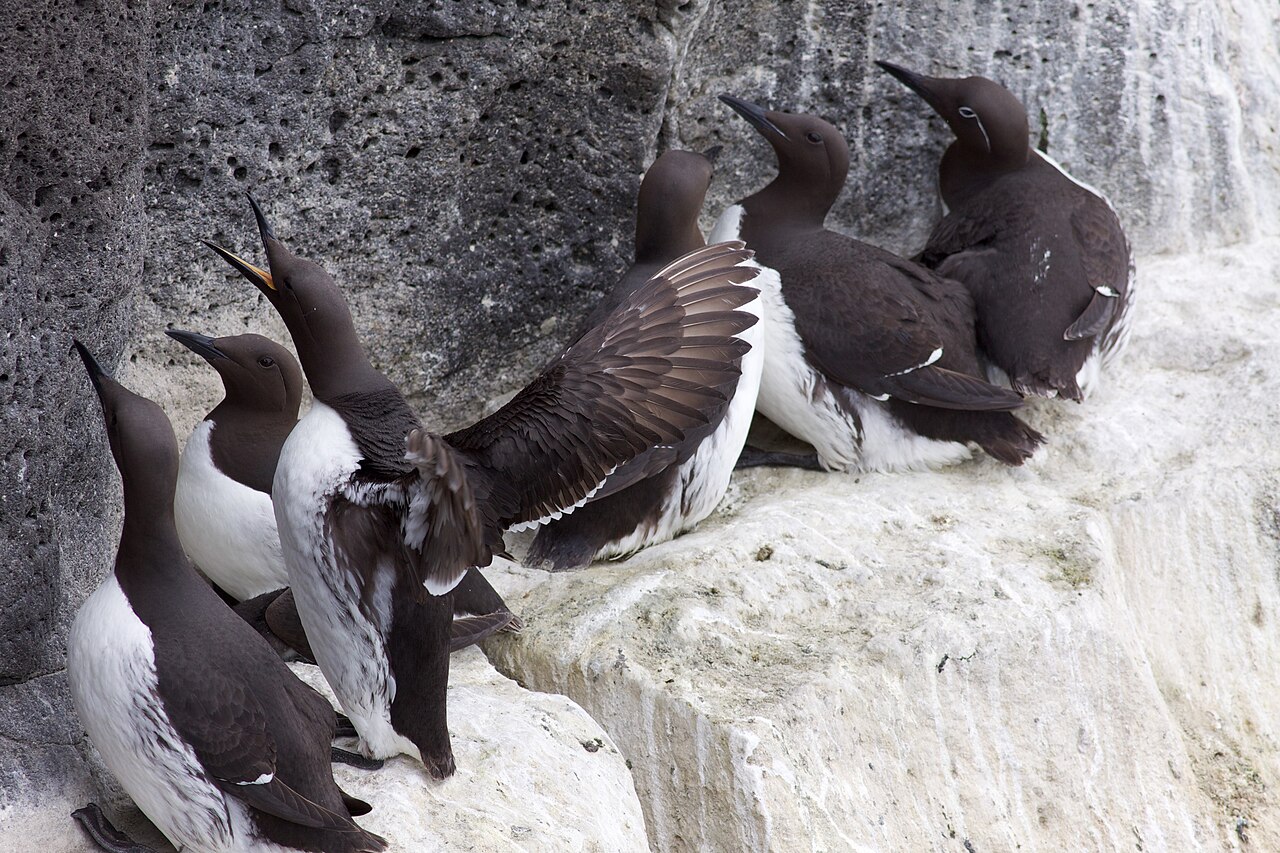
A thick-billed murre (second from right, distinguishable by white marking on bill) with a group of common murres in Reykjanes, Iceland

Group on rocks, Alaska
Temperament
social and colonial
Flight Pattern
short rapid wingbeats
Social Behavior
Breeds in dense cliff colonies, often shoulder-to-shoulder on narrow ledges. Pairs are largely monogamous and lay a single egg, with both parents incubating and provisioning. Chicks depart the ledge at a young age, leaping to the sea and accompanying the male parent while continuing to be fed.
Migratory Pattern
Seasonal migrant
Song Description
Vocalizations are a series of guttural croaks, purrs, and growls, especially loud and continuous at colonies. Calls function in mate contact, chick-parent recognition, and territorial spacing on crowded ledges.
Plumage
Glossy black to blackish-brown upperparts with clean white underparts; breeding adults show a crisp contrast. A stout, black bill with a fine white gape line is characteristic. Nonbreeding birds have a whiter face with a dusky cap and auricular smudge.
Diet
Feeds mainly on small schooling fishes such as capelin, sand lance, and Arctic/polar cod, supplemented by crustaceans (amphipods) and cephalopods. It is a pursuit diver, using wing strokes underwater to chase prey. Dive depths commonly reach 30–100 m and can exceed this when prey schools are deeper. Prey choice varies seasonally and geographically with availability.
Preferred Environment
Forages over continental shelf and shelf-break waters, tide rips, and areas of upwelling that concentrate prey. Frequently works along the marginal ice zone and near colony coastlines during breeding.