The sungrebe or American finfoot is a small aquatic gruiform found in the tropical and subtropical Americas from northeastern Mexico to central Ecuador and southern Brazil.
Region
Tropical Americas
Typical Environment
Found from southern Mexico through Central America into northern and central South America, including parts of Colombia, Venezuela, the Guianas, Ecuador, Peru, Bolivia, and Brazil. It inhabits slow-moving, shaded lowland rivers, oxbow lakes, forest-lined streams, and marshy backwaters. Prefers densely vegetated margins with overhanging branches and submerged roots for cover. Usually avoids open water, keeping close to banks and tangles of riparian vegetation.
Altitude Range
Sea level to 1500 m
Climate Zone
Tropical
Ease of Keeping
Beginner friendly: 1/5
Despite its name, the sungrebe (American finfoot) is not a grebe; it belongs to the finfoot family Heliornithidae and has lobed toes adapted for swimming. Exceptionally secretive, it often slips away into overhanging vegetation rather than taking flight. Males are known to carry tiny chicks tucked under the wings while swimming, a remarkable and rarely seen behavior.


Historical distribution of the three extant Heliornithids. Heliornis fulica in green.


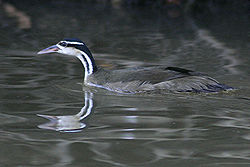


Diagram of chick inside pouch; dotted lines show feather wall that holds chick in pouch

Foraging in Tortuguero National Park, Costa Rica.
Temperament
shy and secretive
Flight Pattern
short rapid wingbeats low over water; reluctant to fly
Social Behavior
Typically solitary or in pairs, keeping to dense riverside cover. Nests are placed over water in thick vegetation; both sexes guard the nest area. Adults are famous for carrying downy chicks under the wings while swimming, providing concealment and transport.
Migratory Pattern
Resident
Song Description
Vocalizations are soft and infrequent, including thin whistles and short, squeaky notes from cover. Calls may become more frequent during the breeding season but remain subdued and hard to locate.
Plumage
Smooth, sleek plumage with warm brown upperparts and paler buff underparts, contrasting with bold black-and-white facial and neck striping. Wings show a pale or whitish trailing edge noticeable in flight.
Diet
Eats aquatic and semi-aquatic invertebrates such as insects, larvae, and small crustaceans, as well as small fish and tadpoles. Will also take seeds and small fruits when available. Forages by gleaning from the water surface, banks, and overhanging vegetation, and occasionally by short dives or lunges.
Preferred Environment
Feeds along shaded stream margins, tangle-filled backwaters, and quiet oxbow lakes. Stays close to dense vegetation, using cover to approach prey and to avoid detection.