
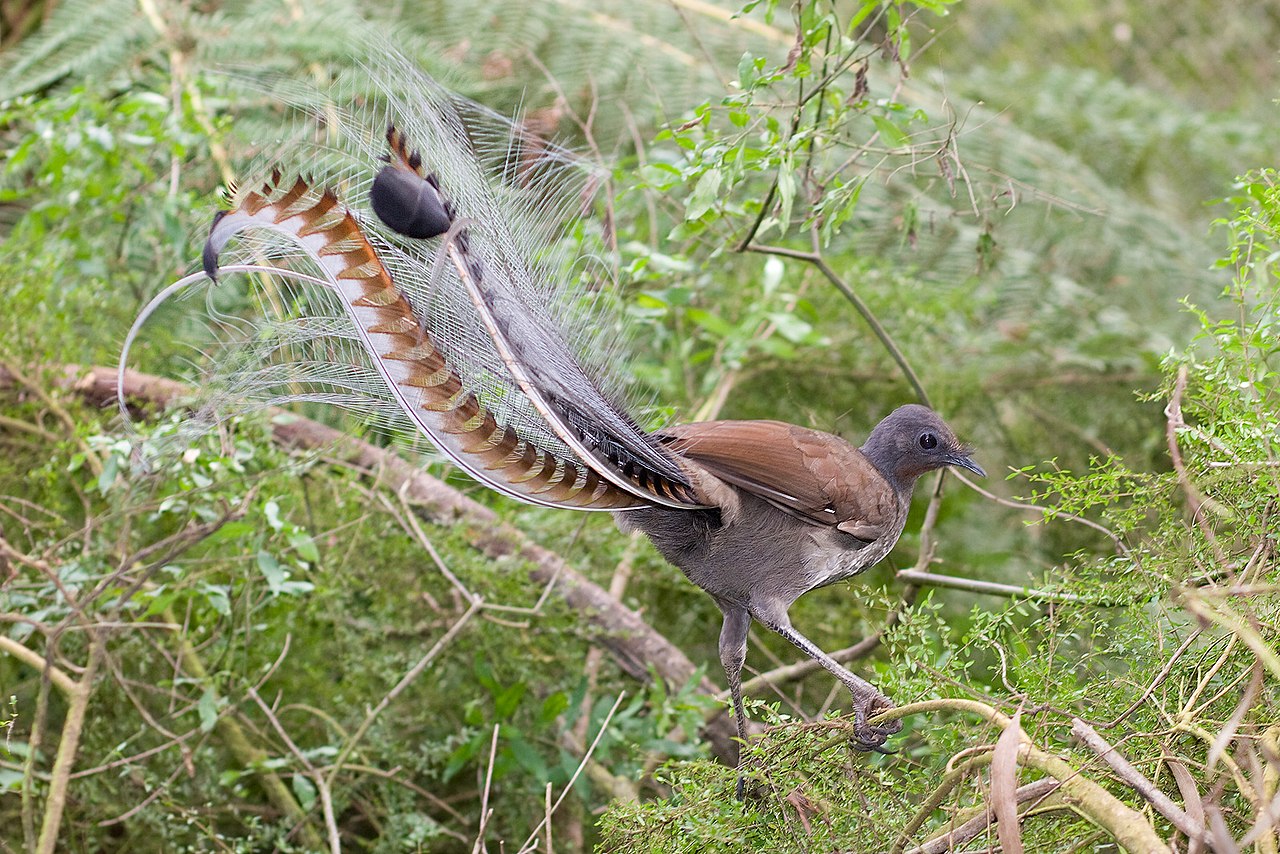
The superb lyrebird is an Australian passerine songbird, one of two species from the family Menuridae, with the other being the much rarer Albert's lyrebird. It is one of the world's largest songbirds, and is renowned for its elaborate tail and courtship displays, and its excellent mimicry. The species is endemic to Australia and is found in forest in the southeast of the country. According to David Attenborough, the superb lyrebird displays one of the most sophisticated voice skills within the animal kingdom—"the most elaborate, the most complex, and the most beautiful".
Region
Southeast Australia
Typical Environment
Occurs in moist eucalypt forests, temperate rainforests, and fern-filled gullies from southern New South Wales through Victoria, including the Dandenong and Otway Ranges and parts of Tasmania (introduced there). Prefers dense understorey with abundant leaf litter for scratching. Often associated with wet sclerophyll forests and rainforest edges, especially near creeks and sheltered slopes. Human disturbance and severe fires can fragment local populations, but birds can persist in large, intact reserves.
Altitude Range
Sea level to 1300 m
Climate Zone
Temperate
Ease of Keeping
Beginner friendly: 1/5
The superb lyrebird is one of the largest songbirds and a master mimic, capable of imitating other birds, mammals, and human-made sounds with striking accuracy. Males perform elaborate courtship displays atop mounds, fanning their lyre-shaped tails while producing complex song sequences. They are ancient, ground-dwelling passerines that rely on dense, moist forests for cover and foraging.


Superb lyrebird in courtship display

Superb lyrebird in courtship display – as seen from the back

Nest site photographed by S. W. Jackson at Bellinger River, 1910


Temperament
shy and secretive
Flight Pattern
short rapid wingbeats
Social Behavior
Mostly solitary and strongly territorial on the forest floor. Males build and maintain display mounds and court multiple females; females alone construct the domed nest and rear the single chick. Pair bonds are not long-term, and territories are defended largely through song and display.
Migratory Pattern
Resident
Song Description
Extraordinarily complex, combining rich whistles with precise mimicry of other birds and environmental sounds. Males deliver long, cascading song bouts during displays, often lasting several minutes and carrying far through the forest.
Plumage
Upperparts brown to grey-brown with fine scalloping, underparts grey with subtle scaling; males possess long, ornate tail plumes forming a lyre when displayed.
Diet
Feeds primarily on invertebrates such as beetles, ants, larvae, spiders, and earthworms uncovered by vigorous leaf-litter scratching. Also takes centipedes and other soil-dwelling arthropods. Occasionally consumes seeds, small fruits, and fungi, especially when invertebrate prey is scarce.
Preferred Environment
Forages on the shaded forest floor in damp gullies, among ferns and deep leaf litter. Often works along rotting logs, mossy banks, and soft soil where prey is concentrated.


