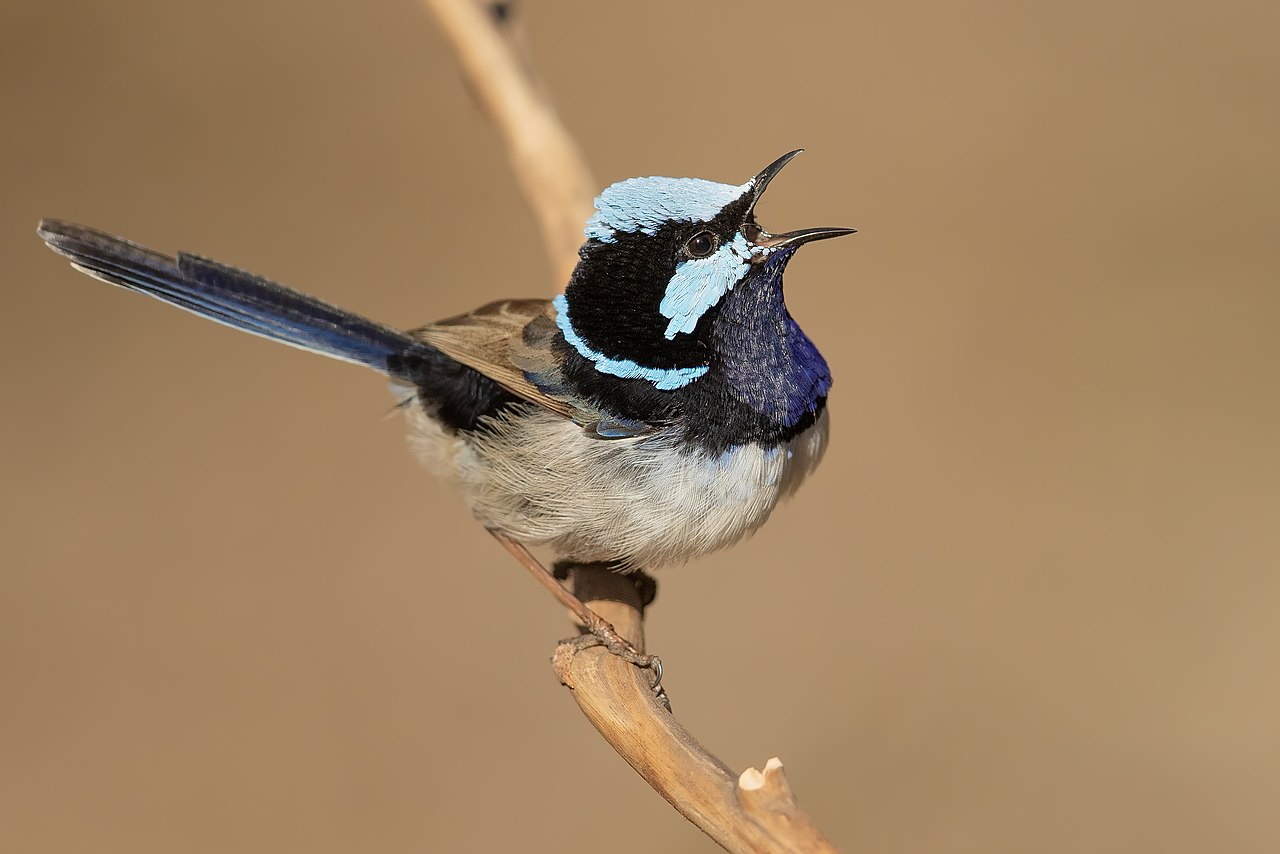
The superb fairywren is a passerine bird in the Australasian wren family, Maluridae, and is common and familiar across south-eastern Australia. It is a sedentary and territorial species, also exhibiting a high degree of sexual dimorphism; the male in breeding plumage has a striking bright blue forehead, ear coverts, mantle, and tail, with a black mask and black or dark blue throat. Non-breeding males, females and juveniles are predominantly grey-brown in colour; this gave the early impression that males were polygamous, as all dull-coloured birds were taken for females. Six subspecies groups are recognized: three larger and darker forms from Tasmania, Flinders and King Island respectively, and three smaller and paler forms from mainland Australia and Kangaroo Island.
Region
Southeastern Australia
Typical Environment
Occurs widely from coastal heath and dune scrub through open eucalypt woodlands, forest edges, and agricultural mosaics to suburban parks and gardens. Prefers habitats with dense, low understory for cover and nesting, often near open patches for foraging. Avoids extensive closed forest and very open grassland lacking shrubs. Common on Tasmania, the Bass Strait islands, and much of southeastern mainland Australia.
Altitude Range
Sea level to 1500 m
Climate Zone
Temperate
Ease of Keeping
Beginner friendly: 1/5
Superb fairywrens live in small, cooperative groups that defend year-round territories. Males in breeding plumage turn an electric blue and black, while females and non-breeding males remain grey-brown with orange-brown lores. Despite forming social pairs, they are well known for frequent extra-pair mating. They readily adapt to parks and gardens if dense low cover is available.


A pair in Ensay, Victoria, Australia
![An immature male in Gippsland, Victoria, Australia. Young males usually develop a dark bill and blue tail before their first winter.[28]](https://upload.wikimedia.org/wikipedia/commons/thumb/f/fd/Malurus_cyaneus_-Cape_Liptrap%2C_Gippsland%2C_Victoria%2C_Australia-8.jpg/1280px-Malurus_cyaneus_-Cape_Liptrap%2C_Gippsland%2C_Victoria%2C_Australia-8.jpg)
An immature male in Gippsland, Victoria, Australia. Young males usually develop a dark bill and blue tail before their first winter.[28]

First-year male starting to moult into breeding plumagesubspecies cyaneus

Male subspecies cyanochlamys with face fan display

Female with juvenile begging for food, Northern Beaches, Sydney

Female, subspecies cyanochlamys, with a grasshopper
Temperament
social and active
Flight Pattern
short rapid wingbeats
Social Behavior
Lives in small, cooperative groups that defend a territory year-round. Nests are domed structures placed low in dense shrubs or grasses. Social pairs form for breeding, but extra-pair mating is common, and helpers often assist with feeding nestlings. Family groups forage together, keeping close to cover.
Migratory Pattern
Resident
Song Description
Produces high, thin trills and tinkling phrases used for contact and territorial displays. Alarm calls are sharp, high-pitched chips delivered from cover. Males sing more prominently during the breeding season.
Plumage
Breeding males show a bright cobalt-blue crown, ear coverts, mantle, and tail with a contrasting black mask and throat and brown wings. Non-breeding males and females are predominantly grey-brown with paler underparts; females show orange-brown lores. Long, often cocked tail is characteristic.
Diet
Feeds mainly on small insects and other arthropods, including beetles, ants, grasshoppers, caterpillars, and spiders. Gleans prey from the ground, leaf-litter, and low foliage, and occasionally snatches small flying insects. Will supplement diet with small seeds and fruit when available.
Preferred Environment
Forages in dense low shrubs, grass tussocks, and along edges of paths and clearings, often near protective cover. Frequently uses suburban gardens and parks that provide thickets and hedges.