

The sharp-tailed grouse, also known as the sharptail or fire grouse, is a medium-sized prairie grouse. One of three species in the genus Tympanuchus, the sharp-tailed grouse is found throughout Alaska, much of Northern and Western Canada, and parts of the Western and Midwestern United States. The sharp-tailed grouse is the provincial bird of the Canadian province of Saskatchewan.
Region
North American prairies and boreal margins
Typical Environment
Occurs from Alaska and northern Canada south through the northern Great Plains and parts of the western and midwestern United States. Prefers mixed-grass and shortgrass prairie, sagebrush flats, shrub-steppe, and aspen parkland with interspersed brush. Requires open, sparsely vegetated display grounds (leks) near protective cover. In winter it uses shrubby draws, willow and birch thickets, and agricultural stubble fields. Avoids dense, closed-canopy forests.
Altitude Range
Sea level to 2000 m
Climate Zone
Continental
Ease of Keeping
Beginner friendly: 1/5
Famous for its elaborate spring lek displays, males stamp their feet, rattle their tails, and inflate purple neck sacs to attract females. It inhabits open grasslands and shrub-steppe, relying on a mosaic of native prairie and brushy cover. In winter it often feeds on buds of willow and birch and may roost in snow burrows to conserve heat. It is the provincial bird of Saskatchewan.


Close-up of a male sharp-tailed grouse

Sharp-tailed grouse nest with eggs
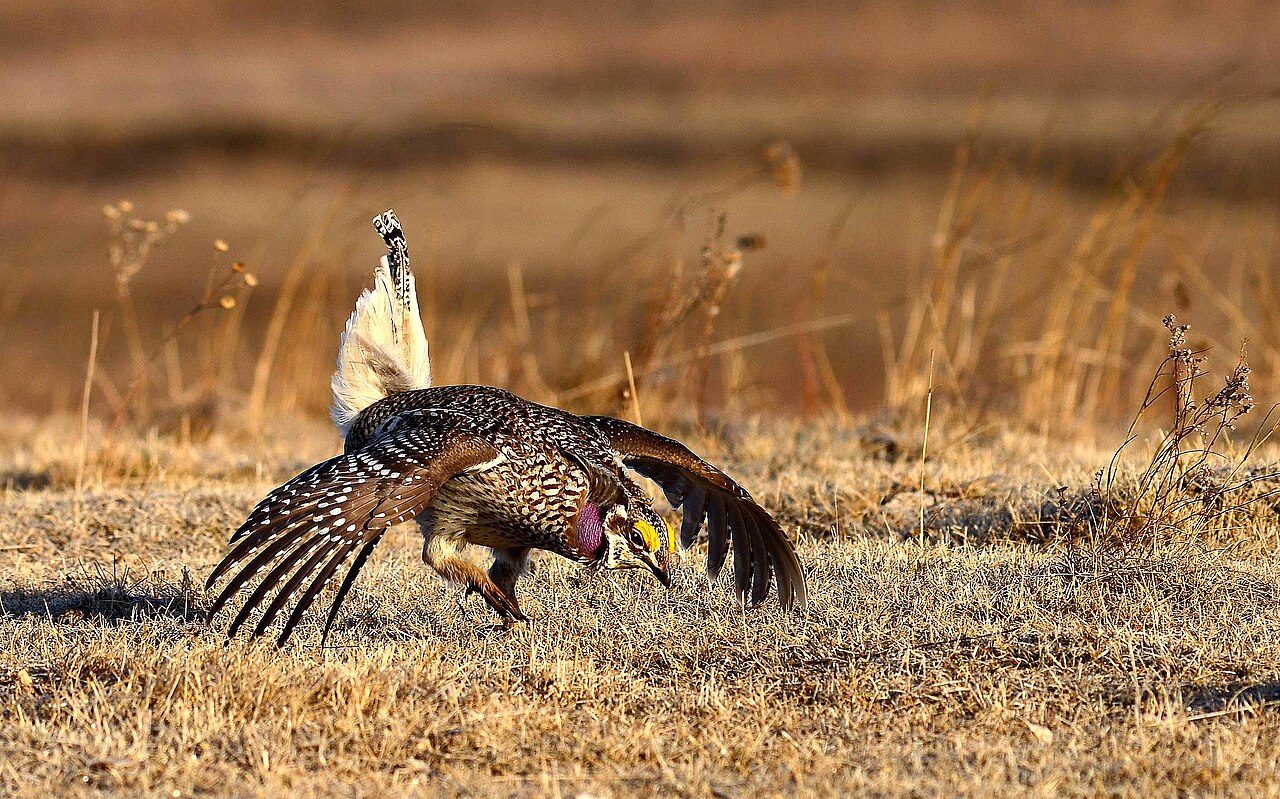
A male performing its mating display

Temperament
wary and cryptic; social on display grounds
Flight Pattern
short rapid wingbeats with brief glides
Social Behavior
In spring, males gather on traditional leks and perform energetic dances; the species is strongly polygynous. Nests are shallow ground scrapes concealed in grasses or shrubs, lined with vegetation. Females alone incubate and rear the brood, leading chicks to foraging areas soon after hatching.
Migratory Pattern
Partial migrant
Song Description
Display vocalizations include soft coos, clucks, and low hoots accompanied by audible tail rattling. Wing whirrs and foot-stamping add mechanical sounds to the performance.
Plumage
Mottled and barred brown, buff, and white with fine chevrons; wings show pale spotting; tail with elongated, pointed central rectrices.
Diet
Eats leaves, buds, seeds, and berries, shifting seasonally to what is most available. In winter it browses willow, birch, and other shrub buds and catkins. During spring and summer, adults and especially chicks consume insects such as grasshoppers, beetles, and ants. It also forages waste grain where available.
Preferred Environment
Forages on the ground in open grasslands, shrub-steppe, and along brushy edges of aspen parkland. In winter it often feeds in shrubby riparian corridors and agricultural stubble fields, staying near cover.


