

The sharp-shinned hawk or northern sharp-shinned hawk, commonly known as a sharpie, is a small hawk, with males being the smallest hawks in the United States and Canada, but with the species averaging larger than some Neotropical species, such as the tiny hawk. The taxonomy is far from resolved, with some authorities considering the southern taxa to represent three separate species: white-breasted hawk, plain-breasted hawk, and rufous-thighed hawk. The American Ornithological Society and some other checklists keep all four species conspecific.
Region
North, Central, and northern South America
Typical Environment
Breeds widely across boreal and montane forests from Alaska and Canada south through the United States and Mexico, with related or conspecific forms extending through Central America into the Andes and parts of southeastern South America. Prefers dense coniferous or mixed woodlands, forest edges, and riparian corridors where it can hunt from cover. During migration it concentrates along ridgelines and coastlines. In winter it uses a broader range of habitats including woodlots, hedgerows, and suburban areas near bird concentrations.
Altitude Range
Sea level to 3500 m
Climate Zone
Temperate
Ease of Keeping
Beginner friendly: 1/5
The sharp-shinned hawk (often called a sharpie) is the smallest hawk in the United States and Canada, with males notably smaller than females. It is a swift, agile woodland raptor that often hunts songbirds, sometimes appearing near backyard feeders. It can be confused with the larger Cooper’s hawk; tail shape and head proportions are key field marks. Southern populations are sometimes treated as separate species by some authorities, though others keep them conspecific.


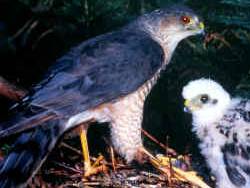
With a chick (nominate group)

Typical rusty underside streaking of an immature individual.

Sharp-shinned Hawk, Fort Collins, Colorado

Click for video of feeding sharp-shinned hawk

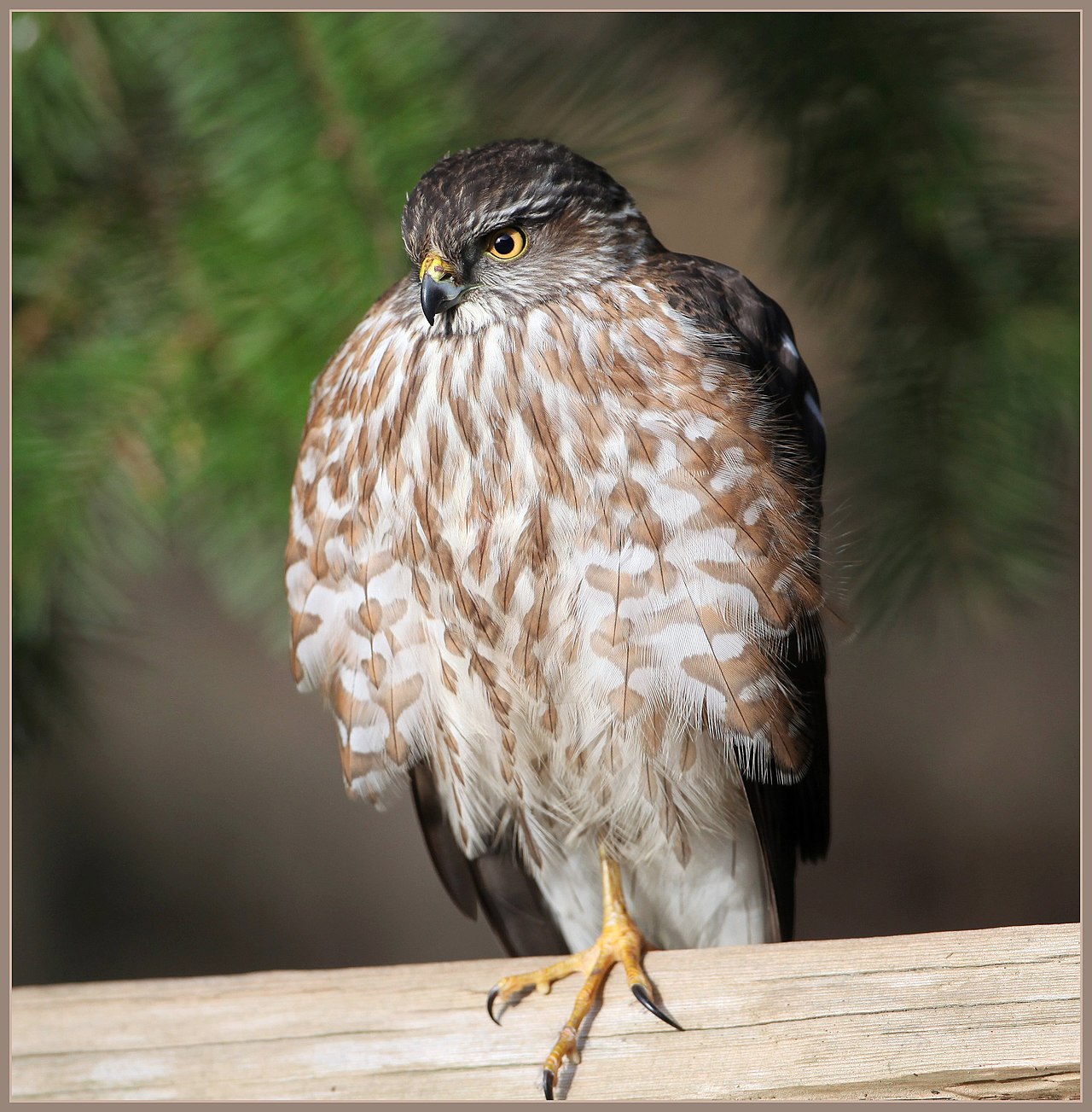
Immature (nominate group)

Endangered subspecies venator, endemic to Puerto Rico
Temperament
solitary and territorial
Flight Pattern
short rapid wingbeats interspersed with brief glides
Social Behavior
Typically solitary outside the breeding season, though large numbers may pass at migration watch sites. Nests in dense forest, often high in conifers, with pairs defending a small territory. Clutch size is usually 3–5 eggs, and both parents participate in rearing.
Migratory Pattern
Partial migrant
Song Description
Vocalizations include a high-pitched, rapid kik-kik-kik series, especially near the nest. Alarm calls are sharp and insistent, while other notes are short and piercing.
Plumage
Adults have blue‑gray upperparts with fine rufous barring on the whitish underparts; juveniles are brown above with heavy streaking below. Tail is long and narrow with a thin white terminal band; wings are short and rounded.
Diet
Primarily preys on small birds such as sparrows, warblers, and finches, captured by surprise from cover. Also takes small mammals, occasionally reptiles and large insects. Hunts with quick dashes through vegetation and along edges, using stealth and agility. Will visit areas with concentrated prey, including backyard feeders.
Preferred Environment
Forages within and along the edges of dense forests, thickets, and riparian corridors. Frequently hunts along hedgerows, woodlots, and suburban neighborhoods where songbirds gather.


