The sanderling is a small wading bird. The name derives from Old English sand-yrðling, "sand-ploughman". The genus name is from Ancient Greek kalidris or skalidris, a term used by Aristotle for some grey-coloured waterside birds. The specific, alba, is Latin for "white".
Region
Global coastlines
Typical Environment
Breeds on sparsely vegetated High Arctic tundra near pools and wet depressions. Outside the breeding season it is found on open sandy beaches, tidal flats, and sandbars along oceanic and large inland shorelines. It favors the wave-wash zone where retreating surf reveals small invertebrates, and often roosts on wide beaches or dunes at high tide. During migration it follows coasts but can also appear on large inland lakes and reservoirs.
Altitude Range
Sea level to 800 m
Climate Zone
Other
Ease of Keeping
Beginner friendly: 1/5
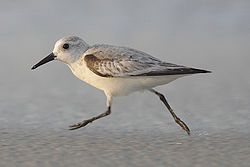
Sanderlings are small, pale shorebirds famous for running back and forth with the surf to snatch exposed prey. They breed on the High Arctic tundra and winter on sandy beaches around the world. In flight they show a bold white wing stripe, and unlike many sandpipers they lack a hind toe, aiding their speedy dash on hard sand.


Sanderlings at Ocean Beach, San Francisco

Sanderling feeding




Temperament
social and active
Flight Pattern
strong, direct flier with swift wingbeats; often low over the surf
Social Behavior
Typically forms tight flocks on beaches, moving in coordinated waves along the shoreline. On the breeding grounds pairs defend small territories and nest in a shallow ground scrape, with both parents involved in incubation and chick care. Outside breeding, large roosting aggregations are common at high tide.
Migratory Pattern
Seasonal migrant
Song Description
Usually quiet on the wintering grounds, giving soft peeping calls during foraging and in flight. On the breeding grounds it produces sharper, trilled notes and short display calls, especially during territorial flights.
Plumage
Non-breeding birds are pale grey above and clean white below, giving a frosty, high-contrast look; breeding adults show mottled rufous, black, and white on the head and upperparts. Plumage appears crisp with a sharp division between grey mantle and white underparts.
Diet
Feeds on small invertebrates such as amphipods, isopods, polychaete worms, insect larvae, and small bivalves. It uses a rapid run-and-peck technique, timing strikes with the retreating waves to seize exposed prey. On the tundra it focuses more on insects and their larvae. It may also probe shallowly in wet sand for concealed prey.
Preferred Environment
The swash zone of sandy ocean beaches is preferred, especially firm, open sand with minimal vegetation. It also forages on tidal flats, lagoon edges, and occasionally along large inland shorelines during migration.