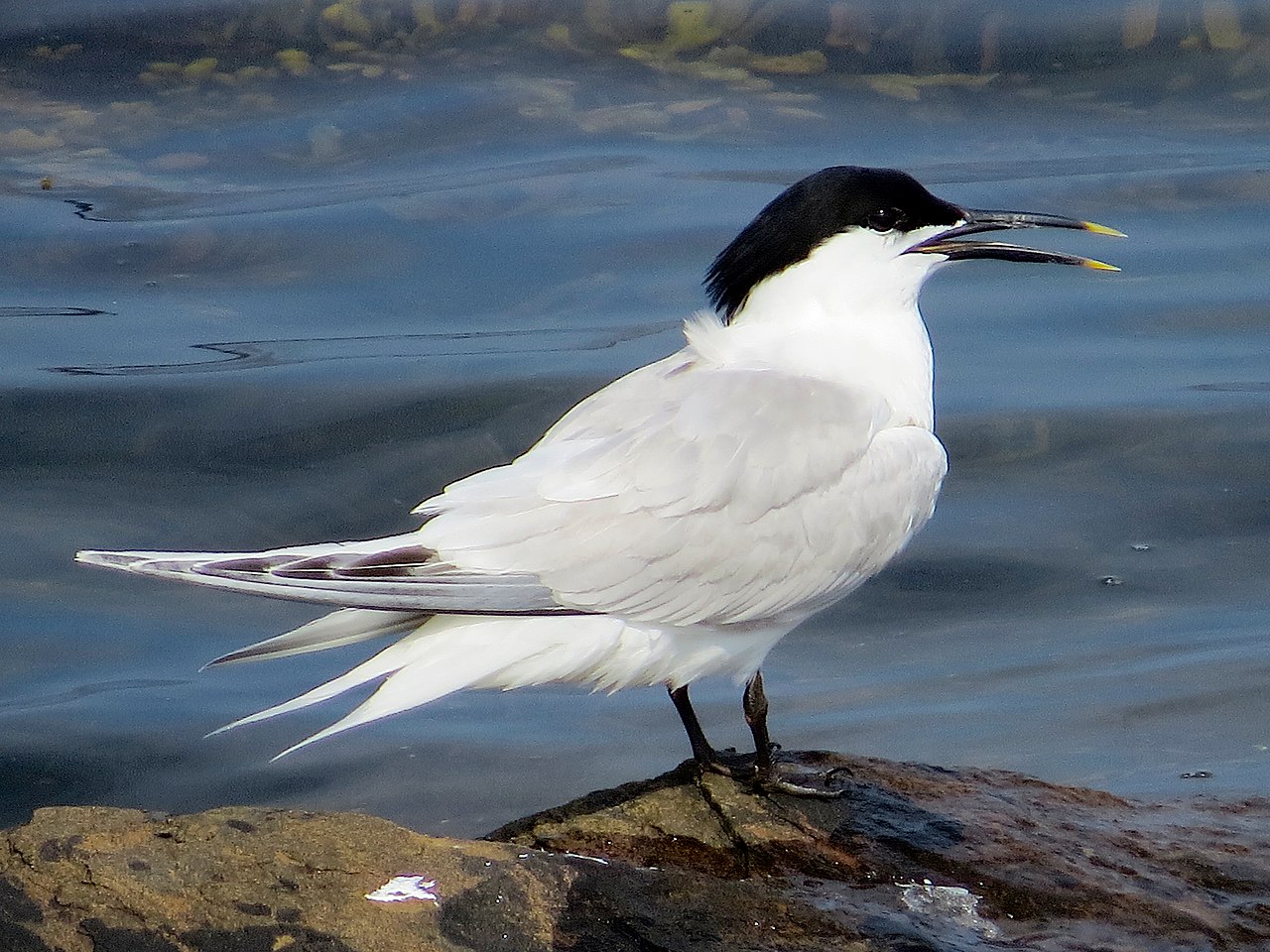
The Sandwich tern is a tern in the family Laridae. It is very closely related to the lesser crested tern, Chinese crested tern, Cabot's tern, and elegant tern and has been known to interbreed with both elegant and lesser crested terns. It breeds in the Palearctic from Europe to the Caspian Sea, and winters in the Mediterranean and on the coasts of Africa, India, and Sri Lanka.
Region
Palearctic coasts and adjacent Atlantic–Indian Ocean shores
Typical Environment
Breeds from Atlantic coasts of northwest Europe across the North Sea and Baltic to the Black and Caspian Seas. Winters chiefly along the Mediterranean and Atlantic coasts of Africa south to the Gulf of Guinea, and east to the Red Sea, Arabian Sea, and coasts of India and Sri Lanka. Prefers low, sandy or shingle islands, saltmarsh islets, and barrier spits for nesting. Foraging occurs in nearshore marine waters, estuaries, and sheltered bays, with occasional use of large inland lakes on migration.
Altitude Range
Sea level to 100 m
Climate Zone
Temperate
Ease of Keeping
Beginner friendly: 1/5
Named after Sandwich in Kent, England, the Sandwich tern is recognized by its black bill tipped with yellow. It breeds colonially on low, open islands and spits, often alongside other terns and gulls, and is highly sensitive to disturbance. It plunge-dives for small fish in coastal waters and may form creches of mobile chicks after hatching.


Juvenile plumage, Northumberland, UK

Eggs, Collection Museum Wiesbaden


Temperament
social and colonial, but territorial at the nest
Flight Pattern
buoyant, agile flight with quick wingbeats; frequent hovering and plunge-diving
Social Behavior
Breeds in dense colonies on open ground, often near other terns or black-headed gulls. Nests are shallow scrapes where both sexes incubate 1–2 eggs and share chick-rearing. After hatching, chicks may gather in creches while parents find them to feed.
Migratory Pattern
Seasonal migrant
Song Description
Calls are sharp, grating and far-carrying, often rendered as a rolling 'kirrick' or 'kerr-ik'. Alarm and colony calls become louder and more harsh during disturbances.
Plumage
Pale grey upperparts with white underparts and a shallowly forked white tail; darker outer primaries create a subtle upperwing wedge. In breeding plumage the head shows a glossy black cap with a shaggy crest; in nonbreeding it recedes to a mottled cap with a white forehead.
Diet
Feeds primarily on small schooling fish such as sand eels, sprats, and anchovies, and occasionally small crustaceans. Typically hunts by hovering and plunge-diving from a few to several meters above the surface. May also dip-feed and pursue fish near tide rips and estuary mouths.
Preferred Environment
Shallow coastal waters, estuaries, lagoons, and nearshore zones beyond breaking waves. During migration it may use large inland lakes and reservoirs when coastal feeding is unfavorable.