
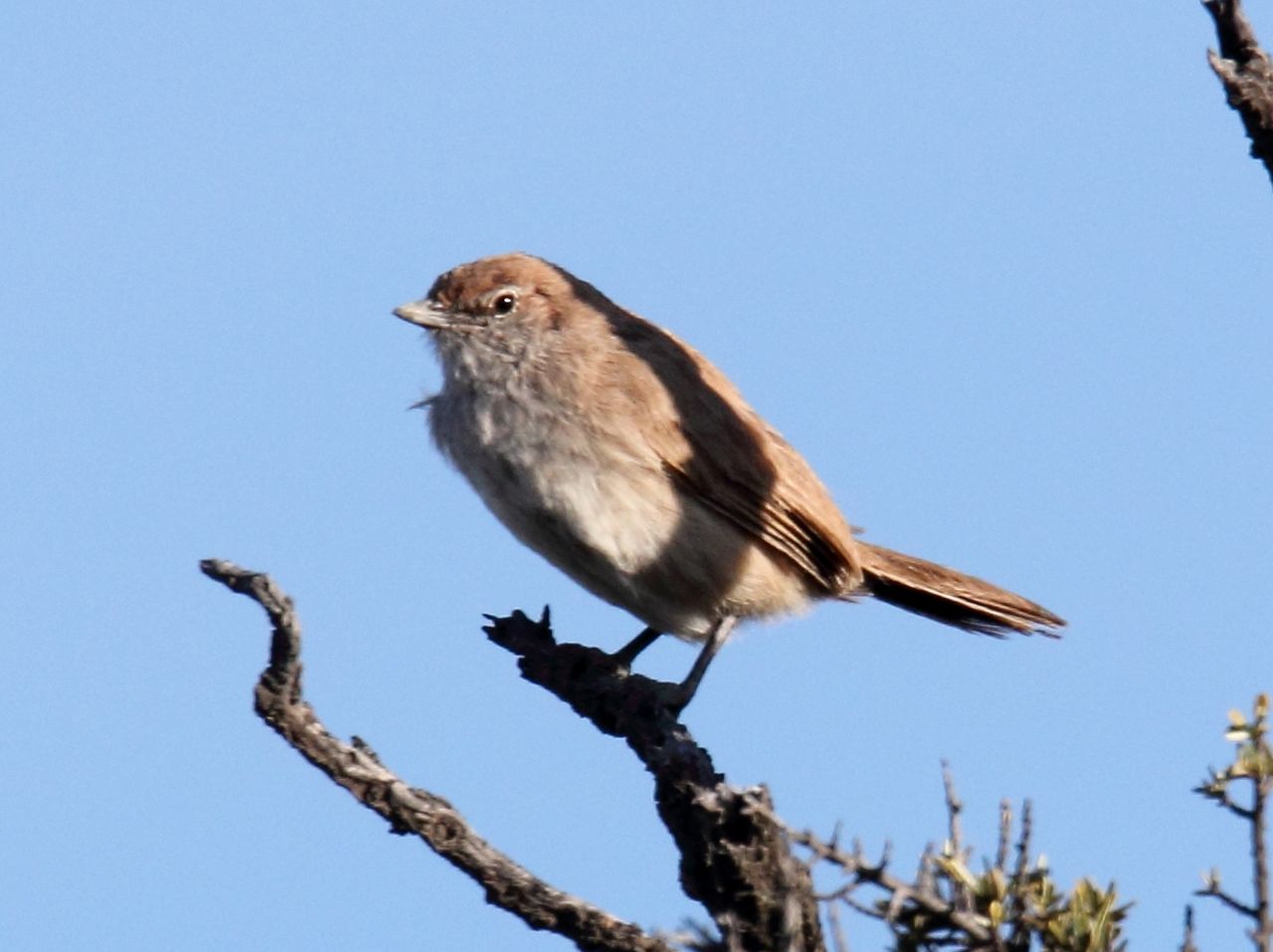
The sandy gallito is a species of suboscine passerine bird in the family Rhinocryptidae, the tapaculos. It is the only species placed in the genus Teledromas. It is endemic to Argentina.
Region
Western Argentina
Typical Environment
Occurs in arid scrub and desert thornbush of the Monte and Andean foothills, favoring rocky slopes, dry washes, and open shrublands with scattered cacti and Prosopis. It keeps close to dense, low cover and uses the spaces beneath shrubs for movement and foraging. The species is patchy but can be locally common where suitable scrub persists. It is associated with sparsely vegetated, sandy or stony soils and avoids tall, closed-canopy habitats.
Altitude Range
300–2200 m
Climate Zone
Arid
Ease of Keeping
Beginner friendly: 1/5
The sandy gallito is a monotypic tapaculo, the only species in the genus Teledromas. It prefers to run between bushes rather than fly, often holding its long tail cocked. Its clear, whistled song carries far across arid scrub, making it easier to detect than to see. It is endemic to Argentina’s dry western landscapes.


Temperament
secretive and skulking
Flight Pattern
short rapid wingbeats with low, brief flights
Social Behavior
Typically found singly or in pairs, especially during the breeding season. Pairs maintain territories and communicate with loud, carrying songs. Nests are placed low, often in cavities, banks, or sheltered at the base of shrubs with a lined chamber. Both sexes likely participate in territorial defense.
Migratory Pattern
Resident
Song Description
A loud, clear series of whistled notes that accelerate and slightly rise in pitch, delivered from within cover or atop a low shrub. Calls include sharp chips and whistles used to maintain contact between mates. The song carries well across open scrub, often betraying its presence.
Plumage
Plain sandy-brown to buff upperparts with a paler, clean underbody and minimal streaking; long, often cocked tail with warmer rufous tones. Subtle grayish tones on the face and nape, with smooth, fine-textured feathers. Overall appearance is uniform and sandy, aiding camouflage in desert scrub.
Diet
Feeds primarily on arthropods such as insects and spiders, gleaned from the ground and low vegetation. It searches beneath shrubs, in leaf litter, and among rocks. Occasional ingestion of small seeds or plant matter may occur, especially in dry seasons when insects are scarce.
Preferred Environment
Forages on or near the ground under thorny shrubs and among rocky outcrops. Prefers microhabitats that offer both open patches for running and dense cover for quick concealment.


