A rifleman is an infantry soldier armed with a rifled long gun. Although the rifleman role had its origin with 16th century hand cannoneers and 17th century musketeers, the term originated in the 18th century with the introduction of the rifled musket. By the mid-19th century, entire regiments of riflemen were formed and became the mainstay of all standard infantry, and rifleman became a generic term for any common infantryman.
Region
New Zealand
Typical Environment
Occurs on the North, South, and some offshore islands, most commonly in mature native forests. Prefers beech and podocarp-broadleaf forests, but also uses subalpine scrub and regenerating bush where old trees and mossy substrates are available. Often associated with trunks, branches, and bark crevices where it can glean invertebrates. Nest sites are typically natural cavities, holes, or spaces behind loose bark in standing trees.
Altitude Range
Sea level to 1400 m
Climate Zone
Temperate
Ease of Keeping
Beginner friendly: 1/5
The rifleman (tītipounamu) is New Zealand’s smallest bird and one of the last surviving New Zealand wrens. Its English name is said to reference the greenish plumage reminiscent of 19th‑century riflemen uniforms. It forages like a tiny treecreeper, climbing trunks and branches to glean insects with a fine upcurved bill. Its calls are extremely high‑pitched, often near the upper limit of human hearing.
Green jacketed British Army rifleman aiming a Baker rifle, c. 1803

Indonesian Army (TNI AD) 330th Infantry Battalion, 17th Infantry Brigade, 1st Infantry Division, Army Strategic Reserve Command (KOSTRAD)
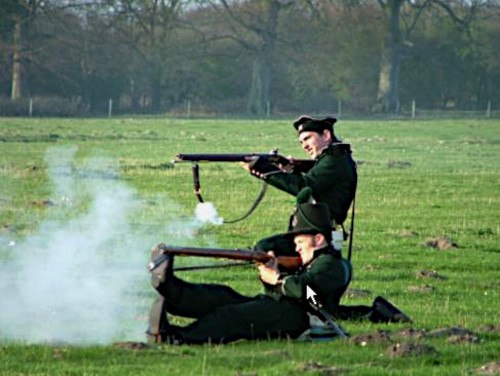
A historical reenactment with the British 95th Rifles regiment.

Uniform of the Robin Hood Rifles depicted on a 1939 cigarette card

John Fitzgerald Kennedy, escorted by a Bermuda Militia Artillery officer in Royal Artillery blue No. 1 Dress, inspects green-uniformed riflemen of the Bermuda Rifles in 1961

Riflemen of the War of 1812 in green fringed hunting shirts. Officer and sergeant in regulation gray. A general staff officer stands in the left foreground; behind him a mounted general officer.
Temperament
active and alert
Flight Pattern
short rapid wingbeats
Social Behavior
Usually seen in pairs or small family parties that keep close contact while foraging. Forms long-term pair bonds and nests in tree cavities lined with moss, feathers, and plant fibers. Both parents feed the young and defend a small territory year-round.
Migratory Pattern
Resident
Song Description
High, thin, and very rapidly delivered notes and trills, with much of the energy at very high frequencies. Contact calls are sharp, almost whispery ticks used constantly while moving through foliage.
Plumage
Very small, with olive-green to yellow‑olive upperparts finely flecked, pale underparts, and a very short often-cocked tail. Males tend to be greener; females are browner with more mottling. Feathers appear tight and sleek, aiding in trunk-climbing behavior.
Diet
Feeds primarily on small insects, spiders, and their larvae gleaned from bark, lichens, and moss. Uses its fine, slightly upcurved bill to probe into crevices and under flakes of bark. Occasionally takes tiny invertebrates from foliage and epiphytes.
Preferred Environment
Forages on trunks, branches, and mossy limbs in native forest and subalpine scrub. Often works methodically up and around tree trunks and along branch undersides.