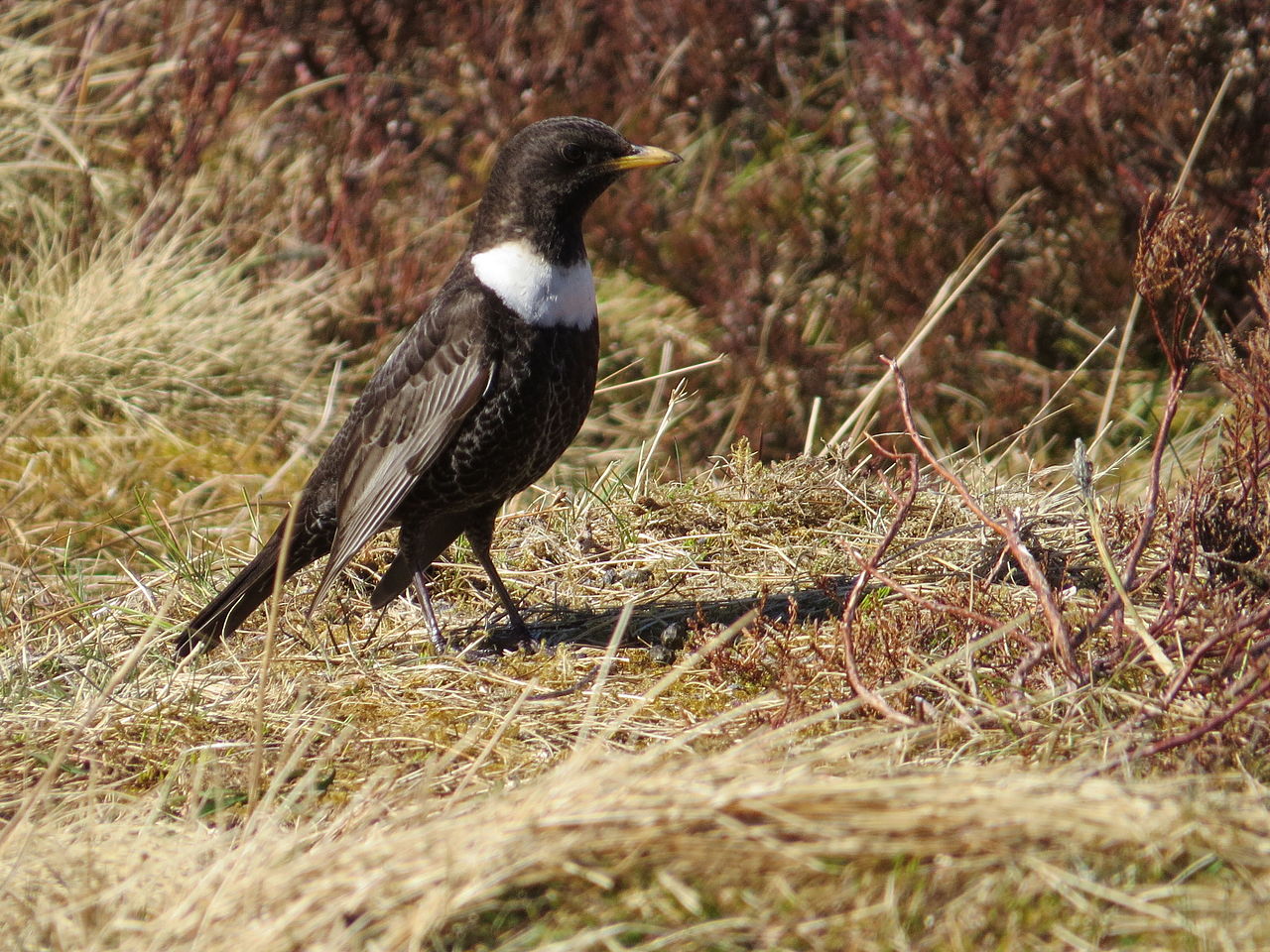
The ring ouzel is a mainly European member of the thrush family Turdidae. It is a medium-sized thrush, 23–24 centimetres (9.1–9.4 in) in length and weighing 90–138 grams (3.2–4.9 oz). The male is predominantly black with a conspicuous white crescent across its breast. Females are browner and duller than males, and young birds may lack the pale chest markings altogether. In all but the northernmost part of its range, this is a high-altitude species, with three subspecies breeding in mountains from Ireland east to Iran. It breeds in open mountain areas with some trees or shrubs, the latter often including juniper and other treeline conifers, rowan, bilberry, heather, and hairy alpenrose. It is a migratory bird, leaving the breeding areas to winter in southern Europe, North Africa and Turkey, typically in mountains with junipers. The typical clutch is 3–6 brown-flecked pale blue or greenish-blue eggs. They are incubated almost entirely by the female, with hatching normally occurring after 13 days. The altricial, downy chicks fledge in another 14 days and are dependent on their parents for about 12 days after fledging.
Region
Western Palearctic
Typical Environment
Breeds from the British Isles and Scandinavia through upland central and eastern Europe to the Caucasus and Iran. Prefers open mountain terrain with heather, bilberry, rocky gullies, and scattered conifers or shrubs, especially near the treeline. During migration it uses valleys, coastal headlands, and berry-rich scrub. Winters mainly in mountains of the western Mediterranean, North Africa, and Turkey, often where juniper is abundant.
Altitude Range
Sea level to 2600 m
Climate Zone
Temperate
Ease of Keeping
Beginner friendly: 1/5
Ring ouzels are mountain thrushes best recognized by the male’s bold white breast crescent. They breed in upland moorland and rocky slopes with scattered shrubs, often juniper and rowan, and migrate to winter in southern Europe, North Africa, and Turkey. Their autumn movements closely track the ripening of berry crops, especially juniper. Populations have declined in some regions due to habitat change and reduced berry availability.




Eggs in collection of Museum Wiesbaden

Juniper berries are a favoured winter food item.

The common buzzard is a predator of ring ouzels.
Temperament
solitary and territorial
Flight Pattern
direct flight with rapid wingbeats
Social Behavior
Breeding pairs defend upland territories, with the male often singing from rocks or stunted trees. Nests are usually low in dense shrubs, banks, or rocky crevices; clutches typically contain 3–6 eggs, incubated mostly by the female. Outside the breeding season, birds form loose flocks at rich food sources, especially berry stands.
Migratory Pattern
Seasonal migrant
Song Description
Song is a clear, fluted, slightly melancholic series of phrases reminiscent of a blackbird but thinner and more ringing. Calls include a harsh tac-tac alarm and a soft chack in flight.
Plumage
Male is sooty-black with a sharply defined white, crescent-shaped breast band and pale feather edges giving a scaly look on the belly and wings. Female is browner with a duller, often incomplete crescent and more obvious pale scalloping below. Juveniles are mottled and may lack a clear breast band.
Diet
In spring and summer it forages mainly for invertebrates such as earthworms, beetles, caterpillars, and snails, gleaned from the ground and low vegetation. In late summer and autumn, fruits and berries become increasingly important, notably rowan and juniper. During winter it may rely heavily on juniper berries in montane habitats.
Preferred Environment
Feeds on open slopes, pasture edges, and heather or bilberry moorland with scattered rocks and shrubs. On migration and in winter it frequents scrubby hillsides, orchards, and berry-rich thickets.