

The red lory is a species of parrot in the family Psittaculidae. It is the second-most commonly kept lory in captivity, after the rainbow lorikeet.
Region
Maluku Islands
Typical Environment
The red lory occurs on several islands of Indonesia’s Maluku (Moluccas) archipelago, frequenting lowland and foothill forests. It uses primary and secondary rainforest, coastal forest, mangroves, and coconut groves, and readily visits plantations and village gardens when flowering trees are available. Birds move locally in response to bloom cycles, often appearing in numbers where nectar is abundant. It is most commonly seen in pairs or small, noisy groups along forest edges and in the canopy.
Altitude Range
0–1200 m
Climate Zone
Tropical
Ease of Keeping
Beginner friendly: 2/5
Red lories are nectar specialists with brush-tipped tongues, so they require a liquid nectar diet rather than standard parrot seed mixes. They are highly active, intelligent, and vocal, and can be quite messy due to their liquid diet. In captivity they are popular, second only to the rainbow lorikeet among lories. They form strong pair bonds and are known for their playful behavior.


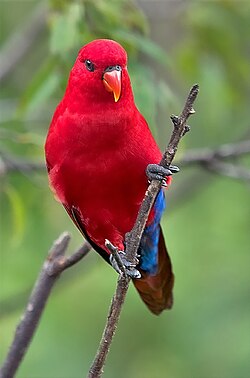
Type illustration of Eos bornea


Temperament
social and active
Flight Pattern
strong flier with swift, direct flight
Social Behavior
Usually seen in pairs or small, noisy flocks, gathering in larger numbers at prolific flowering trees. They are cavity nesters, using hollows in mature trees, and pairs maintain close bonds. Courtship includes mutual preening and vocal duets, and both parents typically attend the nest.
Migratory Pattern
Resident
Song Description
Loud, ringing screeches and harsh chattering contact calls carry over long distances. While feeding they produce softer chatters and squeaks, with rapid excited calls when flock members move between trees.
Plumage
Dense, glossy plumage that is predominantly red with contrasting blue to violet patches on the belly and underwings; some subspecies show blue markings on the shoulder and flanks.
Diet
Primarily nectar and pollen from a variety of flowering trees and shrubs, using a brush-tipped tongue to extract nectar efficiently. They also consume soft fruits such as figs, bananas, and papaya, and occasionally take flower buds. Small insects and larvae may be eaten opportunistically, especially when feeding young.
Preferred Environment
Feeds high in the canopy at flowering trees, including native forest species and cultivated ornamentals. Also visits plantations, village gardens, and coastal groves when blossoms are abundant.


