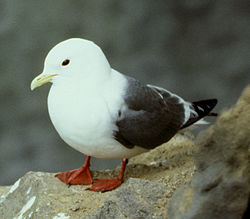
The red-legged kittiwake is a seabird species in the gull family Laridae. It breeds in the Pribilof Islands, Bogoslof Island, and Buldir Island in the Bering Sea off the coast of Alaska, and the Commander Islands, Russia, and spends the winter at sea.
Region
Bering Sea and North Pacific
Typical Environment
Breeds on sea cliffs of the Pribilof, Bogoslof, and Buldir islands (Alaska) and the Commander Islands (Russia). Outside the breeding season it disperses widely over the North Pacific, often along the continental shelf and slope. Foraging is concentrated near productive upwellings and fronts where small fish and squid aggregate. At colonies, birds commute tens to hundreds of kilometers to favored feeding grounds.
Altitude Range
Sea level to 300 m
Climate Zone
Polar
Ease of Keeping
Beginner friendly: 1/5
This scarce gull breeds only on a handful of Bering Sea islands and spends the rest of the year far out at sea. It is best told from the common Black-legged Kittiwake by its vivid red legs and a shorter, stubbier bill. Colonies pack onto sheer cliff ledges where pairs return to the same sites year after year. Climate-driven changes to prey and warming seas are key conservation concerns.


Red-legged kittiwake parent and chick


Temperament
social and colonial
Flight Pattern
buoyant flier with steady, stiff wingbeats and gliding over waves
Social Behavior
Nests in dense colonies on narrow cliff ledges, forming long-term pair bonds. Builds small nests of mud, grass, and seaweed cemented to rock. Both sexes share incubation and chick-rearing duties. Highly site-faithful, often returning to the same ledge each year.
Migratory Pattern
Seasonal migrant
Song Description
Gives a sharp, nasal 'kitti-wake' call, higher-pitched and more rattling than the black-legged species. At colonies, produces squeals and chatter during displays and territorial encounters.
Plumage
Clean white head, neck, and underparts with a medium-dark grey mantle and upperwings; black wing tips with small white 'mirrors'. Non-breeding birds show faint grey smudging around the ear coverts and hind-neck.
Diet
Feeds mainly on small schooling fish (especially lanternfish and sand lance), squid, and marine zooplankton such as krill. Typically seizes prey from the surface or just below, rarely plunge-diving deeply. Often associates with fronts and eddies where prey concentrates. Will follow marine predators or vessels that stir prey to the surface.
Preferred Environment
Pelagic waters near continental shelf edges and productive upwelling zones. Forages offshore from breeding colonies, sometimes far from land.