
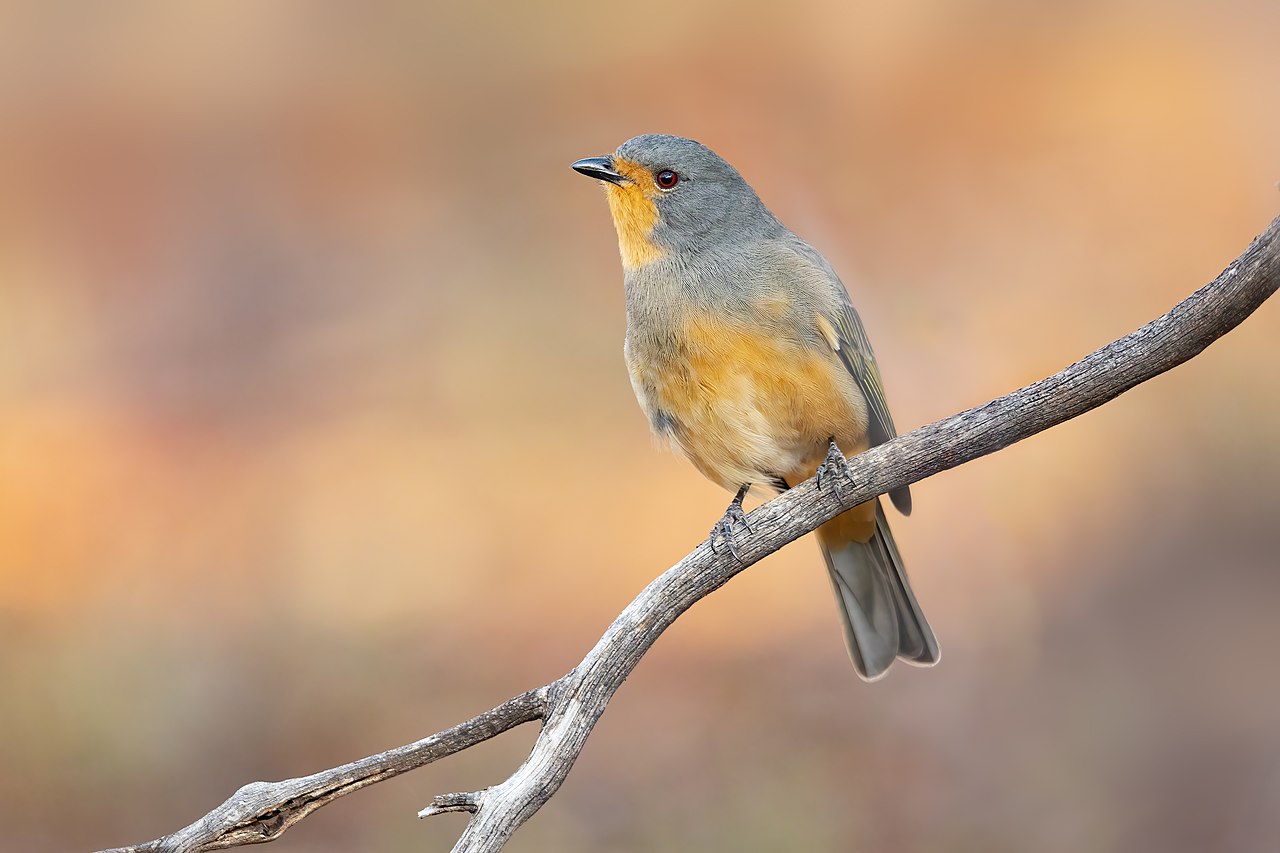
The red-lored whistler is one of nine species of whistler occurring in Australia and a member of the family Pachycephalidae which includes whistlers, shrike-thrushes, pitohuis and allies. The limited range of this endemic bird of the Mallee woodland in one small area in New South Wales and another, larger area encompassing north-western Victoria and adjacent South Australia has seen it listed nationally as vulnerable.
Region
South-eastern Australia
Typical Environment
Occurs patchily in semi-arid mallee eucalypt woodlands with a dense shrub layer on sandy soils and low dunes. It prefers long-unburnt stands of broombush and other mallee shrubs, often with a hummock grass (spinifex) component. The species avoids recently burnt or heavily grazed blocks and relies on contiguous habitat for territories. Key strongholds include reserves and parks across north-western Victoria and adjacent eastern South Australia, with a smaller outlying population in far western New South Wales.
Altitude Range
0–300 m
Climate Zone
Arid
Ease of Keeping
Beginner friendly: 1/5
A shy, ground-favoring whistler of Australia’s mallee, the red-lored whistler is most often detected by its clear, ringing song rather than seen. It favors long-unburnt, dense shrublands and is sensitive to fire frequency and habitat fragmentation. Nationally listed as Vulnerable, its scattered populations occur in north-western Victoria, adjacent South Australia, and a small area of western New South Wales.

Temperament
secretive and skulking
Flight Pattern
short rapid wingbeats, low over scrub
Social Behavior
Typically found singly or in pairs, maintaining year-round territories in dense mallee shrublands. Nests are shallow cups placed low in shrubs, with both sexes involved in territory defense. Breeding usually occurs in spring to early summer and may be cued by favorable rainfall.
Migratory Pattern
Resident
Song Description
A clear, ringing series of mellow whistles, often delivered from a concealed perch within dense shrubs. Phrases carry well and can seem ventriloquial, making the bird difficult to locate. Calls include soft contact notes while foraging.
Plumage
Sandy-brown to grey-brown upperparts with paler buff underparts; males show a warm rufous throat and lores bordered by a subtle dusky malar line. The underparts can show faint greyish mottling on the breast. Females are duller with less extensive rufous and more uniform tones. Tail and wings are plain, lacking strong wing bars.
Diet
Primarily hunts insects and other arthropods such as beetles, caterpillars, and spiders, gleaned from foliage, bark, and leaf litter. It occasionally takes small seeds or berries but remains largely insectivorous. Foraging is methodical, with short sallies and ground gleaning within cover.
Preferred Environment
Feeds within dense broombush and mallee midstory, along shrub edges, and on the ground among leaf litter and hummock grasses. Often remains under cover, emerging briefly to exploit patchy prey-rich microhabitats.


