

The red crossbill or common crossbill is a small passerine bird in the finch family Fringillidae. Crossbills have distinctive mandibles, crossed at the tips, which enable them to extract seeds from conifer cones and other fruits.
Region
Holarctic (Europe, Asia, North America)
Typical Environment
Occupies coniferous forests and mixed woodlands dominated by spruce, pine, fir, or larch. Often found in mature stands with abundant cone production but will use younger plantations during irruptions. Forages mostly in the canopy but also visits edges, clearings, and parklands with ornamental conifers. Occurs year-round in many areas, with irregular movements tracking cone crops.
Altitude Range
Sea level to 3000 m
Climate Zone
Temperate
Ease of Keeping
Beginner friendly: 1/5
Red crossbills have uniquely crossed mandibles that act like a lever to pry open conifer cones, a specialization rare among birds. They are highly nomadic and can irrupt far from usual ranges when cone crops fail or boom. Multiple call types correspond to subtle ecological specializations on different conifer species.


Eggs from the collections of the MHNT

Mediaeval sketch by Matthew Paris in his Chronica Majora (1254) of a crossbill holding a fruit in its beak, with the Latin words Alaudis parum majores ('a little bigger than larks').

'The Cross-Bill' wood engraving in Thomas Bewick's A History of British Birds (1847 edition)

Crossbill skull and jaw anatomy from William Yarrell's A History of British Birds (1843)

Distribution in North America. Year-round Year-round (scarce) Nonbreeding Nonbreeding (scarce)
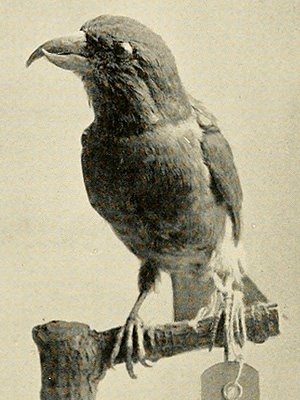
Newfoundland crossbill (L. c. percna)
Temperament
social and active
Flight Pattern
rapid, undulating finch flight
Social Behavior
Usually travels in noisy flocks outside the breeding season and can form large roaming groups when tracking cone crops. Pairs are monogamous during breeding and may nest in mid-winter if food is abundant. Nests are placed high in conifers and are well concealed.
Migratory Pattern
Partial migrant
Song Description
Song is a soft, rambling warble with trills and twitters delivered from treetops. Calls are distinctive metallic 'jip' or 'kip' notes, varying by call type and useful for field identification, especially in flight.
Plumage
Males are mostly brick-red to orange-red with darker wings and tail; females are olive-green to yellowish with streaked underparts. Both sexes show a stout, crossed bill and a slightly notched tail. Wing bars are absent, giving a plain-winged appearance.
Diet
Specializes on conifer seeds, including spruce, pine, fir, and larch, using its crossed bill to lever apart cone scales. Occasionally takes buds, berries, and weeds, and may feed insects to nestlings. Swallows grit to help process tough seeds. Diet composition shifts with local cone availability.
Preferred Environment
Feeds predominantly in the upper canopy of cone-bearing conifers but will use mid-canopy and ground when handling fallen cones. Also visits forest edges, plantations, and parks with ornamental conifers, and may frequent mineral-rich puddles for grit.


