

The plumbeous antbird is a species of bird in subfamily Thamnophilinae of family Thamnophilidae, the "typical antbirds". It is found in Bolivia, Brazil, Colombia, Ecuador, and Peru.
Region
Western and southwestern Amazon Basin
Typical Environment
Occurs in lowland forests of Bolivia, Brazil, Colombia, Ecuador, and Peru. It is most frequently found in dense understory of seasonally flooded várzea and igapó forests, swampy thickets, and river-edge scrub. It also uses secondary growth and vine tangles near oxbow lakes and along streams. The species typically keeps close to the ground to mid-understory, moving through tangled vegetation. It is generally absent from tall, terra firme interior where the understory is more open.
Altitude Range
Sea level to 800 m
Climate Zone
Tropical
Ease of Keeping
Beginner friendly: 1/5
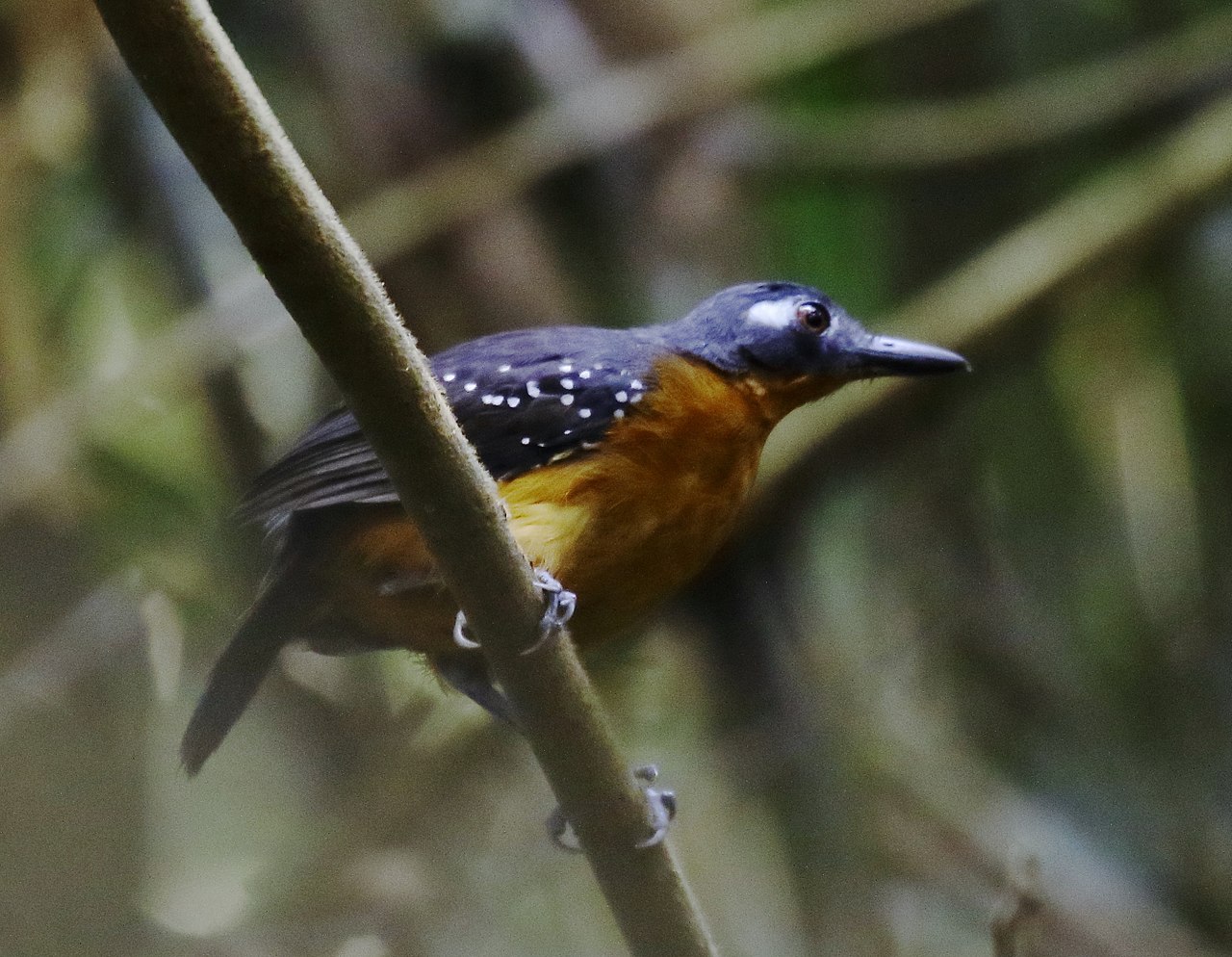
The plumbeous antbird is a skulking understory species of Amazonian forests, where it favors dense, often seasonally flooded thickets. Males are lead-gray while females are warm rufous-brown, a striking sexual dimorphism that helps with quick identification. It often travels in pairs and may occasionally attend army-ant swarms to snatch flushed insects. Its persistence in river-edge and swampy habitats makes it a characteristic voice of Amazonian floodplain forests.


Temperament
solitary and territorial
Flight Pattern
short rapid wingbeats
Social Behavior
Usually found as pairs maintaining year-round territories in dense understory. Nests are placed low, often in thick vegetation; both sexes participate in parental care. It forages methodically, flicking leaves and probing tangles rather than joining mixed flocks frequently.
Migratory Pattern
Resident
Song Description
Song is a series of clear, rising whistles that may accelerate slightly, often delivered from concealed perches. Calls include sharp chips and scolding notes when agitated.
Plumage
Male largely uniform slate-plumbeous with darker face and wings; female rich rufous-brown above with paler, warmer underparts. Both sexes have dense, smooth-looking plumage suited to humid understory conditions.
Diet
Feeds primarily on insects and other small arthropods, gleaned from leaves, twigs, and vine tangles. It occasionally sallies to the ground to seize prey and may probe dead foliage. At times it follows army-ant swarms opportunistically to capture flushed invertebrates.
Preferred Environment
Dense understory of flooded forests, river-edge scrub, and swampy thickets where leaf litter and tangles are abundant. Often forages within 0–2 m above ground in shaded, humid microhabitats.


