The pine grosbeak is a large member of the true finch family, Fringillidae. It is the only species in the genus Pinicola. It is found in coniferous woods across Alaska, the western mountains of the United States, Canada, and in subarctic Fennoscandia and across the Palearctic to Siberia. The species is a frugivore, especially in winter, favoring small fruits, such as rowans. With fruit-crop abundance varying from year to year, pine grosbeak is one of many subarctic-resident bird species that exhibit irruptive behavior. In irruption years, individuals can move long distances in search of suitable food supplies, bringing them farther south and/or downslope than is typical of years with large fruit crops.
Region
Holarctic boreal and subarctic forests
Typical Environment
Occurs across the coniferous forests of Alaska and Canada, the northern and western mountains of the United States, and through Fennoscandia across the Palearctic to Siberia. Prefers mature spruce, fir, and pine woodlands, especially where fruiting shrubs and trees like mountain ash are common. In irruption years, it wanders southward and downslope to parks, orchards, and towns with ornamental berry trees. Breeding typically takes place in quiet, high-latitude or high-elevation conifer stands.
Altitude Range
Sea level to 2500 m
Climate Zone
Continental
Ease of Keeping
Beginner friendly: 1/5
Pine grosbeaks are notably tame and slow-moving, often allowing close approach. They are classic irruptive finches, sometimes moving far south in winters when mountain ash and other berry crops fail. Males show a rosy-red wash while females are yellowish-olive, making mixed flocks striking in winter landscapes. Their thick, conical bills are adapted for crushing seeds and plucking fruit buds.
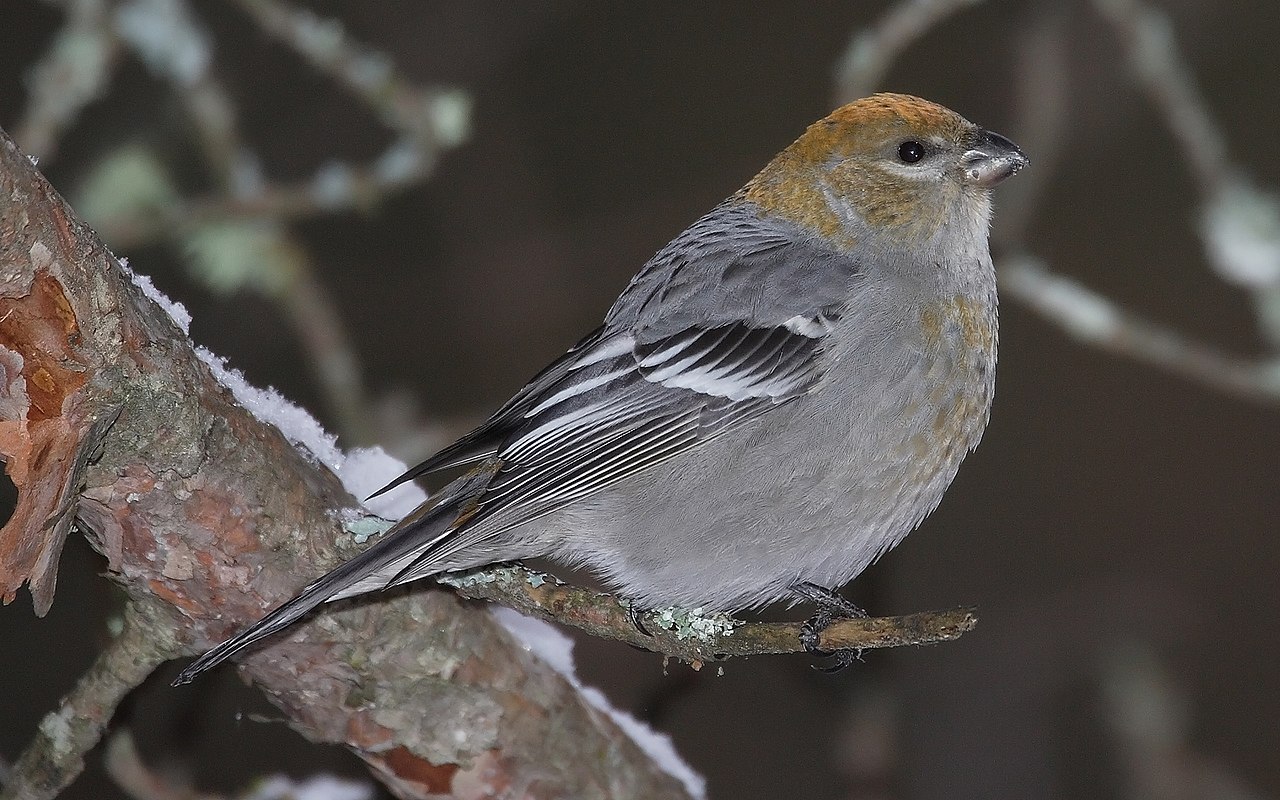


Kenai National Wildlife Refuge, Alaska


Temperament
social and calm
Flight Pattern
steady, undulating finch flight
Social Behavior
Often forms small to medium flocks outside the breeding season, sometimes mixed with other finches. Pairs are monogamous and nest in conifers, with the female primarily incubating. They can be conspicuously tolerant of humans at feeders and fruiting trees.
Migratory Pattern
Irruptive and partially migratory
Song Description
Song is a mellow, flute-like warble that carries well through forests. Calls include soft, whistled notes and clear, ringing 'tee-tee' or 'plee' sounds.
Plumage
Plump finch with soft, dense plumage and two distinct white wing bars; tail slightly notched.
Diet
Primarily consumes fruits and berries such as mountain ash (rowan), juniper, rose hips, and crabapples, especially in winter. Also takes buds and seeds from conifers and deciduous trees. In the breeding season it supplements with insects and larvae to provide protein for nestlings. Will visit feeders for sunflower seeds and fruit.
Preferred Environment
Feeds in canopy and midstory of coniferous forests and along forest edges where fruiting shrubs are abundant. In towns and villages, it forages on ornamental berry trees and occasionally on the ground beneath them.