

The pink cockatoo, also known as Major Mitchell's cockatoo or Leadbeater's cockatoo, is a medium-sized cockatoo that inhabits arid and semi-arid inland areas across Australia, with the exception of the north east.
Region
Australian arid and semi-arid interior
Typical Environment
Occurs across inland Australia, avoiding the humid coastal fringe and the far northeast. It favors mallee and mulga woodlands, acacia shrublands, cypress-pine and eucalypt woodlands, especially along watercourses. The species requires access to permanent or seasonal water and nests in large hollows of mature eucalypts or callitris. It uses open areas for foraging but retreats to timbered sites for roosting and breeding. It is patchy where extensive clearing has reduced old hollow-bearing trees.
Altitude Range
Sea level to 1200 m
Climate Zone
Arid
Ease of Keeping
Beginner friendly: 2/5
Also called Major Mitchell's cockatoo, it is famed for its spectacular crest with crimson and yellow bands. It forms long-term pair bonds and depends on large tree hollows near reliable water. Sensitive to disturbance and habitat clearing, it can be locally scarce despite a wide range. Its flight displays often include dramatic crest-raising and loud calls.


Adult perched on a tree in Melbourne Zoo


Temperament
social and wary; strongly bonded pairs; territorial near nest sites
Flight Pattern
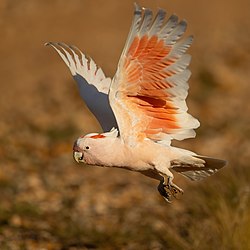
strong direct flight with deep, deliberate wingbeats; occasional glides between trees
Social Behavior
Often seen in pairs or small family groups, forming larger flocks at waterholes outside the breeding season. Pairs typically bond for life and defend nest hollows in tall trees. Breeding usually follows seasonal rains, with 2–4 eggs laid in deep hollows lined with wood chips.
Migratory Pattern
Resident with local nomadic movements following rainfall and food availability
Song Description
Loud, ringing screeches and grating calls carry over long distances, especially in flight. At close range, pairs exchange softer whistles and chattering contact notes during courtship and feeding.
Plumage
Mostly white with soft salmon-pink wash on the face, breast, and underwings; flight feathers show pale panels. Crest is broad and fan-shaped with vivid crimson and yellow bands edged in white.
Diet
Primarily seeds of native grasses, acacias, eucalypts, and cypress-pines, plus bulbs, roots, and fruits. Will take seeds from fallen cones and pods and occasionally feeds on agricultural grains. Uses its strong bill to husk hard seeds and to pry into cones and pods. Foraging often occurs on the ground but also in low shrubs and trees.
Preferred Environment
Feeds in open woodland, shrubland, and along riverine corridors near water. Often concentrates around waterholes and edges of mallee or mulga where seed resources are seasonally abundant.


