The pale batis, also known as the Mozambique batis or East coast batis is a species of small bird in the wattle-eyes family, Platysteiridae. It occurs in eastern Africa, mostly in lowland miombo woodland.
Region
Eastern Africa
Typical Environment
Primarily found along the East African coastal belt, especially in Mozambique and adjacent southern Tanzania, with occurrences in nearby lowland regions. It favors lowland miombo woodland, coastal scrub, and patches of riverine or dune forest. Birds keep to woodland edges, thickets, and lightly wooded savannas where they can sally from exposed perches. It tolerates a mosaic of natural woodland and semi-open areas as long as tree cover persists. Local densities are highest in intact lowland miombo.
Altitude Range
0–1200 m
Climate Zone
Tropical
Ease of Keeping
Beginner friendly: 1/5
Also called the Mozambique batis or East coast batis, this small flycatcher-like bird belongs to the wattle-eyes family (Platysteiridae). It often forages by sally-gleaning from shaded perches and may join mixed-species flocks. Pairs are highly territorial and communicate with distinctive duets. The male’s bold mask and breast band make it one of the easier batises to identify in coastal woodland.

Temperament
active and territorial
Flight Pattern
short rapid wingbeats
Social Behavior
Usually seen in pairs that maintain year-round territories and may loosely associate with mixed-species flocks while foraging. The nest is a small, neat cup placed in a fork, often decorated with lichens and spider silk. Both parents participate in care, with the male frequently provisioning the incubating female and nestlings.
Migratory Pattern
Resident
Song Description
Song consists of clear, high-pitched whistles and short trills delivered from shaded perches. Pairs often duet antiphonally, creating a see-sawing sequence that carries through woodland edges.
Plumage
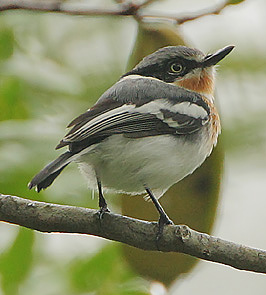
Pale grey upperparts with crisp white underparts; clean, smooth feathering. Male shows a bold black facial mask and a distinct black breast band; female has a warmer buff or rufous-tinged breast band and a subtler mask. Both sexes show a white wing panel and white edges to the tail.
Diet
Feeds mainly on small arthropods such as beetles, caterpillars, flies, and spiders. It hunts by sallying out from a perch to snatch prey or by gleaning from leaves and twigs. Short, agile flights and quick perch changes are typical while foraging in the midstory.
Preferred Environment
Forages in lowland miombo woodland, coastal thickets, and woodland edges with scattered trees. Often works along trails, clearings, and the mid-canopy where visibility and access to prey are good. Will join mixed flocks to exploit disturbed insects.