
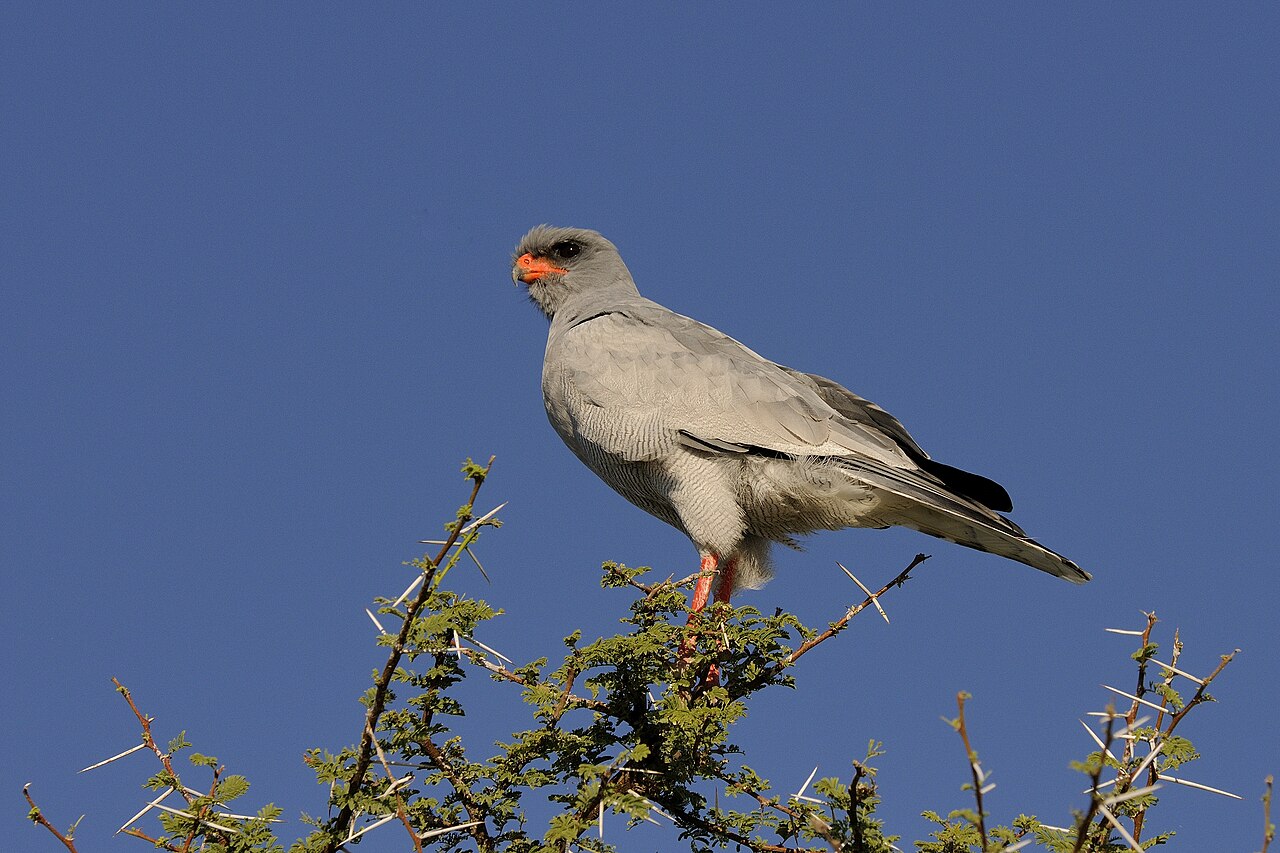
The pale chanting goshawk is a bird of prey in the family Accipitridae. This hawk breeds in southern Africa and is a resident species of dry, open semi-desert with 75 cm or less annual rainfall. It is commonly seen perched on roadside telephone poles.
Region
Southern Africa
Typical Environment
Occurs widely through arid and semi-arid zones, especially the Kalahari, Karoo, and adjacent savannas of Namibia, Botswana, and South Africa, with local presence into southwestern Angola and Zimbabwe. Prefers open scrub, thornbush, semi-desert, and lightly wooded savanna with scattered perches. Common along roadsides where poles and fences provide hunting lookouts. Rare in dense woodland or mountainous forest. Nests in thorn trees or other sturdy trees in open country.
Altitude Range
Sea level to 2000 m
Climate Zone
Arid
Ease of Keeping
Beginner friendly: 1/5
The pale chanting goshawk is a long-legged raptor often seen perched on roadside poles or striding on the ground in search of prey. Its name comes from a distinctive, fluty series of piping notes delivered during display flights. It frequently associates with foraging mammals like meerkats and mongooses, seizing prey that they flush. This species thrives in arid, open country and is a familiar sight across the Kalahari and Karoo.


Juvenile M. c. argentor, Namibia
Temperament
solitary and territorial
Flight Pattern
soaring glider with steady wingbeats and long, buoyant glides
Social Behavior
Typically seen singly or in pairs, maintaining territories year-round. Monogamous pairs build sturdy stick nests in thorny trees, often acacias. Clutches are small (usually 1–2 eggs), and both adults attend the nest.
Migratory Pattern
Resident
Song Description
A melodious, repeated series of clear, fluty whistles—the characteristic 'chant'—often delivered during display flights. Also gives sharp calls near the nest and when alarmed.
Plumage
Adults are pale grey above with finely barred whitish underparts and a long, banded tail with a broad dark subterminal band and white tip.
Diet
Takes small mammals such as gerbils and mice, lizards and snakes, small birds, and large insects like locusts and beetles. Hunts from exposed perches or by coursing low over open ground, and will also stride on foot to flush prey. Occasionally follows foraging mammals (e.g., meerkats, mongooses) to catch prey they disturb, and may take carrion opportunistically.
Preferred Environment
Open semi-desert, scrub, and savanna with scattered trees, fence lines, or poles for vantage points. Common along road verges and farm edges where prey is abundant and visibility is high.


