

The paddyfield pipit or Oriental pipit is a small passerine bird in the pipit and wagtail family. It is a resident (non-migratory) breeder in open scrub, grassland and cultivation in southern Asia east to the Philippines. Although among the few breeding pipits in the Asian region, identification becomes difficult in winter when several other species migrate into the region. The taxonomy of the species is complex and has undergone considerable changes.
Region
South and Southeast Asia
Typical Environment
Found widely from the Indian Subcontinent through Indochina to the Philippines, favoring open country. It occupies grasslands, scrubby plains, pastures, airfields, road verges, and a variety of agricultural lands, especially rice paddies and stubble. The species forages mainly on the ground and readily uses short-sward habitats maintained by grazing or mowing. It nests at ground level, tucked into grass tussocks or low vegetation, and adapts well to disturbed areas.
Altitude Range
0–2500 m
Climate Zone
Tropical
Ease of Keeping
Beginner friendly: 1/5
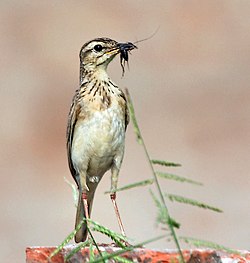
Often confused with Richard’s and Blyth’s pipits, the paddyfield pipit is best told by its smaller size, finer bill, and subtler breast streaking. It frequently pumps its tail and runs rather than hops. Males perform short fluttering song-flights over territories. It thrives in human-modified landscapes, especially rice paddies and grazed fields.



Temperament
solitary and territorial
Flight Pattern
low, direct flight with short rapid wingbeats and brief glides
Social Behavior
Typically seen singly or in pairs, establishing small territories in the breeding season. The nest is a grass-lined cup on the ground, with both parents involved in care. Outside breeding, small loose groups may form in rich feeding sites.
Migratory Pattern
Resident
Song Description
A thin, tinkling series delivered during a short fluttering song-flight, often ending as the bird drops to the ground. Calls include a sharp 'tsip' and softer contact notes.
Plumage
Warm brown upperparts with darker streaking, pale buff underparts with fine streaks on the breast fading on the flanks, and plain lower belly. Feathers appear smooth and sleek, with minimal contrast overall.
Diet
Primarily consumes insects and other small invertebrates such as beetles, ants, termites, grasshoppers, and small spiders. It also occasionally takes seeds or small grains, especially outside the breeding season. Prey is captured by walking or running and making short dashes or pecks.
Preferred Environment
Feeds on open ground with short vegetation, including grazed fields, paddy margins, fallow plots, and road verges. It favors recently disturbed or mown areas where invertebrates are exposed.


