

The painted buttonquail is a species of buttonquail, the family Turnicidae, which resemble, but are unrelated to, the quails of Phasianidae. This species is resident in Australia where numbers are believed to be in decline. A subspecies, the Abrolhos painted buttonquail, is endemic to the Houtman Abrolhos islands.
Region
Australia
Typical Environment
Occurs widely in eastern and southern mainland Australia and Tasmania, with isolated populations in southwestern Western Australia and on offshore islands. Prefers dry sclerophyll forests, woodlands, heaths, and mallee with abundant leaf litter and dense ground cover. Often uses regenerating forests and edges where leaf litter accumulates. It relies on cryptic plumage and ground cover for concealment and will flush only at close range. Human-altered habitats with retained understory and litter can still support the species, though fragmentation can be a concern.
Altitude Range
Sea level to 1200 m
Climate Zone
Temperate
Ease of Keeping
Beginner friendly: 2/5
Unlike true quails, buttonquails are in the family Turnicidae and the females are larger, brighter, and take the lead in courtship. Painted buttonquail are famous for making circular feeding scrapes called 'platelets' by pivoting on one foot over leaf litter. Females often call with a deep booming note and may be polyandrous, while males incubate the eggs and rear the chicks. A subspecies, the Abrolhos painted buttonquail, is confined to the Houtman Abrolhos islands off Western Australia.


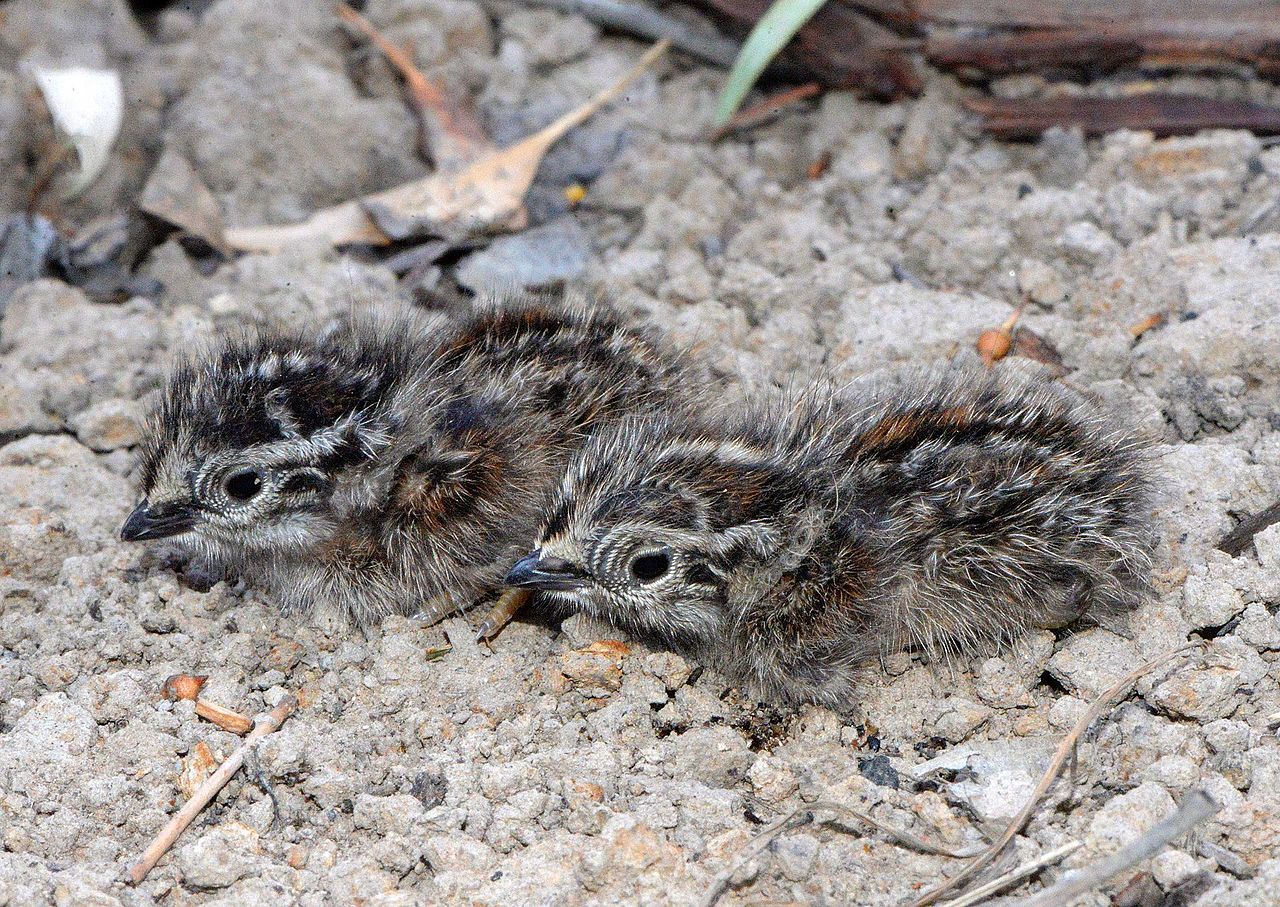
Chicks (mainland subspecies) adopting a defensive posture
Temperament
shy and cryptic
Flight Pattern
short rapid wingbeats with low, explosive flush
Social Behavior
Usually seen singly, in pairs, or small family groups. Females court and may mate with multiple males; males incubate eggs and care for the young. Nests are shallow ground scrapes hidden under tussocks or low shrubs, often with a partial dome of vegetation.
Migratory Pattern
Resident
Song Description
The female gives a deep, rhythmic booming series of notes that can carry through woodland. Males produce softer coos and contact calls; both sexes use quiet churrs and clucks when disturbed.
Plumage
Densely mottled and scalloped upperparts with rufous, black, and buff spots giving a 'painted' appearance; finely barred flanks and paler underparts. Females show richer rufous tones and a bold chestnut collar/breast patch; males are duller overall.
Diet
Feeds on a mix of small seeds, ants, beetles, spiders, and other leaf-litter invertebrates. Foraging often involves pivoting in place to expose food, leaving circular 'platelets' on the ground. Will also take soft shoots and small fruits when available.
Preferred Environment
Searches through leaf litter in dry forests, heaths, and mallee, typically under dense understory or fallen branches. Often forages along edges, tracks, and lightly disturbed areas where litter accumulates.


