

The painted bunting is a species of bird in the cardinal family, Cardinalidae. It is native to North America. The bright plumage of the male comes only in the second year of life; in the first year, they can be distinguished from the female only by close inspection.
Region
North America and Central America
Typical Environment
Breeds in the south-central and southeastern United States, including Texas, Oklahoma, Arkansas, Louisiana, and along the Atlantic Coastal Plain from the Carolinas to Florida. Prefers dense thickets, hedgerows, overgrown fields, riparian tangles, and brushy woodland edges. Winters mainly in Mexico, Central America, and parts of the Caribbean. During migration it uses similar shrubby habitats and edges, often near water.
Altitude Range
Sea level to 1500 m
Climate Zone
Subtropical
Ease of Keeping
Beginner friendly: 1/5
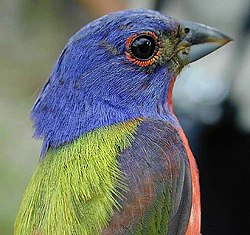
Adult males are among North America's most colorful songbirds, but they do not acquire their full rainbow plumage until their second year. The species favors dense, brushy cover and can be surprisingly secretive despite the male’s bright colors. Some populations undertake a molt migration to northwestern Mexico after breeding. Historical trapping for the cage-bird trade and habitat loss have affected parts of its range.




Temperament
secretive and territorial
Flight Pattern
short rapid wingbeats
Social Behavior
Males defend small territories vigorously during the breeding season and sing from semi-exposed perches. Nests are placed low in dense shrubs, typically holding 3–4 eggs; both sexes participate in parental care, with females doing most incubating. Outside breeding, they may form loose flocks in shrubby habitats and travel in small groups during migration.
Migratory Pattern
Seasonal migrant
Song Description
A fast, sweet, and varied warble delivered in short, tumbling phrases. Calls include a sharp, metallic tsip and soft ticks given from cover.
Plumage
Males are vividly multicolored with a blue head, green back, and red underparts and rump; wings are darker with slight edging. Females and first-year birds are overall olive-green to yellow-green, with a cleaner, uniform look. Feathers are smooth and sleek, aiding a neat, compact appearance.
Diet
Consumes a mix of grass and weed seeds, small grains, and a wide variety of insects such as beetles, caterpillars, and grasshoppers. Insects become especially important during breeding to fuel adults and nestlings. Outside the breeding season, seeds dominate, and the species may visit seed-rich weedy patches and feeders.
Preferred Environment
Feeds in dense brush, field edges, hedgerows, and along riparian thickets, often low to the ground or within shrubs. During winter and migration it forages in scrubby second growth, brushy pastures, and coastal thickets.


