

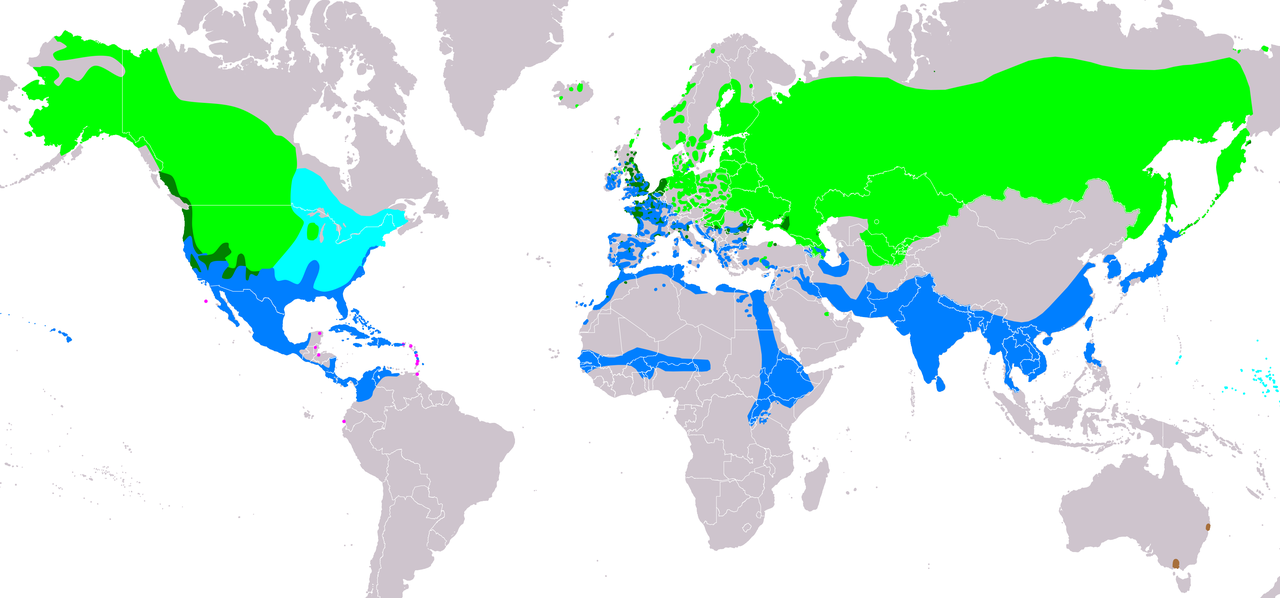
The northern shoveler, often known simply as the shoveler where other related species do not occur, is a common and widespread duck. It breeds in northern areas of Europe and throughout the Palearctic and across most of North America, and winters in southern Europe, the Indian subcontinent, Southeast Asia, Central America, the Caribbean, and northern South America. It is a rare vagrant to Australia. In North America, it breeds along the southern edge of Hudson Bay and west of this body of water, and as far south as the Great Lakes west to Colorado, Nevada, and Oregon.
Region
Holarctic (Palearctic and Nearctic)
Typical Environment
Breeds across northern North America and the Palearctic, favoring prairie potholes, tundra-edge wetlands, and shallow marshes. In winter it migrates to southern Europe, sub-Saharan Africa, the Middle East, the Indian subcontinent, Southeast Asia, Central America, the Caribbean, and northern South America. It is a rare vagrant to Australia. Habitats include shallow freshwater and brackish marshes, flooded fields, sewage ponds, and quiet lake margins with emergent vegetation. It avoids fast-flowing rivers and deep open water, preferring calm, nutrient-rich shallows.
Altitude Range
Sea level to 2500 m
Climate Zone
Temperate
Ease of Keeping
Beginner friendly: 3/5
Named for its exceptionally broad, spoon-shaped bill, the northern shoveler filters tiny invertebrates and seeds from the water with comb-like lamellae. Males in breeding plumage show a glossy green head, white chest, and rich chestnut flanks, while females are mottled brown and cryptic. They often feed by slowly circling in pairs or small groups to stir up food. The species is widespread and adaptable, using a variety of shallow wetlands.




Temperament
social and active
Flight Pattern
strong flier with rapid wingbeats
Social Behavior
Pairs form on wintering grounds or early in spring, and nesting is solitary on the ground near water, often concealed in vegetation. Clutches are incubated by the female while the male remains nearby early in the season. Outside the breeding season they form loose flocks, often mixing with other dabbling ducks. Courtship includes head-pumping and soft clucking displays by males.
Migratory Pattern
Seasonal migrant
Song Description
Males give soft, clucking or wheezy notes and low whistles, especially during courtship. Females produce a series of quacks, lower and softer than a mallard’s. Vocalizations are most frequent on breeding territories and in early spring.
Plumage
Male in breeding plumage has a glossy green head, white breast, and chestnut flanks with pale blue forewing and green speculum; female is mottled brown with pale blue forewing and green speculum. Both sexes show a long, broad, spatulate bill and fairly short tail.
Diet
Feeds primarily on aquatic invertebrates (especially small crustaceans and insect larvae), zooplankton, and seeds from aquatic plants. The wide bill, lined with dense lamellae, is used to sieve prey from the water surface and just below it. Diet shifts toward more animal matter during breeding and includes more seeds and plant material in winter. It may also take small snails and algae when abundant.
Preferred Environment
Shallow, calm waters such as marsh edges, flooded fields, and pond margins with emergent vegetation. Often feeds in pairs or small groups, sometimes circling to concentrate food. Avoids deep, rough, or fast-moving water while foraging.


