

The northern mockingbird is a mockingbird commonly found in North America, of the family Mimidae. The species is also found in some parts of the Caribbean, as well as on the Hawaiian Islands. It is typically a permanent resident across much of its range, but northern mockingbirds may move farther south during inclement weather or prior to the onset of winter. The northern mockingbird has gray to brown upper feathers and a paler belly. Its tail and wings have white patches which are visible in flight.
Region
North America and Caribbean
Typical Environment
Common across most of the continental United States, southern Canada in summer, Mexico, and parts of the Caribbean; it has also been introduced to Hawaii. Prefers open and edge habitats with low shrubs and scattered trees, including suburbs, parks, farms, and desert scrub. Often absent from dense unbroken forests. In winter, it expands use of fruit-rich habitats and urban plantings. It adapts well to human-modified landscapes where shrubs for nesting and fruiting plants are available.
Altitude Range
Sea level to 2500 m
Climate Zone
Temperate
Ease of Keeping
Beginner friendly: 1/5
The northern mockingbird is famed for its remarkable ability to mimic the songs of other birds and even mechanical sounds, often stringing dozens of phrases into long, varied performances. Males may sing day and night during the breeding season, especially under bright moonlight. They are fiercely territorial and will boldly defend nests against much larger intruders, including humans and pets.




With crane fly larvae

Displaying

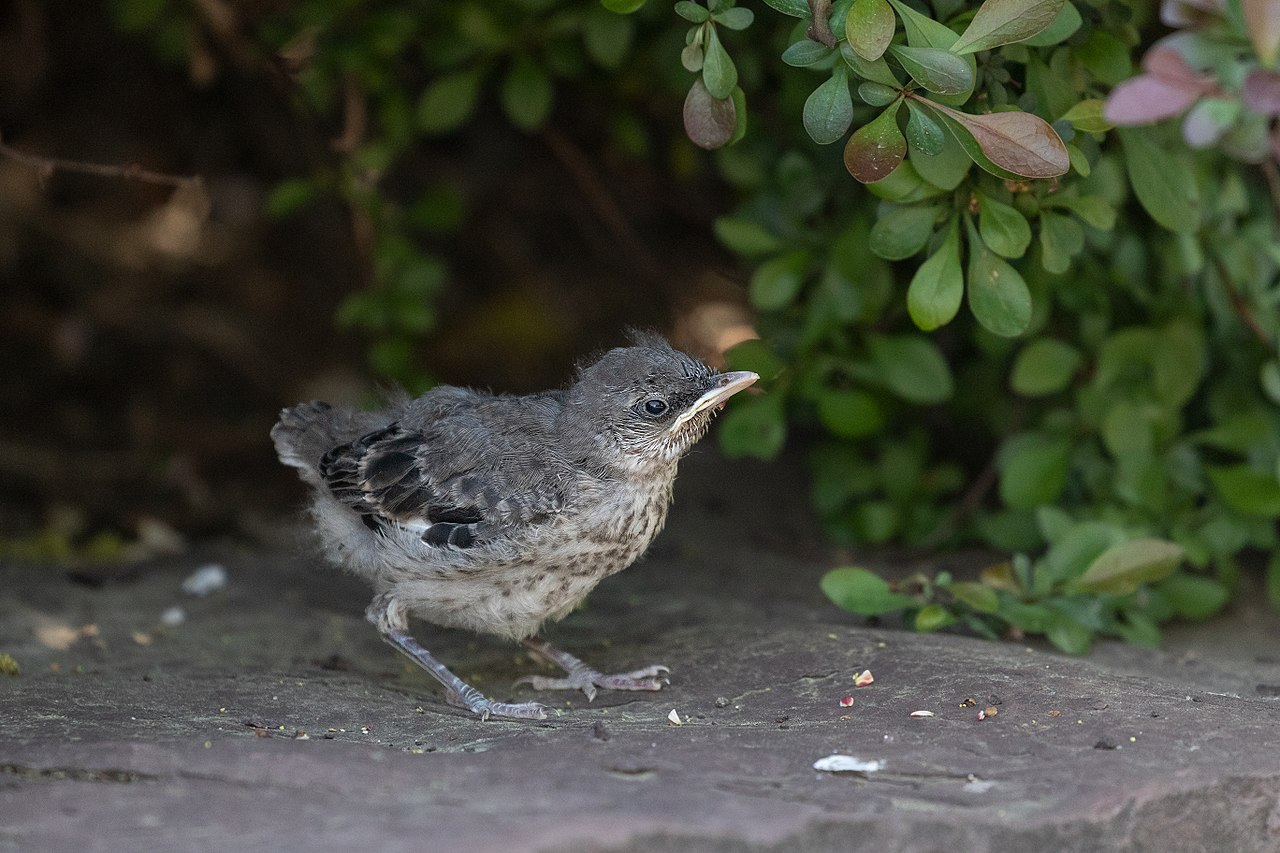
Adult mockingbirds have solid pale grey or buff breasts, juveniles mottled.


Riding a red-tailed hawk

In the urban habitat at Durham, North Carolina

Painting by John James Audubon
Temperament
solitary and territorial
Flight Pattern
short rapid wingbeats with brief glides
Social Behavior
Typically forms monogamous pairs that defend breeding territories vigorously. Nests are placed in dense shrubs or small trees, sometimes close to human activity. Multiple broods may be raised in a season, with males continuing to sing while females incubate. Both sexes participate in territory defense.
Migratory Pattern
Partial migrant
Song Description
Rich, varied series of phrases with expert mimicry of other birds and environmental sounds. Males can cycle through extensive repertoires and may sing at night during the breeding season, especially under bright moonlight.
Plumage
Smooth gray to brownish-gray upperparts with a pale gray to whitish underside; conspicuous white wing patches and white outer tail feathers shown in flight.
Diet
Eats a mix of insects and other invertebrates (beetles, grasshoppers, caterpillars, wasps) and a wide variety of berries and small fruits (holly, mulberry, elderberry, dogwood). Insects dominate in spring and summer, while fruits are more important in fall and winter. Occasionally hawks for flying insects and may probe lawns or leaf litter.
Preferred Environment
Forages on the ground, in low shrubs, and from perches in open areas with scattered vegetation. Frequently visits gardens, hedgerows, and fruiting trees in suburban neighborhoods and parks.


