

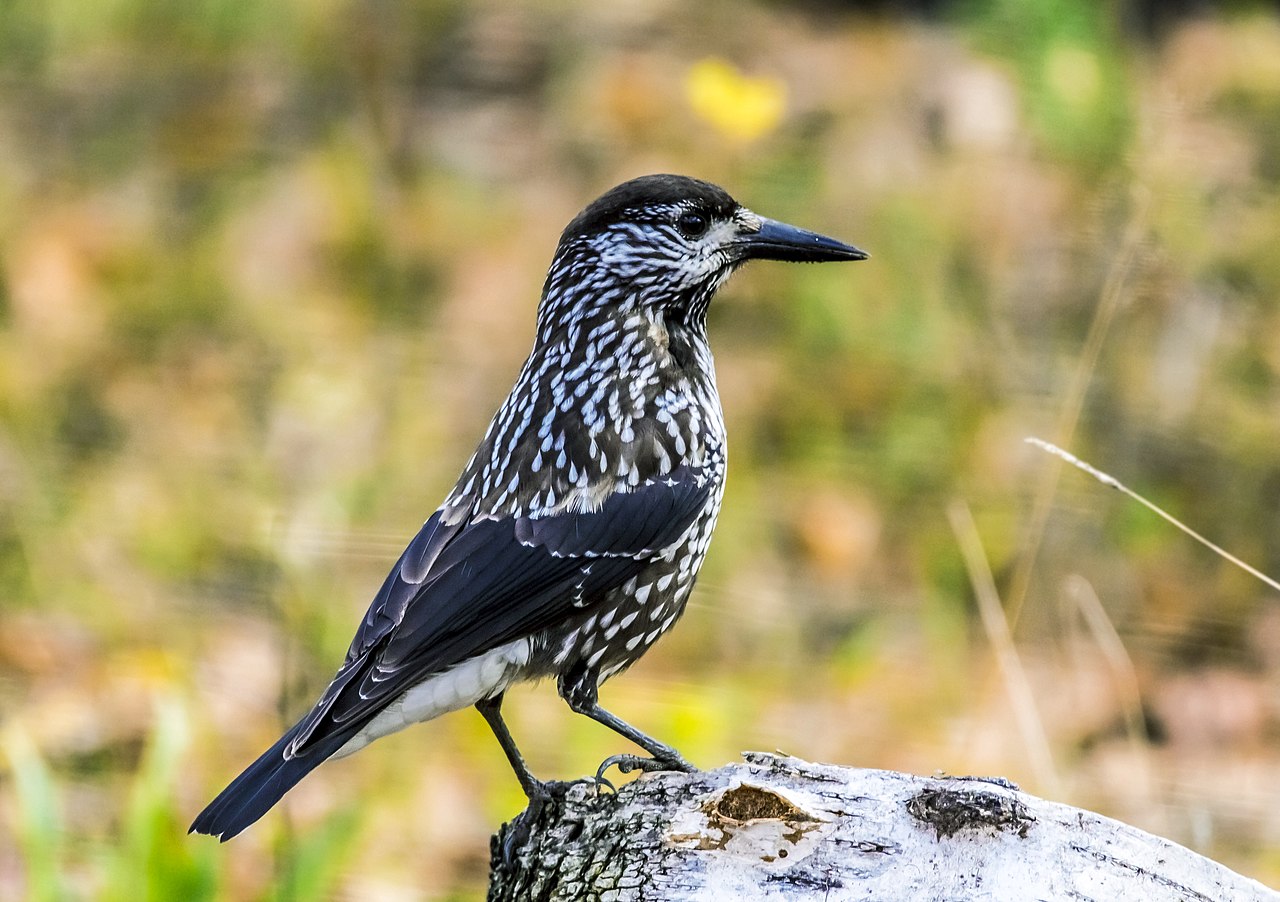
The northern nutcracker, previously known as the spotted nutcracker and Eurasian nutcracker, is a passerine bird in the crow family Corvidae. It is slightly larger than the Eurasian jay but has a much larger bill and a slimmer looking head without any crest. The feathering over its body is predominantly chocolate brown with distinct white spots and patches. The wings and upper tail are black with a greenish-blue gloss.
Region
Northern Eurasia
Typical Environment
Occurs from Scandinavia and the Alps across the boreal and montane forests of Eastern Europe and Siberia to Northeast Asia and Japan, with isolated populations in central and southern mountain ranges. It favors mature coniferous forests dominated by spruce, pine, larch, and stone pine, but also uses mixed woodlands and forest edges. In autumn and winter it may descend to lower elevations and visit parks or villages during poor cone years. It frequently forages in subalpine zones with scattered krummholz and open glades.
Altitude Range
0–3500 m
Climate Zone
Temperate
Ease of Keeping
Beginner friendly: 2/5
A corvid specialized for cracking and caching conifer seeds, it can store thousands of pine nuts each year using a sublingual pouch. Many of the cached seeds are never retrieved, making the species an important planter of pines such as Siberian and stone pine. It breeds very early, often in late winter, fueled by stored seeds, and shows irruptive movements when cone crops fail.


N. c. macrorhynchos in Russia

A Pinus cembra cone stripped of its scales and seeds by a foraging nutcracker

Egg of northern nutcracker

Juvenile N. c. japonica in Ōshika, Nagano Prefecture, Japan
Temperament
bold and inquisitive, but territorial around food caches
Flight Pattern
strong, direct flight with steady wingbeats
Social Behavior
Typically seen singly or in pairs, forming small family groups after fledging. Pairs are monogamous and often breed early in the year in conifer trees, lining nests with soft materials. They cache large numbers of seeds in scattered sites and can relocate many using spatial memory.
Migratory Pattern
Partial migrant
Song Description
Vocalizations are loud, harsh, and rasping, including grating ‘kraaa’ and rattling calls that carry far through forests. Softer whistles and chuckles are given at close range, especially around mates or at the nest.
Plumage
Dense chocolate-brown plumage heavily spangled with white spots and flecks; wings and tail are darker and glossy. The undertail coverts are clean white, contrasting with the darker tail.
Diet
Primarily consumes conifer seeds, especially pine nuts from stone pine, Siberian pine, and spruce cones. Supplements with hazelnuts, acorns, berries, and other plant matter when available. Also takes insects, larvae, and occasionally small vertebrates, eggs, and carrion. Stores surplus seeds in numerous caches for winter and early spring use.
Preferred Environment
Feeds in mature conifer stands, subalpine woodlands, and forest edges where cone crops are abundant. Will forage on the ground for fallen cones and at openings or clearings, and may visit human settlements during food shortages.


