

The northern cardinal, also commonly known as the common cardinal, red cardinal, or simply cardinal, is a bird in the genus Cardinalis. It can be found in southeastern Canada, through the eastern United States from Maine to Minnesota to Texas, New Mexico, southern Arizona, southern California and south through Mexico, Belize, and Guatemala. It is also an introduced species in a few locations such as Bermuda and all major islands of Hawaii since its introduction in 1929. Its habitat includes woodlands, gardens, shrublands, and wetlands. It is the state bird of Illinois, Indiana, Kentucky, North Carolina, Ohio, Virginia, and West Virginia.
Region
Eastern and Central North America into northern Central America
Typical Environment
Found from southeastern Canada through the eastern and central United States, south into Mexico, Belize, and Guatemala. It thrives in woodland edges, suburban gardens, parks, hedgerows, and shrubby thickets. It also occurs in riparian corridors and overgrown fields, often where dense cover meets open foraging areas. The species adapts well to human-altered landscapes and commonly uses bird feeders.
Altitude Range
Sea level to 1800 m
Climate Zone
Temperate
Ease of Keeping
Beginner friendly: 1/5
Males are vivid red with a black face mask, while females are warm brown with red accents—both sexes sport a prominent crest. Unusually for North American songbirds, females also sing, often in duet with males. The species readily visits backyard feeders and has expanded its range northward in recent decades. It has been introduced to places like Hawaii and Bermuda and is the state bird of seven U.S. states.




With a grasshopper


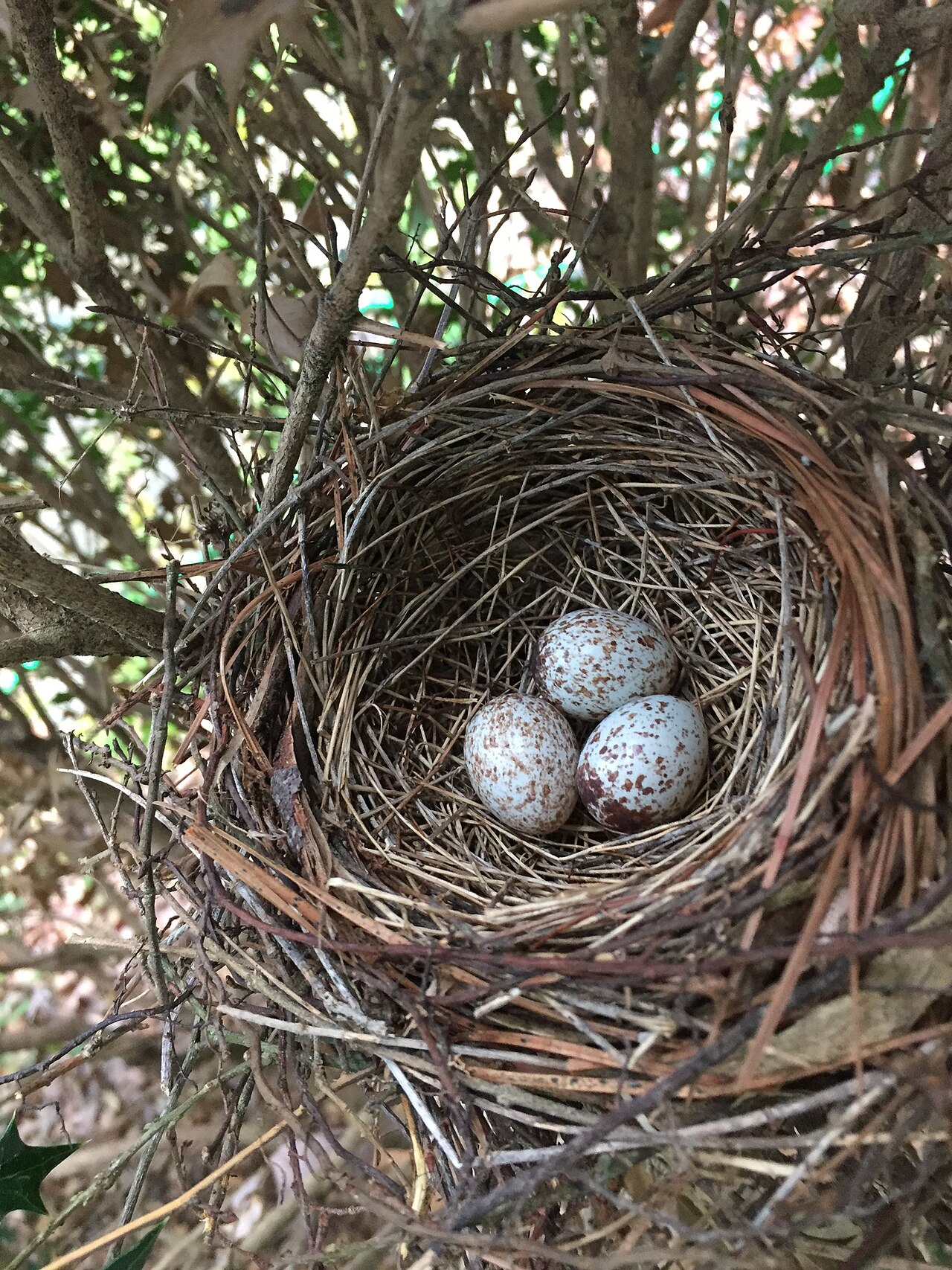
Nest with three eggs in Durham, North Carolina


Temperament
territorial in breeding season; social in winter
Flight Pattern
short rapid wingbeats
Social Behavior
Pairs form strong bonds and defend territories vigorously during breeding. Nests are built low to mid-level in dense shrubs; females typically incubate while males provision them. Outside breeding season, they often join loose flocks and visit feeders together.
Migratory Pattern
Resident
Song Description
Rich, clear whistled phrases such as ‘cheer, cheer, cheer’ or ‘birdy-birdy-birdy,’ delivered loudly from exposed perches. Calls include a sharp metallic ‘chip’ used for contact and alarm.
Plumage
Male is uniformly bright red with a black face mask and a tall crest; female is brownish with warm buff tones and reddish tinges on wings, tail, and crest. Both sexes have dense, sleek plumage and a thick bill.
Diet
Primarily eats seeds (especially sunflower and other weed seeds) and small fruits. Insects such as beetles, caterpillars, and grasshoppers are taken more frequently in spring and summer, and are important for feeding nestlings. They will also consume buds and grains when available. Readily visits bird feeders, favoring sunflower and safflower seeds.
Preferred Environment
Forages on or near the ground and in shrubs, often along edges where cover meets open space. Common at backyard feeders, thickets, hedgerows, and woodland margins.


