The mulga parrot is endemic to arid scrublands and lightly timbered grasslands in the interior of southern Australia. The male mulga parrot is multicolored, from which the older common name of many-coloured parrot is derived.
Region
Australian arid interior
Typical Environment
Found across arid and semi-arid scrublands and lightly timbered grasslands of southern inland Australia, from inland Western Australia through South Australia to western New South Wales and northwestern Victoria. It favors mulga (Acacia aneura) shrublands, open eucalypt woodlands, and mallee. Birds often occur along watercourses, at station homesteads, and on the edges of cleared farmland. They avoid dense forests and coastal habitats, preferring open country with scattered trees and shrubs.
Altitude Range
0–800 m
Climate Zone
Arid
Ease of Keeping
Beginner friendly: 2/5
Also known as the many-colored parrot, the mulga parrot is a striking Australian species adapted to arid interiors. Males are vividly multicolored, while females are more subdued for camouflage. They often move locally in response to rainfall and food availability, and nest in tree hollows, especially in eucalypts and acacias.
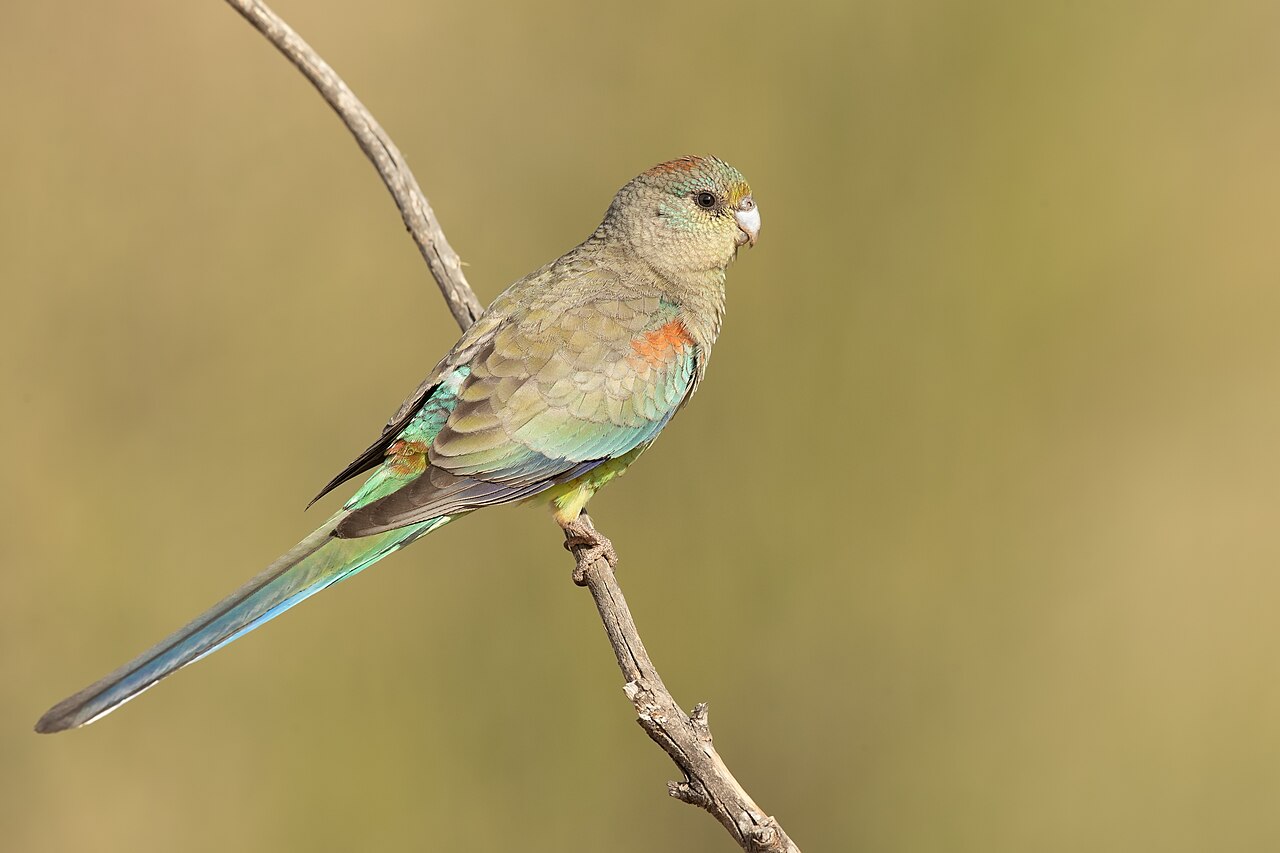


Male
Temperament
wary and fairly quiet
Flight Pattern
swift, direct flight with rapid wingbeats and shallow glides
Social Behavior
Usually seen in pairs or small family groups; larger loose flocks can form at water or abundant food. Breeding often follows rainfall; they nest in hollows of eucalypts or acacias, sometimes in fence posts or stumps. Pairs are attentive, and the female incubates while the male feeds her nearby.
Migratory Pattern
Partial migrant
Song Description
Calls are soft, tinkling whistles and chattering notes, often given in flight. The song is simple and subdued compared to many parrots, with short sequences of clear, metallic notes.
Plumage
Male is brightly colored with smooth green plumage, yellow underparts, blue face highlights, and a red shoulder patch; tail is long and tapered. Female is duller olive-green with paler underparts and reduced or absent red and blue. Both sexes have a long, graduated tail and sleek, tight plumage.
Diet
Primarily takes seeds of native grasses and shrubs, including acacias, saltbush, and mallee species. Also consumes green shoots, buds, and flowers, and will take fruits when available. Insects and their larvae are occasionally eaten, especially during the breeding season for added protein.
Preferred Environment
Forages mostly on the ground in open scrub, along tracks, and at the margins of watercourses and pastoral lands. Frequently visits stock yards, roadside verges, and lightly grazed grasslands where seed is abundant.