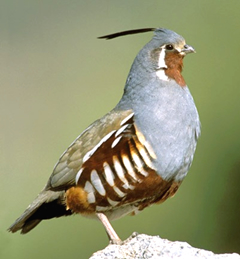
The mountain plover is a medium-sized ground bird in the plover family (Charadriidae). It is misnamed, as it lives on level land. Unlike most plovers, it is usually not found near bodies of water or even on wet soil; it prefers dry habitat with short grass and bare ground. Its height is in the range of 5–9 inches, and length in the range of 8–10 inches ; and it weighs around 102 grams.
Region
Western Great Plains and Southwestern North America
Typical Environment
Breeds primarily on the shortgrass prairies of Colorado, Wyoming, Montana, New Mexico, and neighboring areas, with smaller numbers in the Canadian Prairies. In winter it moves to lowland agricultural valleys and desert flats of California, Texas, and northern Mexico (Baja California, Sonora, Chihuahua). It selects dry, open landscapes with very short vegetation and extensive bare ground, including overgrazed pastures, burned areas, alkali flats, and plowed or fallow fields. Unlike most plovers, it avoids wetlands and saturated soils.
Altitude Range
Sea level to 2000 m
Climate Zone
Temperate
Ease of Keeping
Beginner friendly: 1/5
Despite its name, the mountain plover favors flat, open shortgrass prairie and barren ground rather than mountains or wetlands. It often nests near prairie dog towns or on heavily grazed or recently disturbed ground that provides the bare substrate it prefers. The species has an unusual breeding system in which a female may lay two clutches, with each parent incubating a separate nest. Populations have declined due to habitat loss, agricultural changes, and reduced disturbance creating less bare ground.


Temperament
alert and wary
Flight Pattern
low, direct flight with rapid wingbeats
Social Behavior
During breeding it nests on the ground in shallow scrapes with minimal lining. The species often exhibits a split-clutch strategy, where the male incubates the first clutch while the female lays and tends a second. Outside the breeding season it forms loose flocks, especially in agricultural fields and open flats.
Migratory Pattern
Seasonal migrant
Song Description
Vocalizations are mostly soft, piping whistles and clear, plaintive ‘kew’ notes. Calls carry over open ground and are given in flight and while foraging, especially at dawn and dusk.
Plumage
Sandy-brown upperparts with clean white underparts and a pale buffy wash across the chest; overall plain, smooth plumage without a breast band. Subtle pale supercilium and a fine dark loral line; tail shows white sides when flushed.
Diet
Primarily feeds on insects such as grasshoppers, crickets, beetles, and ants, along with spiders and other small invertebrates. It occasionally takes small seeds, especially in winter when insects are less available. Foraging involves short runs and pauses to pick prey from the ground.
Preferred Environment
Favors very short grass and bare ground that improve visibility of prey, including prairie dog colonies, overgrazed rangeland, burned areas, and plowed or fallow fields. In winter it frequently uses dry agricultural valleys and alkali flats.