
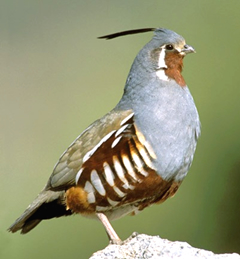
The mountain quail is a small ground-dwelling bird in the New World quail family. This species is the only one in the genus Oreortyx, which is sometimes included in Callipepla. This is not appropriate, however, as the mountain quail's ancestors diverged from other New World quails earlier than the bobwhites, no later than 6 mya.
Region
Western North America
Typical Environment
Found from Washington and Oregon through California and into northern Baja California, with populations in western Nevada and parts of Idaho. It inhabits brushy mountain slopes, chaparral, oak and conifer woodlands, and forest edges with dense understory. Birds breed at higher elevations in summer and shift downslope to milder, brushy foothills and canyons in winter. They rely on thick cover such as manzanita and ceanothus thickets for shelter and foraging.
Altitude Range
Sea level to 3000 m
Climate Zone
Temperate
Ease of Keeping
Beginner friendly: 2/5
The mountain quail is the only member of the genus Oreortyx and is noted for its long, straight twin head plumes. It prefers to run through dense cover and typically explodes into short, rapid flights only when flushed. Coveys often move in single file and make seasonal elevational movements, descending to lower slopes in winter. Chicks are precocial and feed heavily on insects in their first weeks.


Oreortyx pictus


Egg of Oreortyx pictus – MHNT
Temperament
shy and secretive
Flight Pattern
short rapid wingbeats
Social Behavior
Outside the breeding season they form small coveys that feed and move together, often in single file. Pairs are typically monogamous, with nests on the ground concealed under shrubs or grass tussocks. Both adults lead chicks to foraging areas soon after hatching.
Migratory Pattern
Partial migrant
Song Description
Vocalizations include mellow, whistled notes and clear piping contact calls. Alarm calls are sharp, carrying clucks or bark-like notes used to keep coveys together in dense cover.
Plumage
Gray head and breast with rich brown back and rufous flanks boldly barred with white; smooth, compact contour feathers. Throat shows a chestnut patch bordered by white. Both sexes have long, straight twin head plumes, shorter in females.
Diet
Feeds on seeds, leaves, buds, bulbs, and berries such as manzanita and currants, along with acorns and pine nuts when available. Insects and other invertebrates are important in spring and for chicks. Diet shifts seasonally, becoming more herbaceous in winter and more protein-rich during breeding.
Preferred Environment
Forages on the ground and low shrubs within dense chaparral, brushy forest edges, and regenerating clearcuts. Often feeds along trails, drainages, and brushy slopes where cover is close at hand.


