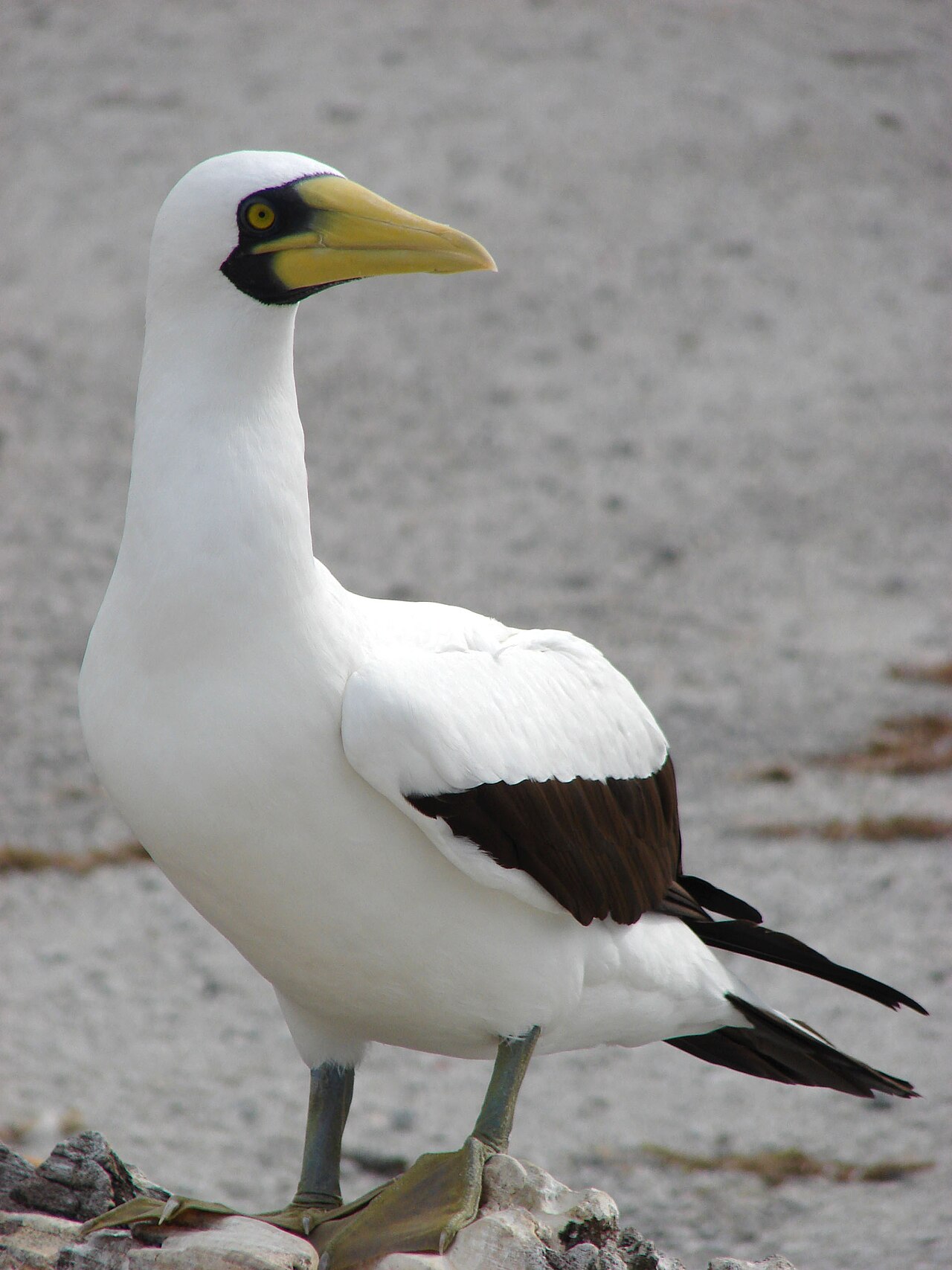
The masked booby, also called the masked gannet or the blue-faced booby, is a large seabird of the booby and gannet family, Sulidae. First described by the French naturalist René-Primevère Lesson in 1831, the masked booby is one of six species of booby in the genus Sula. It has a typical sulid body shape, with a long pointed yellowish bill, long neck, aerodynamic body, long slender wings and pointed tail. The adult is bright white with black wings, a black tail and a dark face mask; at 75–85 cm (30–33 in) long, it is the largest species of booby. The sexes have similar plumage. This species ranges across tropical oceans, except in the eastern Atlantic and eastern Pacific. In the latter, it is replaced by the Nazca booby, which was formerly regarded as a subspecies of masked booby.
Region
Tropical oceans worldwide
Typical Environment
Occurs across tropical waters of the Atlantic, Indian, and much of the Pacific, absent from the eastern Atlantic and largely replaced by the Nazca booby in the eastern Pacific. Breeds on remote oceanic islands, atolls, and cliffs with open, sparsely vegetated ground. Forages far offshore over deep water, often along current fronts and upwellings. Post-breeding adults and juveniles disperse widely over pelagic zones.
Altitude Range
Sea level to 200 m
Climate Zone
Tropical
Ease of Keeping
Beginner friendly: 1/5
The masked booby is the largest of the boobies and is a master of high‑speed plunge diving for fish and squid. Adults show a striking black face mask and contrasting black-and-white wings and body. They nest colonially on remote tropical islands, often laying two eggs, yet typically only one chick fledges due to strong sibling competition. At sea they range widely and are mostly silent, becoming most vocal at breeding colonies.


Subsp. dactylatra In flight, Grand Turk Island

A breeding pair of subsp. tasmani and their chick, Norfolk Island

Juveniles of subsp personata on Kure Atoll in the Hawaiian island chain

Breeding sites in areas relatively free of vegetation, Oahu

Subsp. personata, Courting display, French Frigate Shoals

Egg

Egg and chick of subsp. dactylatra in nest, Ascension Island

Flying fish, such as the Atlantic flyingfish, are a common prey item.
Temperament
social and active
Flight Pattern
strong flier with long glides and rapid plunge-dives
Social Behavior
Breeds in dense colonies on ground or low ledges, forming simple scrapes. Pairs engage in elaborate bill-pointing and sky-pointing displays. Clutches are usually two eggs, but intense sibling rivalry means only one chick typically survives. Both parents share incubation and chick rearing.
Migratory Pattern
Partial migrant
Song Description
Largely silent at sea. At colonies, males give clear whistles and piping notes, while females produce deeper honks and squawks, especially during displays and territorial interactions.
Plumage
Bright white body with black flight feathers and black tail; distinct dark facial mask of bare skin around the eyes. Juveniles are browner with mottling above and duller underparts before whitening with age.
Diet
Feeds mainly on schooling fish such as flying fish and mackerel scad, and also takes squid. Hunts by plunging from heights and pursuing prey underwater with strong strokes. Often exploits areas where predatory fish or dolphins drive prey to the surface. Foraging can be solitary or loose group associations where prey is abundant.
Preferred Environment
Open pelagic waters near current edges, upwellings, and seamounts. Around colonies, frequently forages along drop-offs and channels where prey aggregates.