

The masked duck is a tiny stiff-tailed duck ranging through the tropical Americas.
Region
Neotropics
Typical Environment
Found from Mexico and the Caribbean south through Central America to northern Argentina and Uruguay, with scattered populations in northern South America. It inhabits still or slow-moving freshwater bodies such as marshes, vegetated ponds, and swamps with dense emergent cover like cattails and reeds. The species is highly secretive, often remaining within thick vegetation and venturing into the open only briefly. It avoids fast-flowing rivers and prefers shallow wetlands rich in submerged and floating plants. Local movements occur as wetlands dry or flood, leading to irregular presence at some sites.
Altitude Range
Sea level to 1500 m
Climate Zone
Tropical
Ease of Keeping
Beginner friendly: 1/5
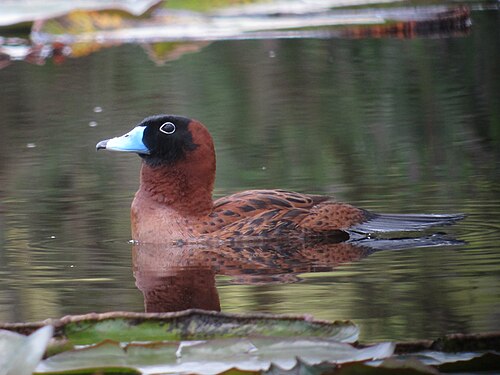
The masked duck is a tiny, stiff-tailed diving duck of the tropical Americas, often overlooked because it stays hidden in dense marsh vegetation. Breeding males show a rich chestnut body with a dark, mask-like head, while females and non-breeding birds are brown and heavily barred with a bold eye-stripe. It frequently cocks its stiff tail above the water and prefers to dive rather than dabble. Secretive habits make it difficult to survey, and it is often detected only when flushed at close range.



Temperament
secretive and skulking
Flight Pattern
short rapid wingbeats, low over water
Social Behavior
Usually solitary or in small, loose groups outside the breeding season. Nests are placed in dense emergent vegetation over or near water, where the female incubates a small clutch. Pairs form seasonally, and ducklings are precocial and leave the nest soon after hatching. The species often remains motionless in cover when disturbed, flushing at close range.
Migratory Pattern
Resident
Song Description
Generally quiet; males give soft grunts, clucks, and buzzing notes during displays. Contact calls are low and carry poorly through dense vegetation, aiding its secretive lifestyle.
Plumage
Breeding male is rich chestnut with heavy dark barring on flanks and a glossy black head and throat forming a mask; tail is stiff and often cocked. Female and non-breeding birds are brown and buff with strong barring and a distinct dark eye-line and pale supercilium. Both sexes show a compact, short-necked shape and a spiky, stiff tail typical of stiff-tailed ducks.
Diet
Feeds mainly by diving and up-ending, taking seeds of aquatic plants, pondweeds, and sedges. It also consumes aquatic invertebrates such as insect larvae, small snails, and crustaceans, especially during breeding. Diet composition varies with wetland availability and seasonal plant seeding.
Preferred Environment
Prefers densely vegetated freshwater marshes, ponds, and shallow swamps with abundant submerged and floating vegetation. Often forages within reedbeds and among water lilies, rarely venturing into open water for long.


