

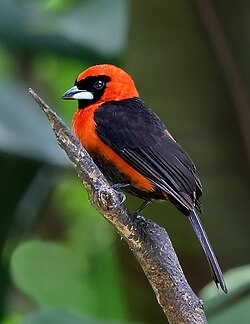
The masked crimson tanager is a species of bird in the family Thraupidae. It is found in Bolivia, Brazil, Colombia, Ecuador, Peru, and Venezuela. Its natural habitats are subtropical or tropical swamps and subtropical or tropical moist shrubland.
Region
Amazon Basin
Typical Environment
Occurs widely along major rivers and floodplains in Bolivia, Brazil, Colombia, Ecuador, Peru, and Venezuela. It favors river islands, oxbow lakes, swamps, and edges of seasonally flooded forests (várzea) and shrubby secondary growth. Often found in dense riverside thickets and tangles, especially near open water. It is most common in lowlands and along dynamic riverine habitats where vegetation regenerates after floods.
Altitude Range
0–800 m
Climate Zone
Tropical
Ease of Keeping
Beginner friendly: 2/5
This striking Amazonian tanager favors river edges, swamps, and seasonally flooded forests (várzea), where it often perches conspicuously. Males show a bold black facial mask and throat against a vivid crimson body, while females are duller with a reduced mask. It frequently travels in small groups and helps disperse seeds of riverine plants. The species is generally common across much of its range.


Temperament
social and active
Flight Pattern
short rapid wingbeats
Social Behavior
Typically moves in pairs or small family groups and may join mixed-species flocks along river edges. Nests are cup-shaped and placed low to mid-level in dense shrubs near water. Territorial behavior is moderate, with males displaying and calling from exposed perches.
Migratory Pattern
Resident
Song Description
Vocalizations include sharp, metallic chips and short nasal notes. The song is a simple series of twitters and thin phrases, delivered from prominent perches along the riverside.
Plumage
Male is bright crimson with a distinct black mask and throat, and darker wings and tail; female is duller crimson-brown with a less defined mask. Plumage appears sleek with slight gloss on darker areas. Juveniles are browner and more subdued overall.
Diet
Feeds mainly on soft fruits and berries, supplemented by insects and other small arthropods. Gleans fruit and prey from leaves and twigs, and occasionally sallies a short distance to snatch flying insects. Often visits fruiting shrubs and early-successional plants typical of river islands and floodplains.
Preferred Environment
Forages in dense riverside thickets, shrubby clearings, and edges of flooded forest. Most activity occurs in the low to mid-story, especially near open water and along sunny gaps.


