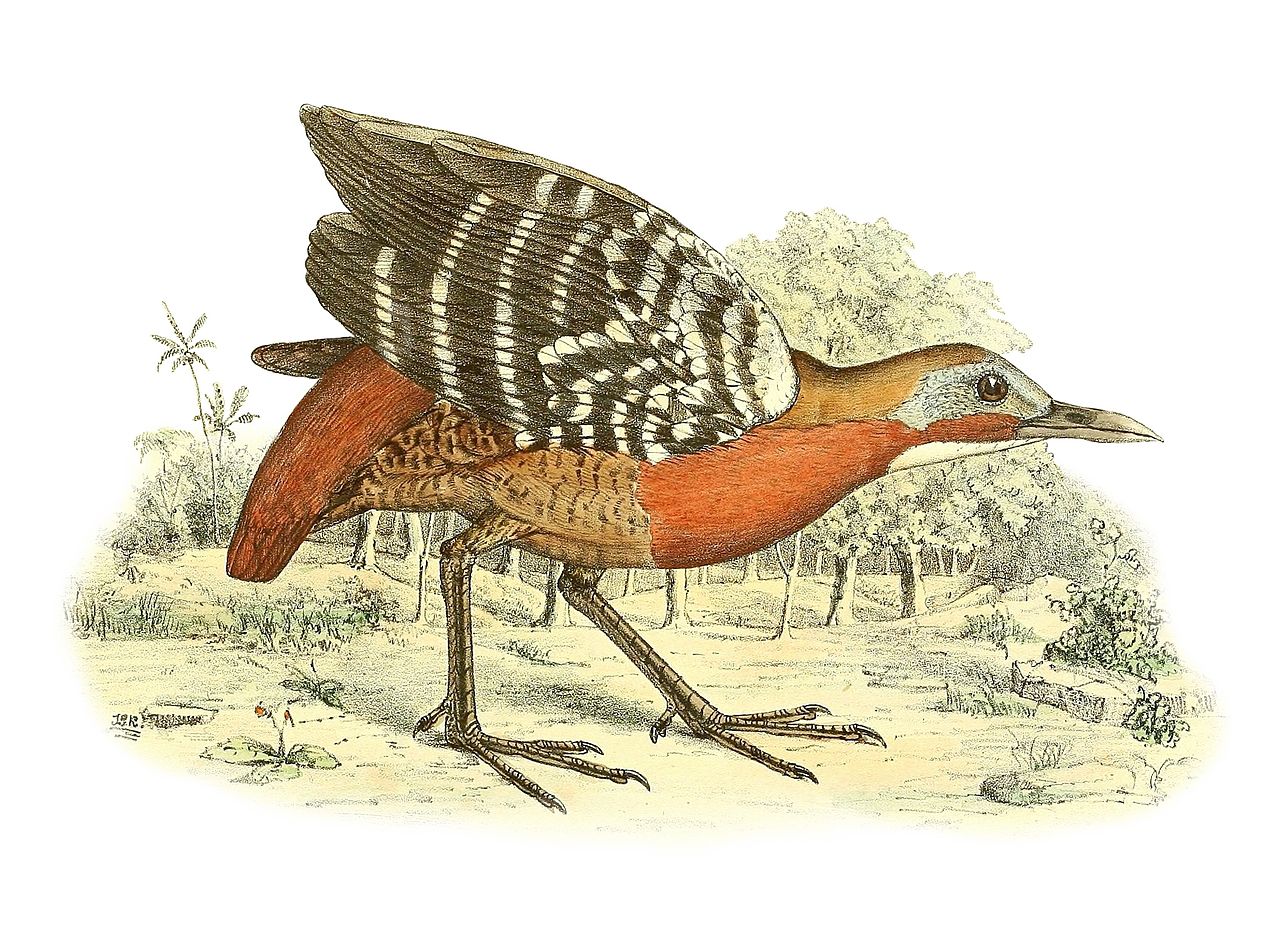
The Madagascar flufftail is a species of bird in the family Sarothruridae. It is endemic to Madagascar. The subspecies is Monotypic.
Region
Madagascar
Typical Environment
Occurs widely in Madagascar’s humid evergreen forests, forest edges, and swampy thickets. Prefers dense understory near streams, marshy clearings, and wet leaf-litter where cover is abundant. Also uses degraded forest and secondary growth if sufficient ground cover remains. It is typically elusive, keeping to tangles, vine-choked areas, and fern beds.
Altitude Range
Sea level to 2000 m
Climate Zone
Tropical
Ease of Keeping
Beginner friendly: 1/5
The Madagascar flufftail is a small, extremely secretive rail that skulks through dense undergrowth, more often heard than seen. It is monotypic and found only on Madagascar, inhabiting humid forests from lowlands to highlands. Males and females look quite different, and pairs often duet with distinctive, repetitive notes at dawn and dusk.

Temperament
solitary and territorial
Flight Pattern
short rapid wingbeats
Social Behavior
Most often encountered as solitary birds or pairs, moving quietly through dense ground cover. Nests are concealed close to the ground or just above it in thick vegetation near water. Pairs maintain small territories and communicate with soft contact calls and duets.
Migratory Pattern
Resident
Song Description
A series of clear, repetitive whistles or piping notes, often given as a duet between pair members. Calls are most frequent at dawn and dusk and can carry some distance through forest understory.
Plumage
Male is dark brown to blackish with bold white spotting and barring on the back and flanks, with a rich rufous head and nape; female is warmer rufous-brown overall with finer barring and less contrasting spotting. Both have short rounded wings and a compact, rail-like body with a short tail.
Diet
Feeds mainly on small invertebrates such as ants, beetles, termites, spiders, and small snails, gleaned from wet leaf litter and shallow mud. Will probe soft soil and mossy tangles for larvae and worms. Occasionally takes small seeds or fallen berries but animal prey dominates.
Preferred Environment
Forages on the forest floor in dense understory, along stream margins, and in ferny or vine-choked thickets. Often keeps to shaded, damp microhabitats with abundant cover and soft substrates.