
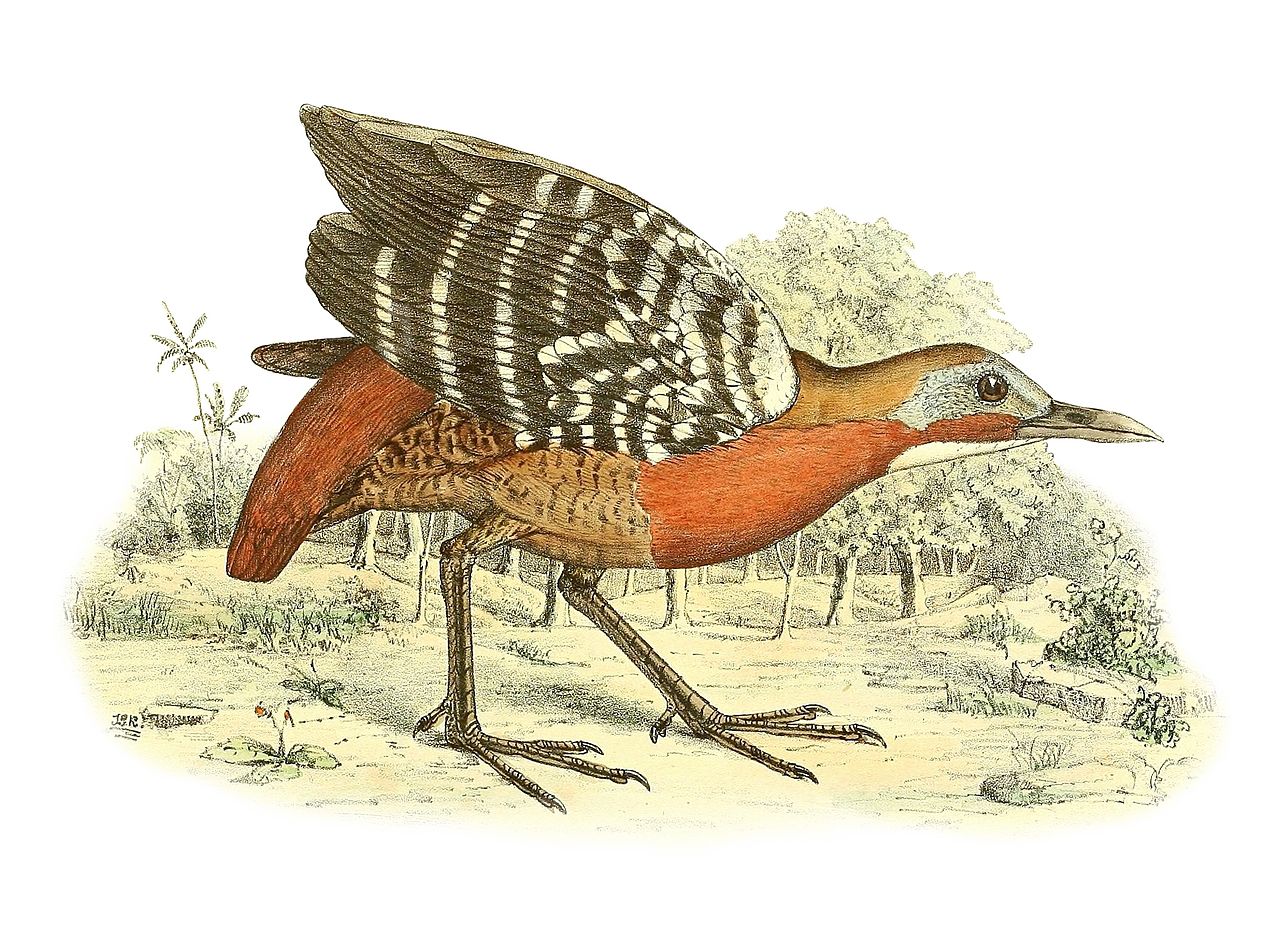
The Madagascar forest rail, also known as the Madagascar wood rail or the kioloides rail, is a species of bird in the family Sarothruridae. It is endemic to forests, often in wet areas, in northern and eastern Madagascar. The Madagascar forest rail is a secretive and shy species, often showing elusive behavior, such as running away from the slightest disturbances. This has contributed to a lack of study on this species; a reason why it is not that well known.
Region
Northern and eastern Madagascar
Typical Environment
Occupies humid evergreen forests from lowlands into montane zones, especially where understory is dense. It frequents wet microhabitats such as stream margins, swampy gullies, and pandanus thickets. The species also uses selectively logged or secondary forest if sufficient ground cover remains. It is rarely seen in open areas and avoids heavily degraded habitats. Activity is concentrated on or near the forest floor.
Altitude Range
Sea level to 1800 m
Climate Zone
Tropical
Ease of Keeping
Beginner friendly: 1/5
This secretive rail slips through dense understory and often prefers to run rather than fly, which makes it difficult to observe. It was formerly grouped with the Tsingy wood-rail but is now treated separately, reflecting Madagascar’s high levels of endemism. Most vocal at dawn and dusk, it gives ringing whistles that carry far through humid forest. Habitat loss is the main concern for the species, though it remains locally fairly common where forest persists.

Temperament
shy and secretive
Flight Pattern
short rapid wingbeats with low, brief flights
Social Behavior
Usually encountered singly or in pairs, moving quietly through leaf litter. Pairs likely hold territories and keep in contact with soft calls. Nests are placed close to the ground in dense cover, with both adults involved in parental care.
Migratory Pattern
Resident
Song Description
Gives clear, ringing whistles and piping notes, often delivered in series at dawn and dusk. Duets between pair members are common, with phrases accelerating and carrying through the forest.
Plumage
Rich brown upperparts with a rufous-tinged nape, contrasting gray face and underparts, and finely barred flanks. The throat is pale to whitish, bordered by darker malar lines. Feathers are smooth and sleek, aiding movement through dense vegetation.
Diet
Forages for insects, spiders, worms, and other invertebrates by probing and flicking leaf litter. It also takes small vertebrates such as tiny frogs or geckos when available. Opportunistically consumes fallen fruits and seeds, making its diet broadly omnivorous. Feeding is typically quiet and deliberate, using cover to remain concealed.
Preferred Environment
Feeds on the shaded forest floor, especially along wet edges of streams and in swampy thickets. Dense understory and tangles of roots or pandanus provide both prey-rich microhabitats and protection from predators.


