
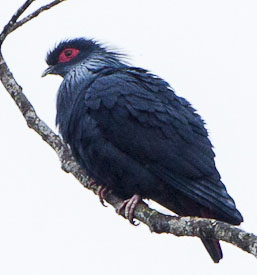
The Madagascar blue pigeon or Madagascan blue pigeon is a species of bird in the family Columbidae. The species is closely related to the other two extant species of blue pigeon, the Comoros blue pigeon and the Seychelles blue pigeon. It is endemic to northern and eastern Madagascar.
Region
Eastern and northern Madagascar
Typical Environment
Occurs in humid evergreen forests from lowlands to mid-elevations, including primary rainforest, littoral forest, and well-wooded secondary growth. It frequents forest edges and tall riparian gallery forest, but relies on large fruiting trees. In some areas it may visit agroforestry mosaics and plantations adjacent to native forest when fruit is abundant. It is largely arboreal, spending most of its time in the upper canopy.
Altitude Range
Sea level to 1800 m
Climate Zone
Tropical
Ease of Keeping
Beginner friendly: 2/5
This striking island pigeon is the largest of the three extant Indian Ocean blue pigeons and plays a key role as a canopy frugivore and seed disperser. It is often detected by its deep, resonant coos and by the whirring wing noise it makes when dashing between tall trees. The species shows a shaggy, hackled head and bright red bare skin around the eye, a hallmark of the genus Alectroenas.

Temperament
wary and alert
Flight Pattern
swift, direct flight with rapid wingbeats
Social Behavior
Usually seen alone, in pairs, or small loose groups at fruiting trees. Nests high in trees, building a simple stick platform where it lays one, rarely two, eggs. Both sexes share incubation and chick rearing, and pairs defend a small area around the nest.
Migratory Pattern
Resident
Song Description
Song is a series of deep, resonant coos given from high perches, often spaced in deliberate intervals. Also produces soft grunts and wing whirrs when taking off or displaying.
Plumage
Pale silvery head with shaggy hackles, contrasting with a dark slate-blue to bluish-grey body and rich chestnut to maroon wings. The nape and neck show lanceolate feathers giving a spiky, ruffed look. Bare orbital skin is bright red and the tail is dark with a subtle gloss.
Diet
Feeds mainly on fruits and berries, including figs and drupes from large canopy trees. It occasionally takes seeds and soft plant matter, swallowing fruits whole and later dispersing seeds. Foraging is typically deliberate, moving tree to tree as fruit ripens across the forest.
Preferred Environment
Primarily forages in the upper canopy and subcanopy at fruiting trees. Will visit forest edges and tall isolated trees in clearings or near villages when in season.


