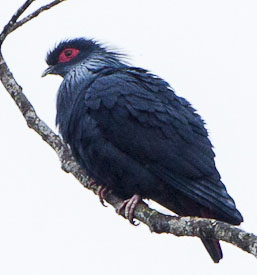
Macleay's honeyeater is a honeyeater endemic to Australia. Within Australia it has a limited distribution, occurring only in northern Queensland from Cooktown to the southern end of the Paluma Range. Its natural habitats are tropical dry forests and tropical moist lowland forests.
Region
Northeastern Australia
Typical Environment
Occurs only in northern Queensland from Cooktown south to the Paluma Range, chiefly within the Wet Tropics rainforests. It uses tropical moist lowland and hill rainforests, riparian forest, and forest edges, and will also enter adjacent eucalypt woodland when flowering is abundant. In towns embedded in rainforest, it frequents gardens with nectar-rich trees and shrubs. It is typically most numerous in mid-story and canopy layers but also forages along edges and clearings.
Altitude Range
Sea level to 1200 m
Climate Zone
Tropical
Ease of Keeping
Beginner friendly: 1/5
Macleay's honeyeater is a rainforest specialist of the Wet Tropics of Queensland and often visits flowering garden trees in nearby towns. It is an active pollinator, regularly probing eucalypts, banksias, and grevilleas for nectar and also taking insects. The sexes look similar, and the species is often first detected by its sharp, scolding calls from the mid-story.


Near Kuranda, Queensland, Australia
Temperament
active and somewhat bold
Flight Pattern
short rapid wingbeats between perches
Social Behavior
Usually seen singly or in pairs, but may join small groups at prolific flowering trees. Territorial around rich nectar sources and may chase other honeyeaters. Nests are small, cup-shaped structures placed in foliage; both parents attend the young.
Migratory Pattern
Resident
Song Description
Vocalizations are sharp, scolding chacks and scratchy, metallic notes delivered from shaded perches. It also gives brief chattering sequences during foraging and alarm.
Plumage
Olive-brown upperparts with paler, scalloped underparts and fine streaking. The face shows bold pale arcs and streaks around the ear-coverts and throat, giving a patterned, ‘lined’ look. Feathers are sleek with subtle mottling on the breast and flanks.
Diet
Feeds primarily on nectar from native blossoms such as eucalypts, banksias, and grevilleas. Supplements its diet with insects and spiders gleaned from foliage, bark, and flowers. Will also take small fruits and occasionally hawk for flying insects. Its nectar feeding contributes to pollination of many rainforest plants.
Preferred Environment
Forages in rainforest mid-story and canopy, along edges, creeks, and clearings where flowering is concentrated. Regularly visits flowering trees in rainforest towns and gardens.