
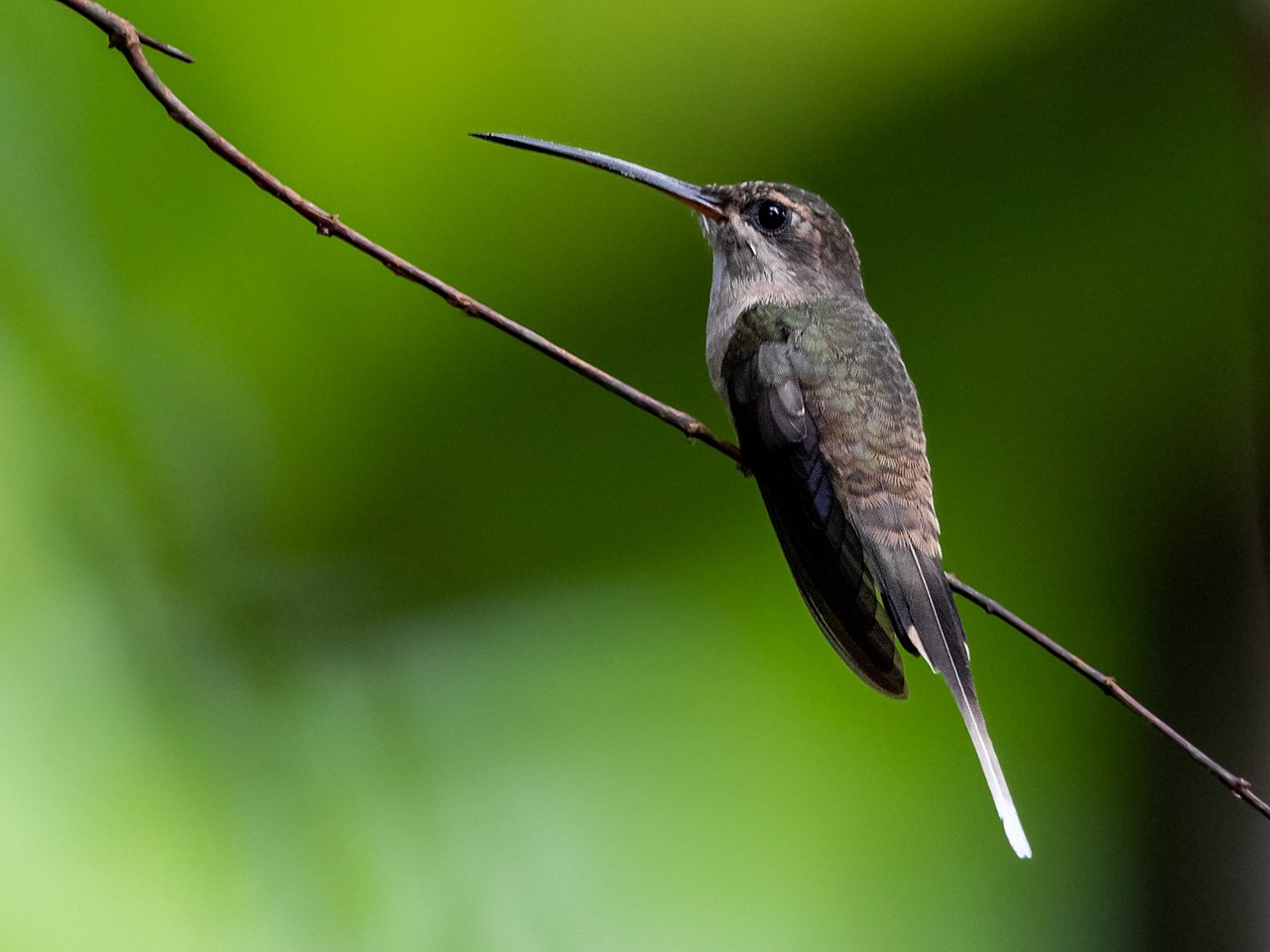
The long-tailed hermit is a large hummingbird that is a resident breeder in Venezuela, the Guianas, and north-eastern Brazil. This species was formerly referred to as the eastern long-tailed hermit.
Region
Northern South America (Guiana Shield and northeastern Amazonia)
Typical Environment
Occurs from eastern and southern Venezuela through Guyana, Suriname, and French Guiana into northeastern Brazil. Prefers humid lowland rainforest, gallery forest, and secondary growth with abundant understory flowers. Common along forest edges, stream margins, and Heliconia thickets. Also visits shaded plantations and gardens near forest.
Altitude Range
Sea level to 1200 m
Climate Zone
Tropical
Ease of Keeping
Beginner friendly: 1/5
A large hermit hummingbird of the Guiana Shield, the long-tailed hermit has extremely elongated central tail feathers tipped white. Males gather in leks to sing persistent, squeaky notes while displaying their tails. It forages by trap-lining between widely spaced flowers, especially Heliconia, and is an important pollinator. The species has also been known as the eastern long-tailed hermit.


Temperament
solitary and trap-lining; can be territorial along feeding routes
Flight Pattern
short rapid wingbeats with agile hovering; fast, direct dashes between flowers
Social Behavior
Males assemble at leks where each sings from a perch and performs tail and body displays to attract females. Outside the lek, individuals forage alone along established routes. The female builds a small conical nest attached to the underside of a drooping leaf using plant fibers and spider silk and solely incubates and raises the young.
Migratory Pattern
Resident
Song Description
At leks, males give a high, thin, squeaky series of repeated notes, often incessant and insect-like. Calls are sharp chips and buzzy trills exchanged during chases around feeding sites.
Plumage
Bronzy-olive to brown upperparts with buffy to grayish underparts; classic hermit facial pattern with bold pale supercilium and moustachial stripe separated by a dusky mask. Central tail feathers very long and white-tipped; other tail feathers shorter with pale tips. Throat slightly paler; overall plumage appears dusky and matte in low light.
Diet
Primarily feeds on nectar from tubular flowers, especially Heliconia, but also visits other understory blossoms. Supplements nectar with small arthropods for protein, gleaned from foliage or hawked in short sallies. Its long decurved bill and tongue are adapted to deep corollas, and it serves as an effective pollinator.
Preferred Environment
Forages in the shaded understory of humid forests, along streams, and at forest edges where flowering plants are dense. Frequently follows a repeated circuit of flowering patches, visiting each in turn.


