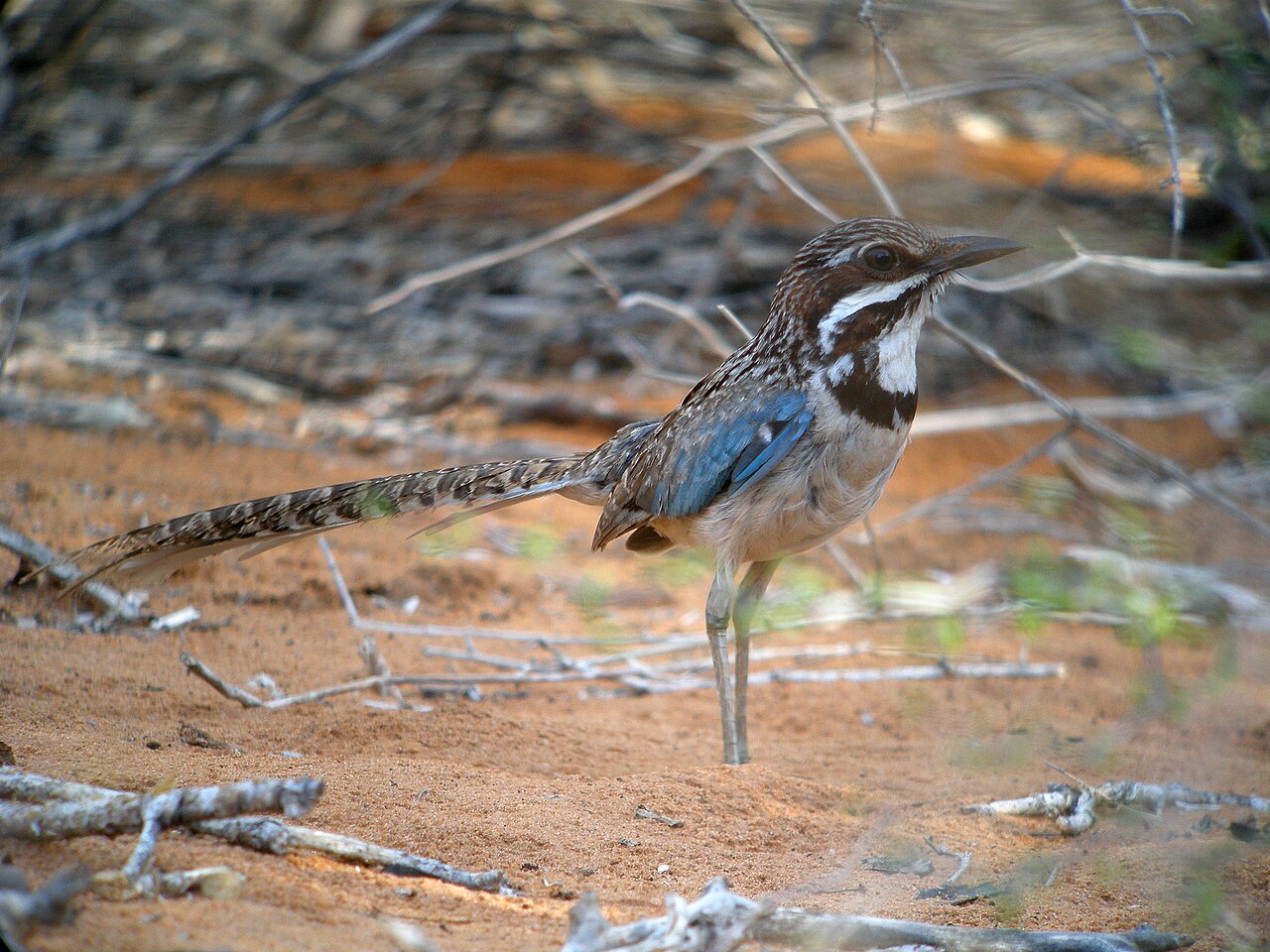
The long-tailed ground roller is a species of bird in the ground roller family Brachypteraciidae, placed in the monotypic genus Uratelornis. Endemic to arid spiny forests near the coast in southwestern Madagascar, this ground roller occurs at extremely low population densities throughout its habitat. This species requires shade and a deep layer of leaves on the ground, and it is absent from parts of the spiny forest lacking these features. It has no recognized subspecies, and its closest relative is the scaly ground roller. The long-tailed ground roller is the only ground roller to definitively display sexual dimorphism. It is a medium-sized bird with a plump silhouette and a long tail. The upperparts are dark brown with black streaks while the underparts are light gray. The white throat is framed by black malar stripes and a black breastband, and a white stripe is present at the base of the bill. Sky-blue feathers are visible at the edge of the wings and the tail. Calls are rarely made outside the breeding season, though multiple courtship calls are made.
Region
Southwest Madagascar
Typical Environment
Found in arid spiny thicket and dry scrub on sandy soils near the southwestern coast. It favors patches with deep leaf litter and shaded understory provided by Didierea, Euphorbia, and other spiny flora. The species avoids open, heavily degraded, or leaf-litter-poor areas. Nesting occurs in self-excavated burrows in sandy banks or flat ground within intact thicket. Local densities are low even in suitable habitat.
Altitude Range
Sea level to 200 m
Climate Zone
Arid
Ease of Keeping
Beginner friendly: 1/5
This species is the sole member of its genus and is confined to the arid spiny forests of southwestern Madagascar. It nests in burrows dug into sandy ground, an unusual trait among rollers. The long-tailed ground roller shows clear sexual dimorphism and is notably secretive outside the breeding season. Habitat loss in the spiny thicket makes it vulnerable to decline.


The long-tailed ground roller is largely terrestrial.

Spiny forest at Ifaty, featuring an Adansonia (baobab) species and other vegetation

Entrance to a nesting burrow
Temperament
solitary and territorial
Flight Pattern
short rapid wingbeats; reluctant flier that prefers running on the ground
Social Behavior
Outside the breeding season it is largely solitary and elusive. During breeding, pairs defend territories and perform courtship displays with tail fanning and soft calls. Nests are placed in burrows excavated in sandy soil, where both adults attend the nest.
Migratory Pattern
Resident
Song Description
Usually quiet except in the breeding season, when it gives a series of clear, whistled notes that carry through the thicket. Calls include soft hoots and squeaky whistles used in courtship and pair contact.
Plumage
Upperparts dark brown with fine black streaking; underparts pale gray. White throat bordered by bold black malar stripes and a black breastband, with a narrow white line at the base of the bill. Edges of the wings and the long graduated tail show bright blue feathers. Females tend to have slightly warmer, buffier tones than males.
Diet
Primarily feeds on ground-dwelling invertebrates such as beetles, ants, termites, grasshoppers, spiders, and centipedes. It occasionally takes small vertebrates like tiny lizards when available. Foraging involves walking or running along the forest floor, picking prey from leaf litter or making short lunges.
Preferred Environment
Forages in shaded, leaf-littered patches within spiny thicket and dry scrub. It often works along paths, clearings, and the bases of shrubs where prey is concentrated. Activity increases after rainfall when invertebrates are more accessible.