The lesser shortwing is a species of chat. This species is now classified in the family Muscicapidae.
Region
South and Southeast Asia
Typical Environment
Found from the Himalayan foothills through northeastern India and Bangladesh to Myanmar, Thailand, Laos, and Vietnam, extending south into the Malay Peninsula and parts of the Greater Sundas. It inhabits dense understory of evergreen and montane broadleaf forests, bamboo thickets, and shaded ravines. The species is strongly tied to intact, humid forest with thick ground cover. It often occurs near streams and on steep, mossy slopes where leaf litter accumulates.
Altitude Range
600–3000 m
Climate Zone
Highland
Ease of Keeping
Beginner friendly: 1/5
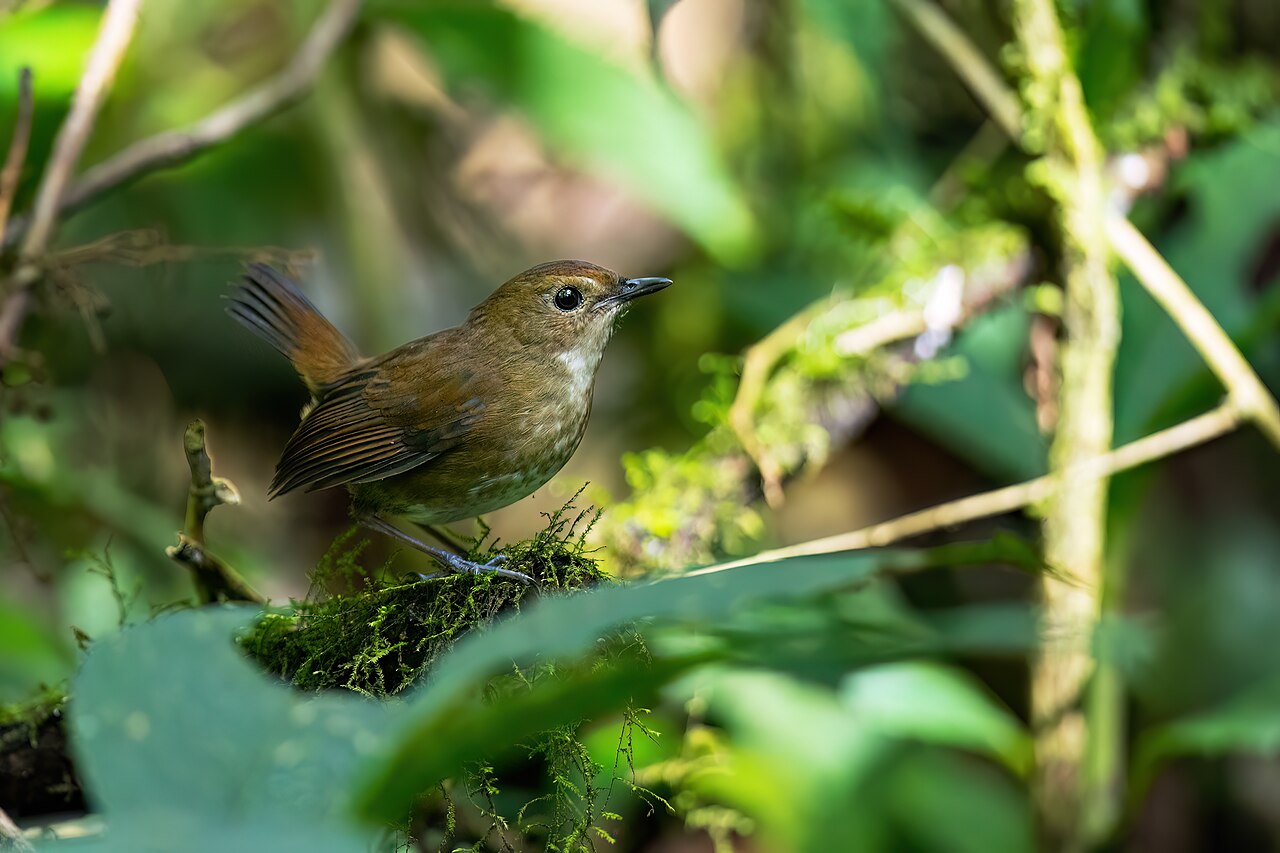
A shy, ground-hugging chat now placed in the flycatcher family Muscicapidae, the lesser shortwing is far more often heard than seen. It favors dense, mossy understory where it slips through cover and forages in leaf litter. Males are dark slaty-blue while females are warm rufous-brown, a strong sexual dimorphism. Its rich, whistled song carries surprisingly far in montane forests.


Lesser Shortwing (Brachypteryx leucophris carolinae)
Temperament
solitary and skulking
Flight Pattern
short, low bursts with rapid wingbeats; prefers running and hopping in cover
Social Behavior
Typically solitary or in pairs, maintaining territories in dense understory. Nests are placed low, often in banks, roots, or dense vegetation, with both sexes involved in rearing young. Pairs can be year-round residents within suitable habitat and are highly secretive during breeding.
Migratory Pattern
Resident
Song Description
A rich series of clear, fluted whistles and melodious phrases delivered from concealed perches. Calls include thin seep notes and soft ticks, often given from deep cover at dawn and dusk.
Plumage
Compact, short-tailed bird with soft, plain plumage and minimal patterning; wings and tail notably short. Male is uniformly dark slaty-blue to bluish-gray; female is warm rufous-brown above with buffy to cinnamon underparts. Both sexes show a faint pale eye-ring and clean, unpatterned face. The overall look is subdued and the tail is often cocked slightly.
Diet
Primarily feeds on insects and other small invertebrates such as beetles, ants, caterpillars, and spiders. It also takes larvae uncovered by flipping leaf litter. Occasional small snails or worms may be consumed. Fruit or berries may be taken opportunistically but form a minor part of the diet.
Preferred Environment
Forages on the forest floor and in the lowest strata of dense understory. Frequently searches along mossy banks, fallen logs, and damp leaf litter near streams. Uses cover to remain concealed while gleaning and pouncing on prey.