The lesser scaup is a small North American diving duck that migrates south as far as Central America in winter. It is colloquially known as the little bluebill or broadbill because of its distinctive blue bill. The origin of the name scaup may stem from the bird's preference for feeding on scalp—the Scottish word for clams, oysters, and mussels; however, some credit it to the female's discordant scaup call as the name's source. It is apparently a very close relative of the Holarctic greater scaup or "bluebill", with which it forms a superspecies. The scientific name is derived from Ancient Greek and Latin, with aithuia being an Ancient Greek term for an unidentified seabird, used by Hesychius and Aristotle, among other authors, and affinis, Latin for "related to", from the lesser scaup's resemblance to the greater scaup.
Region
North and Central America
Typical Environment
Breeds widely across the Prairie Pothole Region and boreal parklands of western Canada and the northern United States. During migration it uses large inland lakes and rivers and congregates on the Great Lakes. Winters along both North American coasts, the Gulf of Mexico, inland reservoirs, and south into Mexico, the Caribbean, and Central America. Prefers large, open waterbodies with nearby emergent vegetation for nesting and cover.
Altitude Range
Sea level to 2500 m
Climate Zone
Temperate
Ease of Keeping
Beginner friendly: 2/5
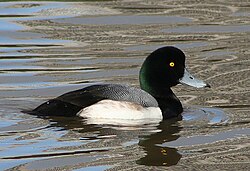
The lesser scaup is a small North American diving duck often called the little bluebill for its slate-blue bill. Males show a glossy purplish to greenish head and fine gray vermiculation on the back, while females are chocolate-brown with a distinct white patch at the bill base. In flight, the white wing stripe is mostly confined to the secondaries—useful for separating it from the greater scaup. They form large winter rafts on lakes and coastal bays and dive for mollusks and other benthic prey.




Temperament
social and gregarious
Flight Pattern
short rapid wingbeats; strong, direct flier
Social Behavior
Forms large rafts on migration and wintering areas, often mixing with other diving ducks. Pairs typically form on the wintering grounds. Nests are shallow bowls concealed in grasses near water, with clutches commonly of 8–11 eggs. Some nest parasitism occurs within the species.
Migratory Pattern
Seasonal migrant
Song Description
Generally quiet; males give soft whistles during courtship. Females produce harsher, gruff notes, including the namesake 'scaup' call.
Plumage
Male with black head and chest, glossy purplish sheen, pale gray finely vermiculated back, white sides, and black rear; female uniformly brown with paler flanks and a clear white patch at the base of the bill.
Diet
Dives to take mollusks (clams, mussels), aquatic insects and larvae, amphipods, and other benthic invertebrates. Also eats seeds and vegetative parts of aquatic plants, especially during migration. Opportunistic, shifting diet with prey availability, including feeding on invasive zebra mussels where abundant.
Preferred Environment
Feeds on medium to large lakes, reservoirs, and sheltered coastal bays with open water and moderate depths. Often forages over soft substrates where benthic prey are concentrated, sometimes in coordinated groups.