

The king eider is a large sea duck that breeds along Northern Hemisphere Arctic coasts of northeast Europe, North America and Asia. The birds spend most of the year in coastal marine ecosystems at high latitudes, and migrate to Arctic tundra to breed in June and July. They lay four to seven eggs in a scrape on the ground lined with grass and down.
Region
Circumpolar Arctic
Typical Environment
King eiders breed on Arctic tundra along coastal regions of North America, Greenland, northern Europe, and Siberia. Outside the breeding season they occupy coastal marine habitats, especially shallow shelf seas and areas near pack ice. They winter in high-latitude marine waters, often around polynyas and persistent leads in sea ice. Nesting occurs on the ground near freshwater ponds or coastal wetlands, usually not far from the sea.
Altitude Range
Sea level to 500 m
Climate Zone
Polar
Ease of Keeping
Beginner friendly: 1/5
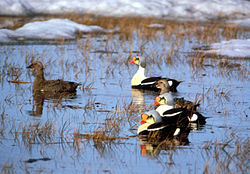
Male king eiders are striking, with a pale blue crown, green nape, and a bright orange knob at the base of the bill. They are powerful divers that forage on the seafloor, often in cold, ice-laden waters. In winter they gather in large flocks near pack ice and polynyas, sometimes far offshore.




Temperament
social and gregarious
Flight Pattern
strong, direct flight with rapid wingbeats, usually low over water
Social Behavior
Outside the breeding season they form large flocks, sometimes mixed with other sea ducks. On the tundra they nest on the ground in a shallow scrape lined with grass and down, laying 4–7 eggs. Pair bonds form prior to arrival on breeding grounds; males typically depart early in incubation.
Migratory Pattern
Seasonal migrant
Song Description
Males give mellow, cooing and gurgling notes, especially during courtship displays. Females produce low, hoarse quacks and grunts. At sea they are generally quiet, using soft contact calls within flocks.
Plumage
Males have crisp black-and-white body contrast with a smooth, pale blue crown and green nape; females are mottled and barred brown with a cryptic, finely patterned appearance.
Diet
They feed mainly on benthic invertebrates such as mussels, clams, snails, sea urchins, and crustaceans. They also take polychaete worms and occasionally small fish. During the breeding season they may supplement with aquatic insects and some plant material.
Preferred Environment
Foraging occurs over shallow coastal shelves, rocky bottoms, and around pack ice edges where benthic prey is accessible. They dive from the surface and use strong underwater swimming to reach the seafloor.


