

The king vulture is a large bird found in Central and South America. It is a member of the New World vulture family Cathartidae. This vulture lives predominantly in tropical lowland forests stretching from southern Mexico to northern Argentina. It is the only surviving member of the genus Sarcoramphus, although fossil members are known.
Region
Central and South America
Typical Environment
Occurs from southern Mexico through Central America and much of South America east of the Andes, including the Amazon Basin, to northern Argentina. It primarily inhabits undisturbed lowland tropical forests but also uses gallery forests, forest edges, and adjacent savannas. Birds roost in tall emergent trees and often commute over the canopy to locate carcasses. It is generally absent from dense urban areas and open treeless habitats. Local presence depends on intact forest cover and carrion availability.
Altitude Range
Sea level to 1500 m
Climate Zone
Tropical
Ease of Keeping
Beginner friendly: 2/5
The king vulture is a striking New World vulture with a vividly colored, bare head and a large orange caruncle. It often dominates other scavengers at carcasses thanks to its powerful bill, which can open tough hides. Unlike some relatives, it relies mostly on eyesight and often follows other vultures to locate food. It is the sole living member of its genus and ranges from southern Mexico to northern Argentina.


Eleazar Albin's 1734 drawing which has sometimes been identified as a "painted vulture"

Juvenile and adult in Costa Rica
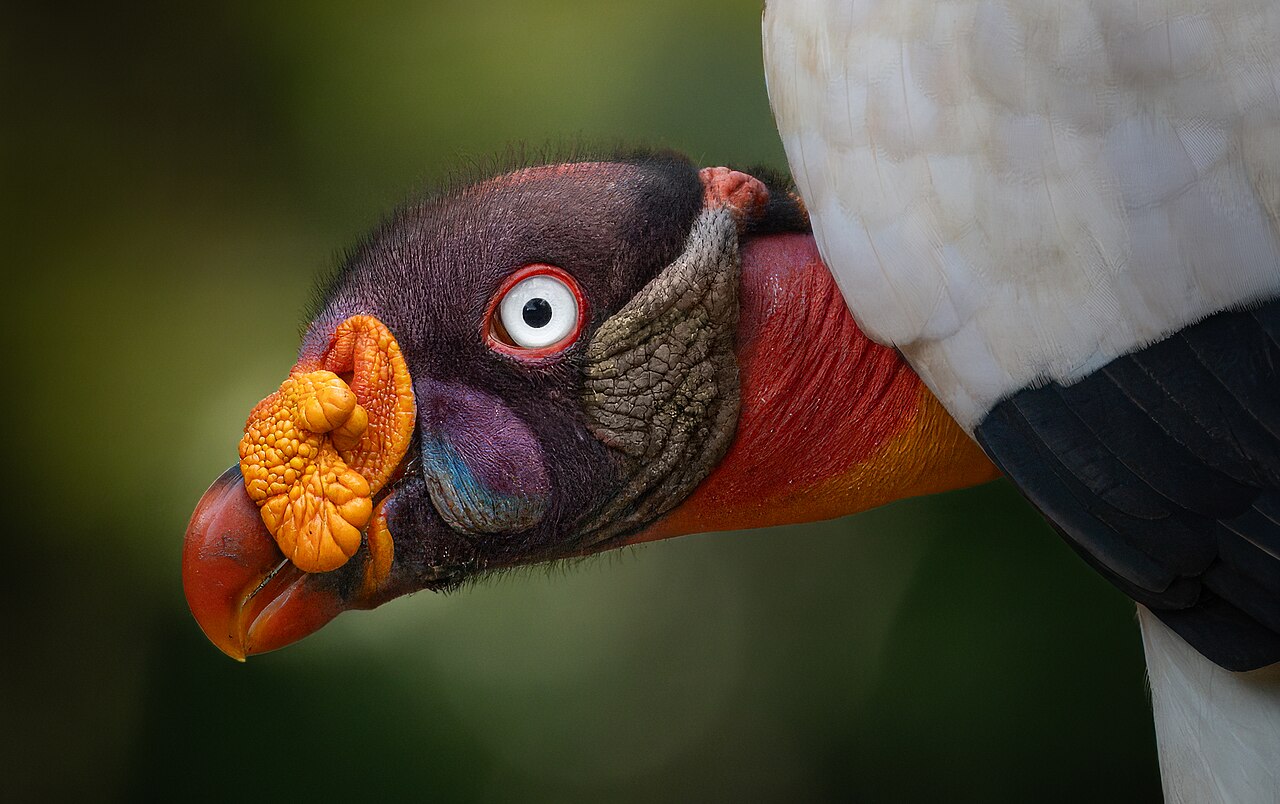
Side view of head, showing the king vulture's distinctive colorful head and beak

London Zoo, 2006

Flying.

Egg exhibited at Brevard Zoo

Adult at the Berlin Zoo

Cozcacuauhtli from the Codex Laud
Temperament
mostly solitary and dominant at carcasses
Flight Pattern
soaring glider
Social Behavior
Often roosts communally in tall trees but forages singly or in loose association with other vultures. Forms long-term pairs; nesting typically in tree cavities, hollow logs, or on the ground in sheltered spots. Usually lays a single egg; both adults incubate and feed the chick by regurgitation.
Migratory Pattern
Resident
Song Description
Mostly silent; lacks a well-developed syrinx. Emits low grunts and hisses, especially at carcasses or around the nest.
Plumage
Contrasting pale body (white to pale buff) with black flight feathers and tail; dark grey to black neck ruff. Head and neck are bare and wrinkled with multicolored skin and a prominent orange caruncle above the bill.
Diet
Feeds primarily on carrion, especially medium- to large-sized mammals, but will take any available carcass including reptiles and fish. Its strong bill can tear into thick hides, allowing it to open carcasses that smaller vultures cannot. It typically locates food by soaring and watching other scavengers rather than by smell. Very rarely takes weakened or small live prey.
Preferred Environment
Forages over forest canopies, along edges, river corridors, and clearings, descending to the ground to feed. Often uses thermal updrafts to cover large areas efficiently. Frequently attends carcasses within forest interiors where visibility is limited.


