

The killdeer is a large plover found in the Americas. Its shrill, two-syllable call is often heard, sounding like "kill deer". It was described and given its current scientific name in 1758 by Carl Linnaeus in the 10th edition of his Systema Naturae. Three subspecies are described. Its upperparts are mostly brown with rufous fringes, the head has patches of white and black, and two black bands cross the breast. The belly and the rest of the breast are white. The nominate subspecies breeds from southeastern Alaska and southern Canada to Mexico. It is seen year-round in the southern half of its breeding range; the subspecies C. v. ternominatus is resident in the West Indies, and C. v. peruvianus inhabits Peru and surrounding South American countries throughout the year. North American breeders winter from their resident range south to Central America, the West Indies, and the northernmost portions of South America.
Region
Americas
Typical Environment
Breeds widely from Alaska and Canada through most of the contiguous United States and into Mexico, with resident populations in the Caribbean and parts of northern South America. Winters across the southern United States south through Central America and the West Indies to northern South America. Favors open habitats such as shorelines, mudflats, pastures, fields, airports, and gravel lots, often near water but not strictly tied to it. Readily exploits human-altered landscapes that provide bare or short vegetation and gravel.
Altitude Range
Sea level to 2500 m
Climate Zone
Temperate
Ease of Keeping
Beginner friendly: 1/5
Killdeer are well known for their loud, insistent “kill-deer” calls and for their dramatic broken-wing distraction display to lure predators away from nests. They often nest on gravel or open ground, including human-made sites like parking lots and rooftops. In flight, a rufous rump and long white-edged tail are conspicuous. They have two bold black breast bands that distinguish them from many other plovers.


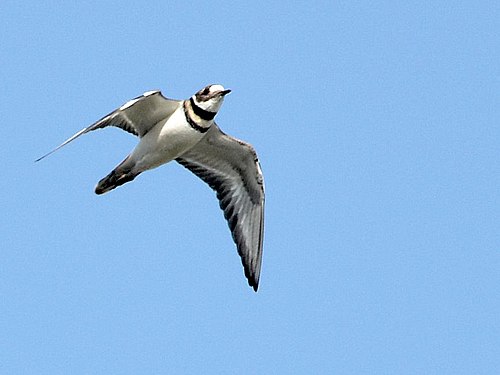
In flight

The subspecies C. v. ternominatus in Cuba

Copulation

A female on a nest in Pennsylvania

Eggs in a nest on the ground

A chick in New Jersey


Temperament
alert, vocal, and wary
Flight Pattern
fast, direct flight with rapid wingbeats; agile low passes over open ground
Social Behavior
Generally seen singly or in pairs during breeding; forms small loose flocks outside the breeding season. Ground-nesting in shallow scrapes lined with pebbles; both sexes incubate. Performs broken-wing distraction displays and other decoy behaviors to protect eggs and chicks.
Migratory Pattern
Partial migrant
Song Description
Loud, ringing two-syllable calls that sound like “kill-deer,” repeated in series, especially in flight or when alarmed. Also gives sharp chips, trills, and agitated chatter near the nest.
Plumage
Upperparts medium-brown with rufous fringes; underparts white with two bold black breast bands and a white collar. Rump rufous and conspicuous in flight, with white-edged tail. Face pattern shows black and white patches including a white forehead and supercilium.
Diet
Primarily terrestrial invertebrates including beetles, grasshoppers, caterpillars, earthworms, spiders, and small crustaceans. Occasionally takes snails and other small prey, and rarely seeds. Forages by running and pausing, pecking at prey on the surface, and sometimes foot-trembling to flush hidden invertebrates.
Preferred Environment
Open ground with sparse or short vegetation such as mudflats, sandbars, gravel lots, pastures, and lawns. Frequently feeds along shorelines and in human-modified habitats where bare ground is available.


