

The jungle babbler is a member of the family Leiothrichidae found in the Indian subcontinent. Jungle babblers are gregarious birds that forage in small groups of six to ten birds, a habit that has given them the popular name of "Seven Sisters" in urban Northern India, and in Bengali, with cognates in other regional languages which also mean "seven brothers".
Region
Indian Subcontinent
Typical Environment
Occurs widely across much of India and parts of Nepal, Bangladesh, and Pakistan, especially in lowlands and foothills. Prefers open woodland, scrub, hedgerows, rural fields, and city parks rather than dense forest. Common around villages and suburban neighborhoods where it forages on the ground and in low shrubs. Avoids very arid deserts and dense evergreen forests.
Altitude Range
Sea level to 1800 m
Climate Zone
Subtropical
Ease of Keeping
Beginner friendly: 1/5
Famous for moving in tight-knit parties of six to ten birds, the jungle babbler is widely nicknamed the 'Seven Sisters' across northern India. Groups keep in contact with continuous chatter and use sentinel behavior, with one bird often standing guard while others forage. They readily adapt to gardens and urban parks and can become surprisingly confiding around people.


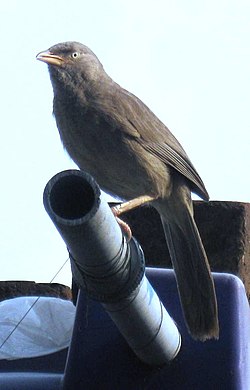
Adult ssp. orientalis in Kawal, A.P., India.

A pair from Western Ghats allopreening after a monsoon rain



Temperament
social and active
Flight Pattern
short rapid wingbeats
Social Behavior
Highly gregarious, moving and foraging in cohesive family groups that maintain contact with constant calls. Exhibits cooperative breeding, with helpers assisting in nest defense and feeding. Nests are cup-shaped and placed in low trees or shrubs; groups roost communally.
Migratory Pattern
Resident
Song Description
Produces a noisy mix of chatters, churrs, and scolding notes with frequent call-and-response within the group. Vocalizations are more about maintaining contact and alarm than melodious song, creating a constant background chatter where they occur.
Plumage
Dusty brown to gray-brown overall with fine, pale streaking on the head and breast and a slightly paler throat. Feathers appear soft and somewhat loose, giving a scruffy look. Tail is long and graduated.
Diet
Feeds mainly on insects such as ants, termites, beetles, and caterpillars, gleaned from leaf litter and low vegetation. Also takes small vertebrates like tiny lizards or tree frogs on occasion. Supplements diet with fruit, berries, grains, and kitchen scraps in human-dominated areas.
Preferred Environment
Forages mostly on the ground and in low shrubs, frequently along paths, hedges, and garden beds. Often works cooperatively, with individuals probing leaf litter while others keep watch.


