The Java sparrow, also known as the Java finch, Java rice sparrow or Java rice bird, is a small passerine bird. This estrildid finch is a resident breeding bird in Java, Bali and Bawean in Indonesia. It is a popular cage bird, and has been introduced into many other countries.
Region
Southeast Asia
Typical Environment
Occurs naturally on the islands of Java, Bali, and Bawean, where it inhabits open lowlands, farmland, rice paddies, and village edges. Through introductions it is established in various tropical and subtropical urban and agricultural landscapes in parts of Asia, the Pacific, and the Americas. It prefers areas with abundant grass seeds and cultivated grains and is often found near human settlements. Roosting commonly occurs in dense shrubs, bamboo, and plantation trees.
Altitude Range
Sea level to 1500 m
Climate Zone
Tropical
Ease of Keeping
Beginner friendly: 4/5
Also called the Java finch or rice bird, it is native to Java, Bali, and Bawean in Indonesia but has been widely introduced through the cage-bird trade. Large flocks can form in agricultural areas and are known to feed on ripening rice, which has earned them a mixed reputation among farmers. Males perform a soft, buzzy song often accompanied by bill-clicking in courtship. Wild populations have declined sharply due to trapping, though introduced populations persist in several regions.

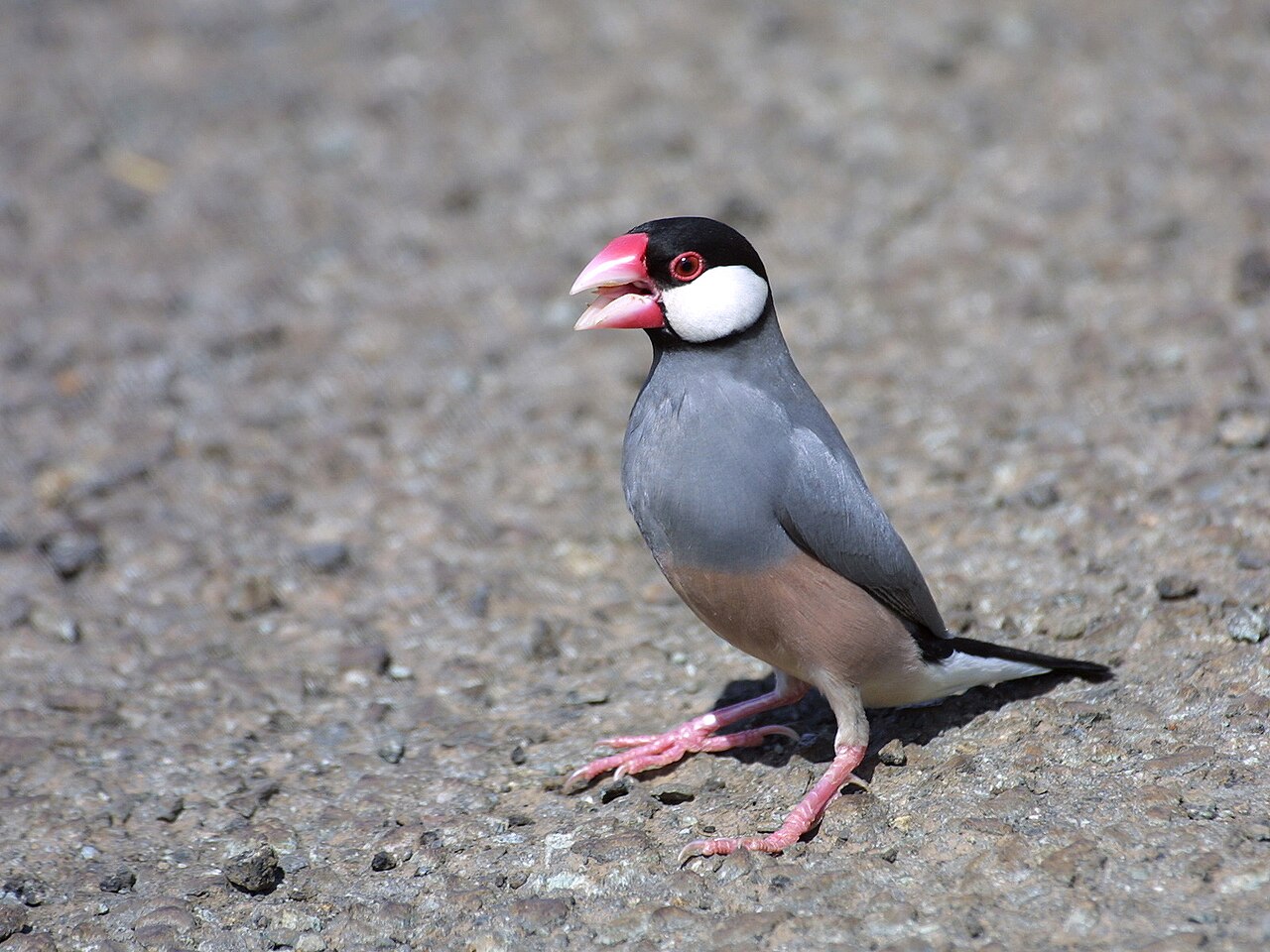
Adult in Hawaii

A juvenile in Hawaii with a black/dark-grey beak

A white Buncho in Yatomi, Japan
Temperament
social and active
Flight Pattern
direct flight with rapid wingbeats
Social Behavior
Forms tight flocks outside the breeding season and often feeds and roosts communally. Pairs bond strongly and may nest in tree cavities, buildings, or dense vegetation, lining nests with grass. They can breed in loose colonies where suitable nest sites and food are abundant.
Migratory Pattern
Resident
Song Description
The male’s song is a soft, buzzy warble interspersed with clear chip notes and characteristic bill-clicks. Calls in flocks are metallic and contact-oriented, keeping groups coordinated while feeding and flying.
Plumage
Smooth grey body with a black head and tail, pale grey breast, and a pinkish vent; large white cheek patches are prominent. Feathers appear sleek and even, giving a clean, well-defined contrast between head, cheeks, and body.
Diet
Primarily consumes grass seeds and cultivated grains, especially rice, millet, and other small cereals. Will also take weed seeds from fallow fields and roadsides. Occasional small invertebrates may be ingested incidentally but are not a major component of the diet.
Preferred Environment
Feeds in open fields, rice paddies, harvested plots, and weedy verges, often on or near the ground. Also forages on seed heads in grasses and visits urban parks and gardens where seed is available.